NOT only in music, art, and literature has Poland produced great men. One of her scientists ranks with Galileo and Newton. It is rarely given to one man to alter the entire view of the world for all mankind, to make the race face in a new direction. But this honor belongs to Nicolaus Copernicus. Before he announced his discoveries, every one held to the Ptolemaic theory that the earth was the center of the universe. It was a tremendously complex and cumbrous system, and made man consider himself more highly than he ought.
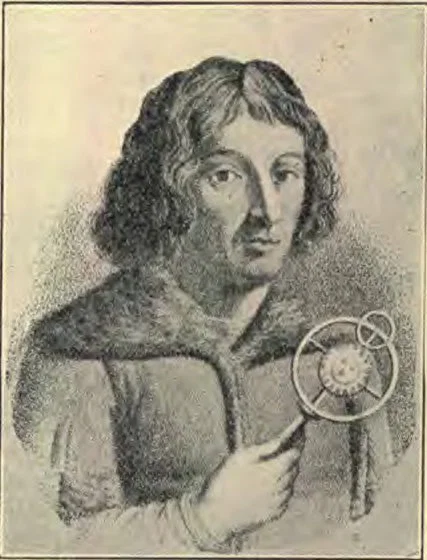
The age was one of discovery. While the young student of astronomy was poring over his books in Cracow, Columbus and the other venturesome Spanish, Portuguese, and Dutch navigators were spanning the oceans and continents of the earth. It was Copernicus who began to shake the faith of mankind in the old-established doctrine that “the sun do move.” He elaborated his thesis to a system, and man, for the first time, began to realize that he was not, as he had fondly believed, the center around which the universe revolved, but merely “a speck of cosmic dust.” The Copernican method, more than the mere discovery, made man more humble and modest. The old way of propounding a theory and making the facts fit it, received its deathblow from the labors of the Polish astronomer. He began the modern method of searching for a theory that would fit the facts. This had an almost incalculable influence on the thought of the world. Man no longer believed that the universe was created solely for his benefit. The world came out of its scholastic, college-boy stage and learned to regard itself with the sense of humility that comes to every young man when he goes out among his fellows and realizes that he knows so little. Man had found himself, and modern progress became possible.
It is a tribute to Poland as well as to the man himself that Prussia should have claimed Copernicus as one of her sons. It is true that Thorn (Torun), where he was born (Feb. 19, 1473) and where he lived for many years, is now Prussian, that is, German, but it was incorporated into the kingdom of Prussia at the second partition of Poland, in 1793, two hundred and fifty years after the death of Copernicus. Besides, why did the astronomer write “Polonus” after his name in the matriculation book of the University of Bologna, if he was a German? To say that Copernicus was a German is about as reasonable as to claim that Jesus Christ was a Turk because Jerusalem and Bethlehem are now within the Turkish Empire.
It was the ambition of his mother that he should be a preacher, like her own brother, the eloquent bishop. The father, however, opposed the idea, intending to make his son a man of business. The parental disagreement resulted, while the young Nicolaus was a student at the University of Cracow, in his Latinizing his name, and turning to medicine as a profession. Upon receiving license to practice, however, he at once discarded medicine for his absorbing delight, mathematics. At twenty-one he was teaching mathematics in the university. He soon began to show his grasp of the higher conceptions by improving some of the methods of trigonometry. At this period of his life he also invented a quadrant with which to measure the height of trees, steeples, or mountains. His fame spread abroad, and he was invited to lecture at Bologna. There he met the famous astronomer, Novara. The Italian scientist believed and taught the old Ptolemaic theory of astronomy. Copernicus watched the heavens with him, but soon decided that mathematics, not theology, was the basis of the movements in the heavens.
From Bologna he went to Padua and thence to Rome, all the while slowly elaborating and expounding this theory of stellar and planetary movement. But the old theory was part of the teaching of the church, and Copernicus was a good Catholic. He soon perceived that alchemy, astrology, even orthodoxy itself, were being arraigned at the bar of intellect by his ideas. This was heresy. But, he asked, is it sinful to attempt to understand God’s works?—“No. To know the mighty works of God; to comprehend his wisdom and majesty and power; to appreciate, in degree, the wonderful working of his laws, surely all this must be a pleasing and acceptable mode of worship to the Most High, to whom ignorance cannot be more grateful than knowledge.”
Yet Copernicus loved the church, and, in his fear lest he interfere with the work of the clergy, he ceased lecturing. Then, with the benediction of the Pope, he himself took to preaching. Afterward he practiced medicine gratis for the poor. He instructed the people in the science of sanitation. He devised a system of sewerage and utilized the belfry of his church as a water tower, all to aid his fellow townsmen and to convince them that he wished them well. He helped King Zygmunt, of Poland, to establish a scientific, honest system of coinage, and then wrote a book on the coining of money, which is valuable even today.
Year by year he worked at his great problem of the earth, the sun, and the stars. In the upper floor of the barn, back of the old dilapidated farmhouse where he lived for forty years, he cut holes in the roof, and also in the sides of the building, through which he watched the movements of the stars. He lived in practical isolation and exile. The [Catholic] church had forbidden him to speak in public except upon themes that the Fathers in their wisdom had authorized. No one dared invite him to speak, nonep. 4 could read his writings, or hold converse with him except on strictly church matters. But he cared not.
“The stars do me honor,” he said. “I am forbidden to converse with great men, but God has ordered for me a procession of the stars.” Ostracism and exile gave him the opportunity he needed for digesting all that had been written on astronomy, and for testing, very laboriously with his rude instruments, every one of the hypotheses of his brain.
And so the years passed. The vigorous, aggressive man had become old, feeble, bowed, and almost blind from constantly watching the stars and from writing at night. At last his great book, “The Revolution of the Heavenly Bodies,” written in Latin, was completed. It had been nearly forty years in the making. For twenty-seven of these, as he himself tells us, not a single day or night passed without his having added something to it. What should he do with these pages of truth that he had written five times?
The censor at Rome, he knew, would not permit the book to be published. Did it not contradict and refute all that the priests had taught of astronomy? To bring it out in his own town without ecclesiastical authority would be equally dangerous. So the great soul sent the manuscript, with a bag of gold to pay the cost of publication, to Nuremberg, a free city, of free science, free art, and free speech. But he was still full of tender reverence for the church. So he wrote a preface, dedicating the volume to “His Holiness Pope Paul.”
Months passed, months of weary waiting. Would they burn the book? The old man, stricken with fever, was within a few days of his death, when a messenger arrived from Nuremberg. It was May 23, 1543. He brought a printed copy of the book. With the sight of the blessed volume before him, the great soul passed.
In the old Jagiellonian Library of Cracow, one summer day, in the year of grace 1900, the attendant pointed out a small brass instrument, of globe, rings, and circles, curiously worked with astronomical symbols long since out of date. It was the original planisphere of the great cosmographer. Outside, in the picturesque stone courtyard, the floral tributes of its dedication still unfaded, stood the bronze statue of Nicolaus Copernicus, holding in his hand a facsimile of this brass instrument. The sun seemed to have special interest in this man as its rays lovingly fell on him. He had reestablished its supremacy in the universe.—“Poland, the Knight Among Nations.”