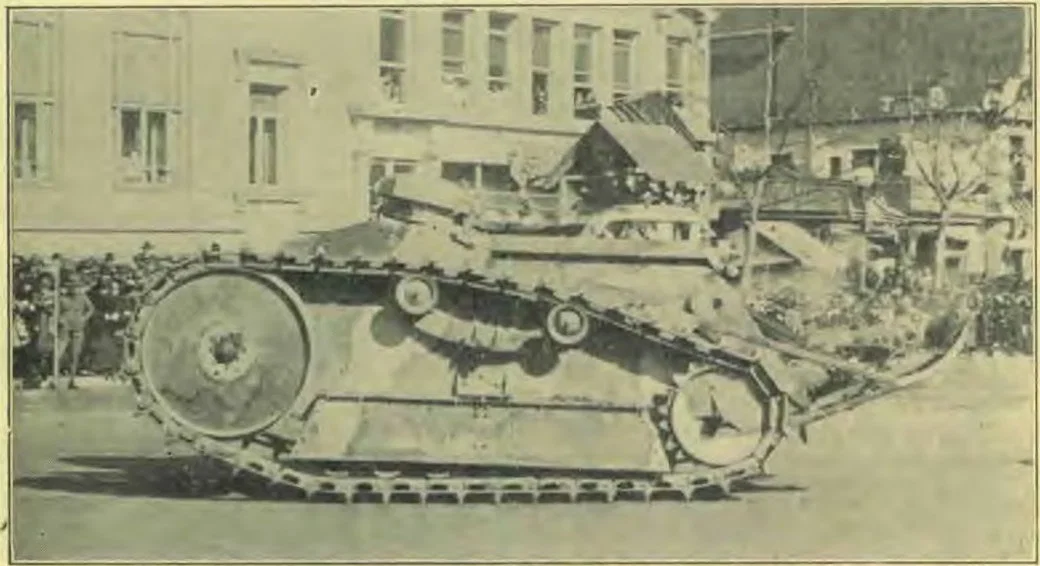
A ONE-MAN TANK MAKING ITS WAY UP PENNSYLVANIA AVENUE.
The Welcome-Home Parade
By L. E. C.
THE District of Columbia troops, returning from overseas, were accorded a reception at the national capital typical of the cordial welcome which will be extended to returning local units by other cities the country over, Washington, however, gaining added impressiveness from the fact that President Wilson led the parade.
Originally the “Welcome Home” was designed as a joint tribute to Mr. Wilson and the home-coming soldiers, sailors, and marines, but he preferred to participate as a private citizen, “with the idea of making the capital’s celebration one that should be representative of the spirit of gratitude that is prevalent throughout the land—that America’s men saved world liberty, and that all honor goes to them.”
Long before the hour scheduled for the start of the parade crowds began to gather along the line of march. At 12:45 P. M., street car traffic on Pennsylvania Avenue was suspended, and fifteen minutes later the procession started, in step with music furnished by the Marine Band, veterans of many a demonstration.
President Wilson received an almost constant ovation as he walked from the Peace Monument to the reviewing stand in front of the White House. As he entered the stand, a men’s chorus, one thousand strong, sang “The Star-Spangled Banner.”
It is estimated that fully fifteen thousand persons were in the marching columns. Every branch of military and naval service was represented, and officials and civilians of many callings also participated. Baby tanks puffed along, and one of the famous French “75’s,” towed by a huge caterpillar tractor, and wearing real war paint of green and yellow, was of special interest. Immediately following the District men, the honor contingent, came a caisson banked with flowers, over which floated a large silk banner containing a single gold star and bearing the inscription, “The Boys We Left Behind Us.”
Simultaneously with the start of the procession , there began a “sky parade” in which twenty-three airplanes, including a huge dirigible, the C-3, took part. The aviators “did every stunt in the birdman’s bag of tricks, and in addition to the straight parade formations, there were mimic combats, loops, reversements, spirals, wing covers, and long, difficult dives.” Lieut. Charles E. Ford, in charge of this aerial display, furnished many thrills by whizzing low over the tops of buildings. Engine trouble finally forced him to make a “false landing” on the Monument grounds, and his plane was slightly damaged.
Perhaps no spectators enjoyed the Welcome-Home Parade more than did the three hundred wounded men from the Walter Reed Army Hospital, who, as guests of the city, occupied seats just opposite the reviewing stand. L. E. C.