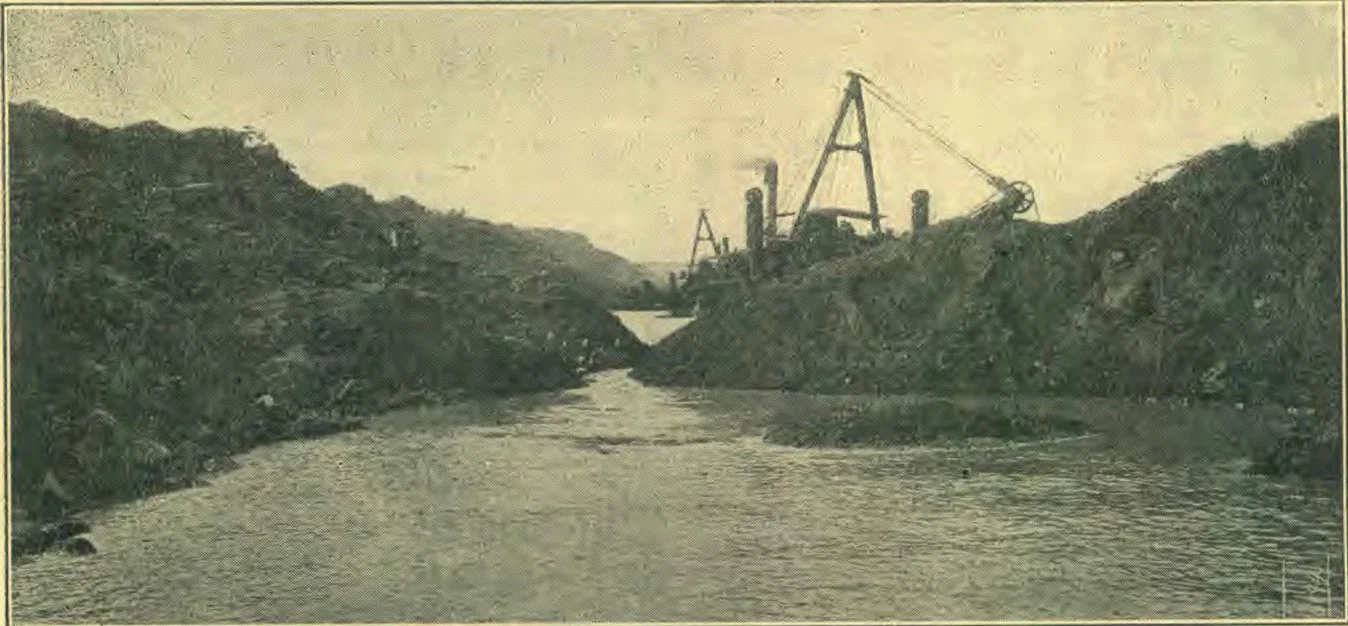
THE Spaniards seem to have known what they were about when they called the cut Culebra, or the “Snake.” We were too previous when we tried to change the name to “Gaillard,” after the gallant colonel who was supposed to have conquered it. For this old earthworm, this subterranean monster of the slime, is still alive and wriggling. Every week the Canal Record reports 200,000 cubic yards of dirt dug out, and every week as much more flows in to fill the ditch. The dipper dredge “Gamboa” races day and night with her sister, the “Paraiso,” for the championship of the isthmus, but still no ground is gained. Their names may soon be changed to “Sisyphus” and “Tantalus.”
HOW THE LATEST LANDSLIDE CHOKED THE PANAMA CANAL
Not content with pouring in soil from both sides, old Culebra humps its back in the middle, and suddenly an island fifteen feet high arises in the midst of the canal. The earth breaks into waves like water, and one follows another into the excavated prism. Any one who has tried to walk across one of those big pneumatic mattresses which amuse the Midway crowds, will understand how it works.
The stuff of which this ground is made is tough enough to dig; but once soaked up with tropic rains, it begins to flow like molasses in cold weather or tar in hot weather, under the unbalanced pressure of the hills on either side. There are 175 acres of land now mobilized, and they are advancing on the front of more than half a mile.
It is no wonder that the “angle of repose” has not yet been found, because it is very small. Some of these landslides have been propelled by an inclination of one in ten. What a lucky thing for us that President Roosevelt rejected the advice of the foreign consulting engineers, and decided on a lock canal instead of a sea level. If we had had to cut down eighty-seven feet deeper, the Canal Zone would hardly have been wide enough for the slope of its sides, and the working force might have settled down in Panama for life. As it is, the situation is bad enough. The area in motion is estimated at 10,000,000 cubic yards, and if removed at 200,000 yards a week—but there is no use trying to figure out when the canal will be open to traffic. There are too many X’s in the problem.
Meantime, Uncle Sam is in an embarrassing position. Having invited the nations of the world to celebrate the opening of the Panama Canal, he finds it closed. The tourists who started for San Francisco by water found themselves obliged to cross the isthmus ignominiously by rail, as they could have done any time in the last fifty years. A hundred vessels are waiting at Balboa and Cristobal for passage, or, having given it up in disgust, have gone on around by the Strait of Magellan. Fruit from California and Hawaii is spoiling by delay. Miles of switch yard tracks in New Jersey are clogged with cars loaded with locomotives and munitions to be sent to Vladivostok for use in Russia. A million-dollar shipload of wool from Australia, much needed by the mills of Massachusetts, was held up by the blockade.
The seal of the Canal Zone bears the boast, “The land divided, the world united.” But nature has vetoed this. What we see now is the land united and the seas separated.—The Independent.