A Trip in Java

6%

Review and Herald Publishing Assn. · Takoma Park Station, Washington, D. C. · Oct 24, 1916

FromThe Youth’s Instructor, Vol. 64, No. 43.

Read the full edition

A Trip in Java

(Continued)
K. M. ADAMS
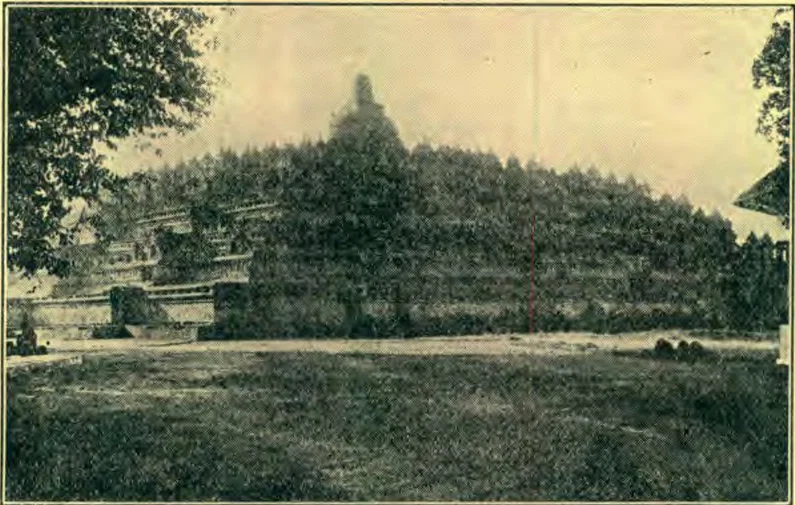
BORO-BUDUR, THE BUDDHIST TEMPLE
SHORTLY after our return to Weltevreden we arose early to take the train to Jokjogarta, or Jokjo, as it is commonly called. The road-beds in Java are well ballasted and the trains ride smoothly. The telegraph poles are made of railroad steel rails stood on one end. No wood can be used, as the rain and white ants work such great ravages. There are baggage cars in connection with the trains, but only sixty-six pounds will be carried free of charge.
After the train leaves Weltevreden for Jokjo, it travels through endless rice fields. The whole country toward the sea is as level as a floor. The monotony of the rice fields is broken by clumps of trees, beneath which lie clustered the houses of native villagers. Thousands of coolies can be seen scattered everywhere; in one place they are planting the rice stalks in the flooded fields one stalk at a time, while over yonder they are reaping in the same fashion. On the other side of the track, the view is much the same, except that in the smoky distance are the pale-blue mountains and rugged peaks, reminders of the hidden powers beneath that may without warning burst forth at any moment and engulf the pleasant scene.
As the day progressed, the traveling became very wearisome. We were glad when Jokjo was reached at seven o’clock that night, and were soon asleep, resting from the fatigue of the day. Next morning we arose at four o’clock, in order to catch the early train at Muntilam. The moon was shining brightly as we left the hotel to go to the station, and it seemed more like evening than early morning. A coolie was carrying our suitcases, three on his head and one in his right hand. He earned the small amount customarily given.
The morning air was cool, almost chilly, as the train carried us along. In a little more than an hour we reached Muntilam, where we awaited the sado that was to take us to Boro-Budur. We jolted along between rice fields for seven miles or more before we came in sight of this stupendous monument of Buddhism. After breakfast in the hotel we went to inspect the structure. More than three hundred feet square and about one hundred and fifty feet high, it appears a solid work of masonry. It is entirely composed of blocks of stone which are less than two feet in any dimension. There are four flights of steps that ascend to the uppermost terrace, one on each side. The pile appears to be square. After walking around the uppermost terrace, and peering into the latticed cupolas, in each of which there is a statue of Buddha, we inspected the center structure. It is solid so far as is known, for no one has made an opening into it.
The next two terraces have the same cupolas with images inside. Many of these images are without heads; presumably they have been broken off by the later race of Mohammedans, who detest idolatry and images of any form. The lower terraces are decorated with the most intricate design of bas-relief. There are eleven hundred statues of Buddha on the structure, but the number of figures in this bas-relief are innumerable. Each figure is about two feet high; there are about three to the foot, for they are placed side by side as close as is possible, and the total length of the bas-relief is three and one-half miles. These figures are all carved out of stone. The sculpturing is remarkably good, the figures and faces are well formed, and there is hardly a grotesque figure to be seen. Men, women, horses, elephants, monkeys, carriages, snakes, boats, umbrellas, and bows and arrows are some of the subjects, and all are well executed. Scholars tell us that these pictures are the story of Hindu mythology. If so, they are a wealth of information.
Boro-Budur was unknown one hundred years ago. It was discovered by Sir Stamford Raffles, who was at that time the governor of Java, which then belonged to England. He removed the débris that covered the temple. It looked like a large hill covered with trees and grass. It has been kept clean and in repair since that time, although some of the walls have sunk a little, and are overhanging and cracking. It is supposed to be about eleven hundred years old.
There is a curious fable concerning the building of Boro-Budur. A certain Hindu prince who was ruling in Java was madly in love with a beautiful princess, but she did not return his affection. However, in order to quiet his urgent pleadings for her hand, she said if he would erect a wonderful temple that would exalt the religion of Buddha, and complete the work in ten days, she would become his bride. Immediately he called together all the people of his kingdom, and spurred on by the exhortations of their ruler, the entire work was finished in the allotted time. When the princess surveyed the work, she said, “This monument is indeed beautiful and the images fine, but their expression is cold, and, like my feelings for you, there is no life in them.” So in spite of her promise, the princess refused to marry her lover.
Boro-Budur is truly a wonderful work of art. Viewed from a distance it is imposing, with its many minarets and spires silhouetted against the sky; scrutinized closely it reveals a wealth of detail and perfection that cannot but command awe and wonder. If the pyramids are the greatest physical feat of the ancient race, truly Boro-Budur is the culmination of magnificence in art.
The Javanese are at their best in making cutlery, and their krises, or swords, are famous throughout Malaya. The best krises are made of layers of iron and steel. These layers are thin as paper, and they are welded together to make the feathery blade. First comes a layer of tempered steel, then a layer of soft iron, and so on till the blade is built up. After the welding process, the blade is rubbed with lime juice, and arsenic is applied. By a chemical process, the arsenic unites with the iron, and remains there. The blade is then tempered, and fitted with a handle and scabbard, and is ready for sale. Just one cut from such a blade, if not fatal itself, will produce poisoning from the arsenic that is in the blade.
Many krises are made with snaky blades, in order that they may make a more ragged wound. Some have jeweled hilts and the scabbards are decorated with gold. The handles of most of them are shaped like the handle of a revolver. Many krises are worn by the coolies of today, but they are not of any special workmanship, only plain large blades.
On the road back to Muntilam there is a much smaller temple. Inside of this is a stone statue of Buddha about twenty feet high. On the face is the same expression of calm, majestic peace that characterizes his images. This temple is about sixty feet high. On the exterior are representations of Vishnu and other Hindu gods. We returned to Muntilam in our sado, feeling well satisfied with our trip. In a few moments the train was hurrying us in the direction of Samarang.
(To be concluded)