The Land of the Lapps

6%

Review and Herald Publishing Assn. · Takoma Park Station, Washington, D. C. · Jan 9, 1917

FromThe Youth’s Instructor, Vol. 65, No. 2.

Read the full edition

The Land of the Lapps

(Concluded)
W. S. CHAPMAN
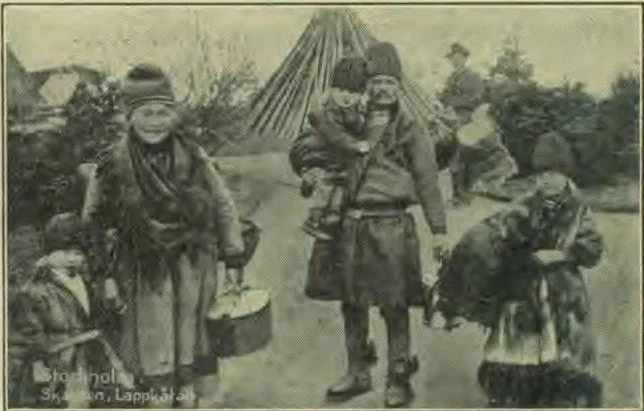
The dress of the Lapp in winter is very attractive, especially if newly made. The cap, or lapinlakki, is heavy and square-topped with a bright scarlet crown, with a band of otter fur around the head. A sieppura, or collaret of bear’s fur, encircles the neck, with the bear’s mask hanging over the heart. The coat, or outer garment, the matsoreo, is made of soft, gray-brown reindeer skin. Short, hairless leather breeches are joined at the middle of the thigh by the sapakket, or reindeer-skin leggings, reaching to the ankles, and are there made fast to the leather boots by narrow, red, clothlike bandages. The summer dress is not so attractive, as the fur parts are omitted.
The boots are made quite large, so that the foot can be surrounded by Lapp grass, which takes the place of stockings. This grass is a crisp, green, dry grass, without knots and without seeding tips. It is twisted up and kneaded in the palms of the hands to break the fiber, and then becomes like a pad of soft horse-hair in texture. A supply of this grass is always carried by each Lapp, and the foot covering is renewed as needed. It requires some skill and practice before the grass can be properly wrapped about the feet.
The customs of the people vary slightly, depending upon the location of the home and the occupation of the owner. On the borders of civilization, and where Western customs have been adopted, the Lapp’s home and surroundings differ materially from that of the wandering or lake Lapp, or from that of the inland farmer. But everywhere a stranger is ever welcome. He has but to open the door and walk in, then help himself. Hospitality is as natural to a Lapp as it is to breathe.
To the wandering Lapp, the fisherman or herder, the idea of a home, as we realize it, is unknown. Almost anywhere else in the world a host will ask his guest to “come inside.” While all that the Lapp has is at the disposal of the visitor, yet he has no house pride. Any shelter, a rock or the sunny side of a bank, for a dining-place, is all-sufficient, and a place on the ground inside his brown, cloth-covered la-wo, or tent, similar to our Indian tepee, at night, is the sum total of all entertainment he ever thinks can be expected of him. In cold weather, however, a more substantial dwelling, in the shape of a hut of peet or sod, is erected, and is about twelve feet in diameter at the base.
The small farmer—one who is tired of wandering, and possibly growing old—settles down by some lake, cultivates a small patch of ground, and from his crops and the fishing manages to eke out a precarious living. Generally these farmer huts consist of two rooms, a general living-room and a tiny, cupboard-like sleeping-room, which is often the dairy also. These, with two box beds, make up the total accommodations for possibly a large family and servants, to say nothing of occasional traveler guests. But while the hospitality in these settlements is indeed open-handed, the chances of obtaining food, except it may be dried rotten fish, and possibly coffee, is small indeed.
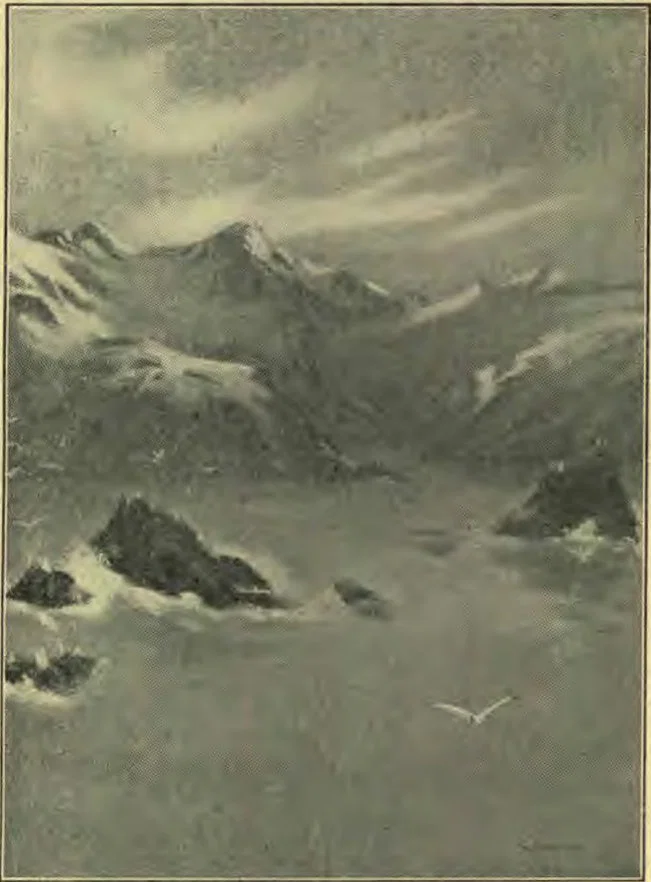
THE GATES OF RUSSIAN LAPLAND
The more prosperous farmer, with perhaps a thousand reindeer, owns a comfortable encampment near grazing ground for his herd. Such dwell in a kata, or tent, about twelve feet in diameter at the base, the ground inside comfortably covered with fur skins for mattresses and for bed covering, and is usually stocked with a bountiful supply of frozen meat, smoked meat, tongues, buckets of frozen milk, and bladders of frozen blood, of which they are passionately fond. In Lapp homes there is no separation in sleeping because of sex or social position. Usually, all sleep in one room. The Lutheran Lapps, as they prepare for retiring, unite in singing hymns of praise to God.
In Arctic Lapland there are no arbitrary hours for work or rest or sleep. Among the herders especially, who have no timepieces, the thought of hours finds no place. It would occasion no comment to see children preparing for bed at 4 A. M., or a laborer starting for the fields to work at 2 A. M., for the sun shines, practically, during all the twenty-four-hour day. Paul Du Chaillu, the noted traveler, commenting on this, wrote:—
“I was under the impression, before visiting this part of the country (Arctic Lapland), that the long-continuous daylight or dark short days must degenerate men; I found to the contrary; the farther north I traveled in Norway or Sweden, the more healthy seemed the people, the larger the families, and the greater the number of births according to the population. . . . It is not uncommon to see a family of fifteen or eighteen children by one wife, and sometimes, though rarely, twenty to twenty-four. Fish and milk are evidently good food for the increase of the human race. I met many people living to a great age, showing them to be strong men and women.”
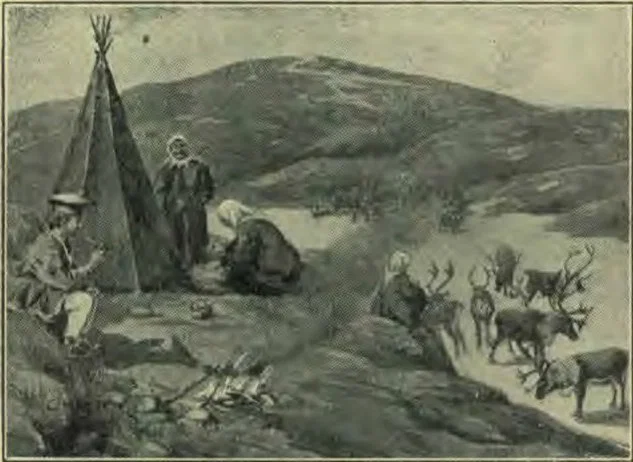
HERDER LAPPS' ENCAMPMENT
A LAPLANDER AND HIS FAMILY
Among the Arctic Lapps, however, who are not so comfortably situated or so well fed as are the Swedes and Norwegians, the mortality among infants up to two years of age is very great, comparatively few surviving the rigors of their first winter’s experience.
The winter storms in Arctic Lapland are sometimes indescribably fierce—something frightful. Of these Du Chaillu has this to say:—
“My journey over the mountains beyond the arctic circle, between 69° and 70° lat., was over. I had met many a storm on the Atlantic; the tornado of the equator had often passed over my head or struck the ship which bore me; but of all the windstorms I ever encountered, that of the mountains which we had just crossed was the grandest. As I look back to those days, I fancy I can hear the shrieks and howling of the wind, and remember how I crouched upon the rocks for safety while the tempest beat upon me as if the elements had obtained the mastery over the world, and chaos was coming again.”