The Rubber Industry

4%

Review and Herald Publishing Assn. · Takoma Park Station, Washington, D. C. · Nov 23, 1915

FromThe Youth’s Instructor, Vol. 63, No. 47.

Read the full edition

The Rubber Industry

We have all seen rubber in many forms, but there are many who do not know how it is grown and made into automobile tires, overshoes, and many other useful things. The changes rubber undergoes from the time it leaves the tree till it comes from the factory are very interesting.
The Malay Archipelago is one of the most important rubber-producing districts of the world. Rubber does not grow here naturally. South America is the native home of the rubber tree. As a great deal of money is made in wild rubber,—that is, rubber taken from wild trees,—the idea that rubber could be raised was put forward, and experimental gardens were established in India, and later in the Malay Peninsula, to find out whether rubber raising would be profitable. The results of the experimental gardens were highly satisfactory, and rubber plantations were speedily started. Plantation rubber rapidly made its way to the front, and now rubber raising ranks among the world's great industries.
Rubber is obtained from the sap of a tree, much in the same way that maple sugar is prepared from the sap of the maple tree. The trees are set out in the same way and about the same distance apart as those of an apple orchard. The rubber tree grows to a much greater size than apple trees; so, when the trees become larger, the weaker and poorer ones are cut down to make room for the others.
Tapping is the process of extracting the rubber from the tree. This is usually done by making a slanting cut in the bark of the tree. The rubber sap, or latex as it is called, slowly oozes out and runs down the gash and into the latex cup.
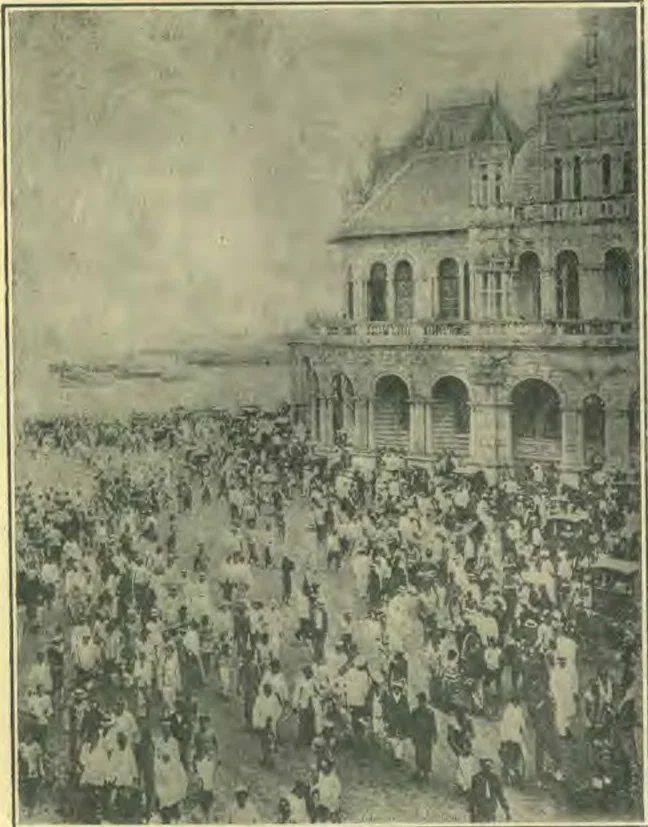
A STREET SCENE IN SINGAPORE, MALAY PENINSULA
Unless tapping is done with great care, much injury will result to the trees. All horticulturists will tell you that to cut into the bark entirely around the tree will kill it, as the sap channels are just under the bark, and they are the arteries of the tree. Tapping is done two or three times a week, so a carefully laid plan must be followed to avoid injury to the trees. A line is usually drawn around the tree close to the ground and another about the height of six feet. Perpendicular lines are drawn from the top circular line to the one near the ground, dividing the bark of the tree into four quarters. A tap is made in one of these quarters; the next time, a tap is made just above or below the first tap, until all that quarter has been tapped. Then the opposite quarter is tapped. In this way three quarters of the tree trunk is recovering from its wounds while the other quarter is being tapped.
As the latex comes out, it looks like cream. The first that flows is of the highest quality, and is collected at once. The rubber prepared from this always brings the highest price. The trees are tapped early in the morning, and the rubber is collected during the day. A man goes from tree to tree and empties the latex cups into a receptacle that he has, and then the latex is taken to the factory. The last latex is scraped from the cut in the bark where it has congealed, and is even scraped up from the ground if any has run down.
Rubber has the same relation to latex that butter has to cream, but it cannot be removed from the latex by churning. A small amount of acetic acid is added to the latex, and this coagulates the rubber and separates it from the water and other constituents of the latex. The amount of rubber in latex varies from thirty to forty-five per cent.
When the rubber has coagulated, it is run through the mangles or washing machines. These mangles are much like the mangles used in laundries for ironing clothes, except that the rollers are usually covered with ridges instead of being smooth. In the mangles the rubber has water poured over it continually, and dust, insects, and bits of bark are all washed out.
The rubber comes from the mangles in a thin, flat sheet not unlike a strip of cloth. It is then hung up to dry. The drying is the most delicate part of the process, for it is in this stage that rubber is easily spoiled. On many large estates the rubber is dried in a vacuum, heated by steam. This process of drying calls for a great deal of machinery, and is costly. It is undoubtedly the best method. But on small estates drying in a vacuum would cut the profits materially, so the drying is generally done by hanging the sheets up in a dark shed.
Often the rubber while drying becomes sticky and even melts down to a liquid. It sometimes becomes infected with bacteria or mold, and is spoiled in this way. All through the preparation extreme care must be taken or hundreds of dollars' worth of rubber may be spoiled.
The rubber is roughly divided into three classes: fine crape, so called from the appearance of the sheet rubber; medium, or ordinary rubber; and scrap, or the rubber that has been scraped from the cut in the bark of the tree. The best rubber sells for about fifty-five cents a pound in the raw condition, and the value of the other grades is lower. An acre of trees nine years old will produce about four hundred pounds of rubber a year. Roughly, the gross earnings of an acre of rubber is two hundred dollars.
Because of the remarkable growth of the automobile industry and the increased use of electricity, the demand for rubber is steady, and it is doubtful whether the supply of rubber will be sufficient in the future. Shares in a properly conducted estate are a paying investment. Dividends of fifteen and twenty per cent a year are not uncommon.
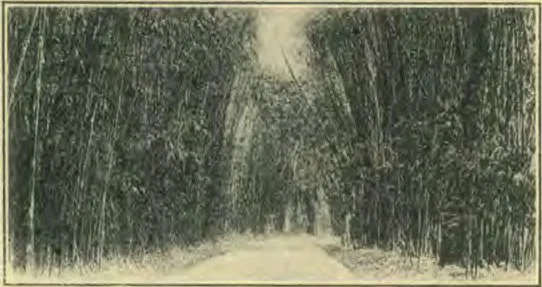
BAMBOO ALLEY, SINGAPORE.
Strange as it may seem, with all the modern machinery for the production of rubber, the wild rubber exported from South America, made by the natives by dipping a pole into the latex and holding it over the smoke of an open fire until it hardens, and repeating the process till a great ball is formed, is the best grade of rubber in the market, and commands the highest price. The name of that kind is Pará rubber, and to say that an article is made of Pará rubber is to establish its quality. The process is too slow to be profitably used on plantations.
The process that makes rubber useful is called vulcanization. In the raw state rubber will freeze in cold weather and become soft in hot. Mr. Goodyear was an inventor who was interested in rubber, and he spent many years trying to treat it so that it could be used in all kinds of weather. One day as he was experimenting with some rubber, he accidentally spilled some sulphur into it. He thought the rubber was spoiled, so threw it outside. On going out later he happened to notice that the rubber was not frozen, although the day was very cold. He brought it into the house and exposed it to heat, but it was not affected. This gave him the start, and he perfected his discovery, and lived to see rubber used in hundreds of ways.
Most of the rubber goods we buy are made of cloth and rubber united. All the raincoats and overshoes are made of cloth with a layer of rubber over it. Automobile tires are made by building up the structure, first a layer of cloth, then a layer of rubber, till the tire is completed. The rubber unites firmly with the canvas cloth and makes a strong fabric.
Many of the poorer grades of rubber articles are made of rejuvenated rubber. The worn-out boots and bicycle tires that the old-clothes man buys at the back door, are sent to a factory where the rubber is extracted from the canvas, and is used again.
Chemists know very little about rubber. It has been studied, analyzed, and experimented upon almost without limit, yet its chemical structure is unknown. They do know that it is composed of carbon and hydrogen, but beyond that point, differences of opinion begin. Specialists have tried to make rubber in the laboratory. They have almost done so, but not quite. A fortune awaits the man who discovers a way of making rubber below the present price.
The next time you use a rubber eraser, or take down the rubber telephone receiver, pause for a moment and imagine a forest of rubber trees, then remember that this most useful substance, together with every other useful preparation of nature, has been given to us by God, and silently offer a prayer to him in thankfulness for his love.
F. A. DETAMORE.