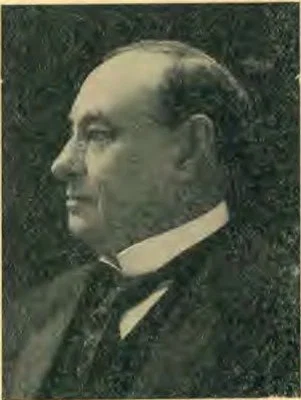
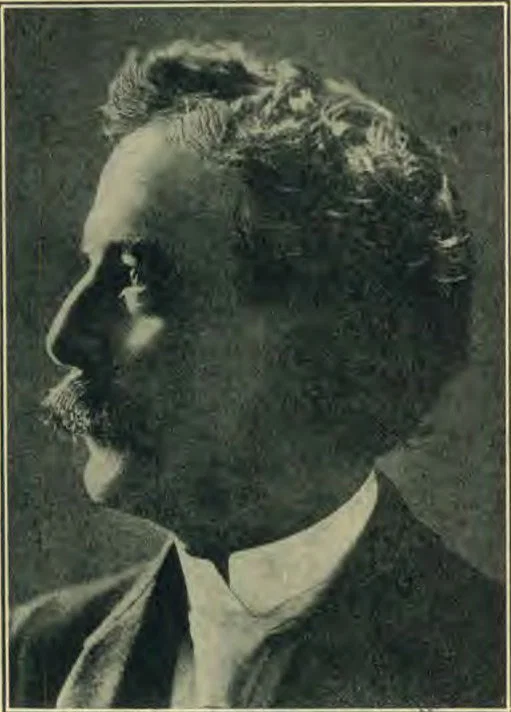
Dr. Harvey W. Wiley, for thirty years chief of the Division of Chemistry in the United States Department of Agriculture, is best known and honored for his heroic fight in behalf of our pure food law and its proper enforcement.
TOBACCO and the potato belong to the same family of plants. They represent the black sheep and the white sheep of the family, respectively. Tobacco is one of the most poisonous members of its family, being a close relative of the deadly nightshade. Its chief poisonous ingredient is nicotine, which, next to hydrocyanic (prussic) acid, is the quickest and most deadly poison known. In a single cigar there is enough nicotine, if it were all taken at once, to kill a strong man not used to its influence. It is claimed that the nicotine is usually all burned, but there are indisputable proofs that some of it is inhaled. In burning, tobacco produces considerable amounts of a poisonous substance, pyridine, which is one of the agents used for denaturing alcohol.
I am not a King James, although I belong to the Non-Smokers’ and Anti-Cigarette Leagues. If people over twenty-one want to use tobacco, let them do so, but in a way which does not offend abstainers. As for minors, however, if teaching and persuasion fail, I would enlist the strong arm of the law to protect the youth of the country against the insidious inroads of nicotine. The nation looks to its youth; we must educate them and save them from injury. They must not be permitted to use either alcohol or tobacco, even if parents are indifferent to or encourage their use. Every parent and every American
boy should read “The Case Against the Little White Slaver.” It contains the views of Thomas A. Edison and Henry Ford on the cigarette habit. The book will do any boy good. When two men such as Edison and Ford join in the crusade against cigarettes, no parent can fail to look with anxiety upon the beginning of the habit in a son or daughter. Mr. Ford says to his friend, the American boy, “If you will study the history of almost any criminal, you will find that he is an inveterate cigarette smoker. Boys, through cigarettes, train with bad company. They go with other smokers to pool rooms and saloons. The cigarette drags them down. Hence, if we can educate them to the dangers of smoking, we shall perform a service.”
Mr. Edison says, in speaking of the degeneration produced by narcotics and cigarettes, “Unlike most narcotics, this degeneration is permanent and uncontrollable. I employ no person who smokes cigarettes.”
This is a lesson that every father and mother may well take to heart. Already some of the greatest industries of this country, especially the railways, refuse
to employ any one who uses alcoholic beverages. Now one of the greatest industries of this country, that presided over by Mr. Edison, refuses to employ any one who smokes cigarettes. It is not difficult to see that the boy who learns to use tobacco is loading himself with a heavy handicap for the race of life. He is excluding himself from employment in some of the greatest industries in the world.
In the little book referred to, which is distributed free by Mr. Henry Ford, I am quoted as follows:—“I commend Mr. Ford, Mr. Edison, and all people who join them in efforts to curtail or restrict, obliterate or destroy, the pernicious habit of cigarette smoking. The use of cigarettes is making inroads on the strength of the nerves of
all who smoke them, especially boys of tender years or women who smoke them because they think that the practice is smart. The effect may not be so bad on people of more mature years, but not in any case, no matter how old a man or woman, is smoking helpful. Besides constituting a nuisance, the financial strain connected with the use of tobacco stands between millions of people and home comforts.”
Prof. Henry W. Farnam, of Yale, has made a notable contribution to the campaign for restricting the use of tobacco, in an article in the Unpopular Review for January, 1914, which was reprinted in pamphlet form. He introduces his article with the following suggestive quotation from Thomas Paine’s essay on “Common Sense:”—
“Perhaps the sentiments contained in the following pages are not sufficiently fashionable to procure them general favor; a long habit of not thinking a thing wrong, gives it a superficial appearance of being right, and raises at first a formidable cry in defense of custom. But the tumult soon subsides. Time makes more converts than reason.”
Professor Farnam asked the authorities of fifty-two universities, colleges, and schools what stand was taken with regard to smoking by the students. The response was most encouraging. Twenty-four of the institutions absolutely prohibited smoking, eleven partially prohibited it, fifteen discouraged it, and only two had no policy relating thereto.
This is a most pregnant thought. When it becomes apparent that those who are in charge of the education of the young men of our country are practically unanimous in their condemnation of smoking, it is time to consider seriously a nation-wide propaganda to protect our youth.
Professor Farnam then goes on to voice the sober sentiment of the thinking and ethical members of the medical profession of the United States. Not only does the tobacco user handicap himself in the race of life, and lay the foundations which exclude him from4many profitable industries; but he also proceeds to sap the physical foundations of his being, the inevitable result of the continual pounding on the nerve centers with any powerful narcotic drug. The palpitating heart and the trembling hand from the long and excessive use of tobacco are a too frequent spectacle.
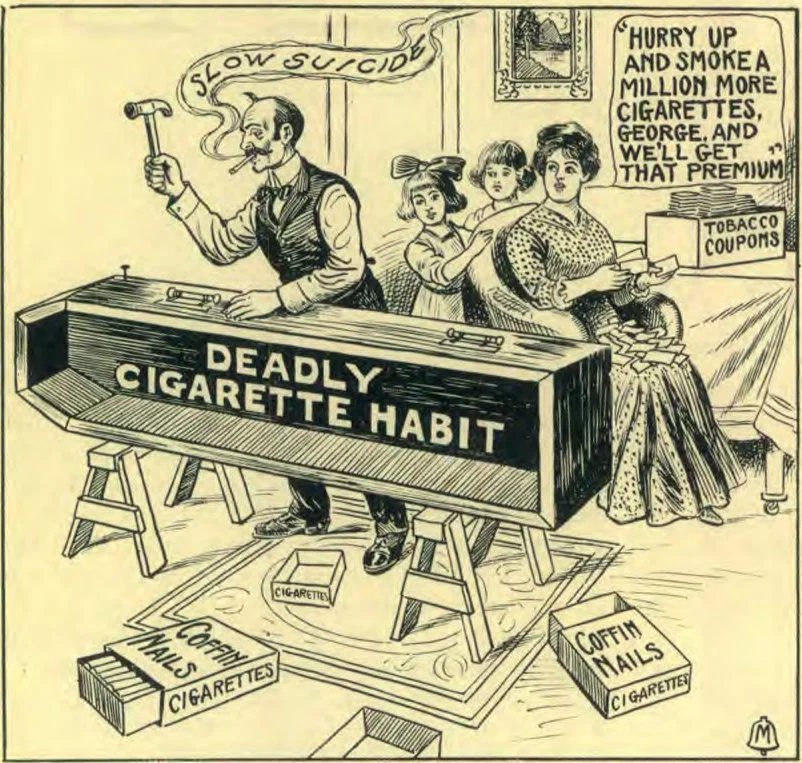
THE TOBACCO-COUPON COLLECTING CRAZE
Every time papa drives a nail in his coffin, mamma gets the infinitesimal
part of a mite toward a two-bit premium.
Unfortunately, there are many subtle ways of encouraging young men to smoke. Hundreds of thousands of dollars are spent every year in telling the readers of periodicals of the merits of this, that, and the other brand of tobacco. This cannot fail to influence thousands of young men. It is considered a smart thing on the stage to light a cigar or cigarette. I rarely go to the theater without seeing this done.
There are, strange to say, a few ministers of the gospel who indulge in this habit, and some of them actually promote it. But more dangerous than the example of any one else is the influence of young women who encourage their admirers in the use of tobacco, and unfortunately often join them. Why a young woman should want to encourage the man she expects to marry to use tobacco, is more than I can imagine. If she wants her husband to have every opportunity to succeed, she is guilty of the greatest folly in helping him to acquire an injurious habit.
The Life Extension Institute of the life insurance companies of the United States issues a monthly health letter. Number thirteen is entitled “What It Costs to Smoke Tobacco.” Attention is called to the fact that in 1880 the annual consumption of tobacco in the United States was about five pounds a head, but in 1914 it had risen to more than seven pounds. In
Great Britain the annual consumption a head is only two pounds. Especially has the cost of our cigarette bill mounted into high figures. In 1914 more than 16,000,000,000 cigarettes were consumed in the United States, more than 412,000,000 pounds of chewing and smoking tobacco, and nearly 33,000,000 pounds of
snuff. It is estimated that the annual expenditure for tobacco in this country is at least $1,200,000,000. This is a high price to pay for a mistaken sense of contentment. Nor does this include the injury to health and the general breaking down of the nervous system that come as a result of indulgence in this
wholly useless habit. Comparative experiments in regard to the efficiency of users and nonusers of tobacco universally show the superiority of the nonusers. Dr. Pack made an investigation, in six educational institutions, of students who were competing for places on the football team. He found that only thirty-three per cent of the smokers were successful, while sixty-seven per cent of the nonsmokers attained their goal. In regard to their scholastic standing, the average marks obtained by smokers were 74.5 per cent, while those obtained by nonsmokers were 79.4.
Of the men receiving the highest marks, four were smokers and eleven nonsmokers. Of the men receiving the lowest marks, twelve were smokers and six nonsmokers. Out of 180 men examined, eighty-five per cent of those conditioned or failing were smokers, and only forty-four per cent were nonsmokers. These are lessons of extreme value.
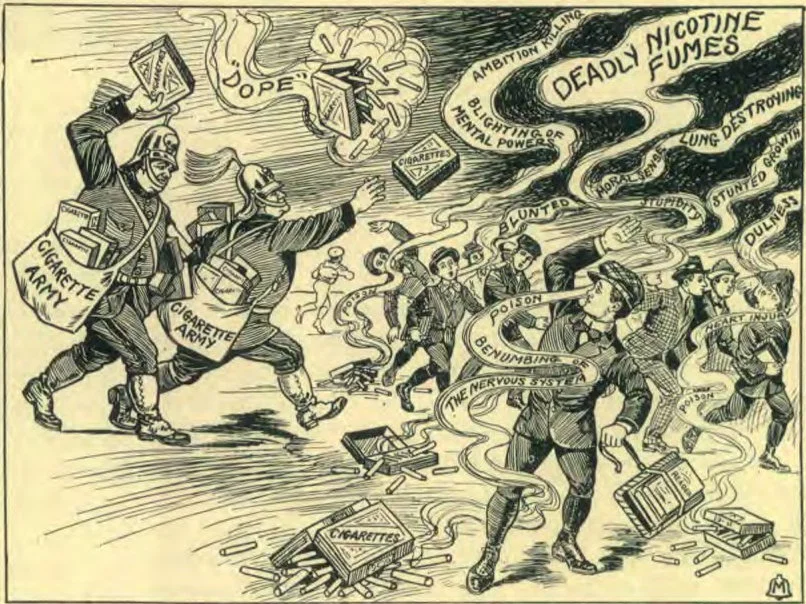
FIGHTING WITH POISONOUS GAS BOMBS
The cigarette forces in their mercenary warfare against our youth.
While tobacco, next to alcohol, is the most generally used narcotic or sedative, it stands on an entirely different plane from that occupied by alcohol, opium, cocaine, and other dangerous and seductive drugs. The use of tobacco is popular and does not yet generally offend the public taste. To be sure, its use is surrounded with restrictions which ought at least to call attention to the fact that there is something wrong with it. From the ethical point of view, this condition is, of course, restrictive, but from a moral point of view the use of tobacco is practically unhindered. The man who indulges to excess in alcoholic beverages loses his standing to a certain extent in a community, but the character of the smoker still stands unstained.
Our readers ought to consider the propriety of consistently discouraging such an expensive, useless, and dangerous habit. Boys and girls should be told the truth about tobacco and the havoc it works. They5should be taught by precept and example that it is not manly or womanly to use it. If it were manly to use tobacco, it certainly would be womanly; and yet ninety per cent of this magazine’s readers would be horrified to think that the use of tobacco might become as general among girls and women as it is among boys and men. Let us take care that no such condition arises. Let us discourage the tobacco habit.
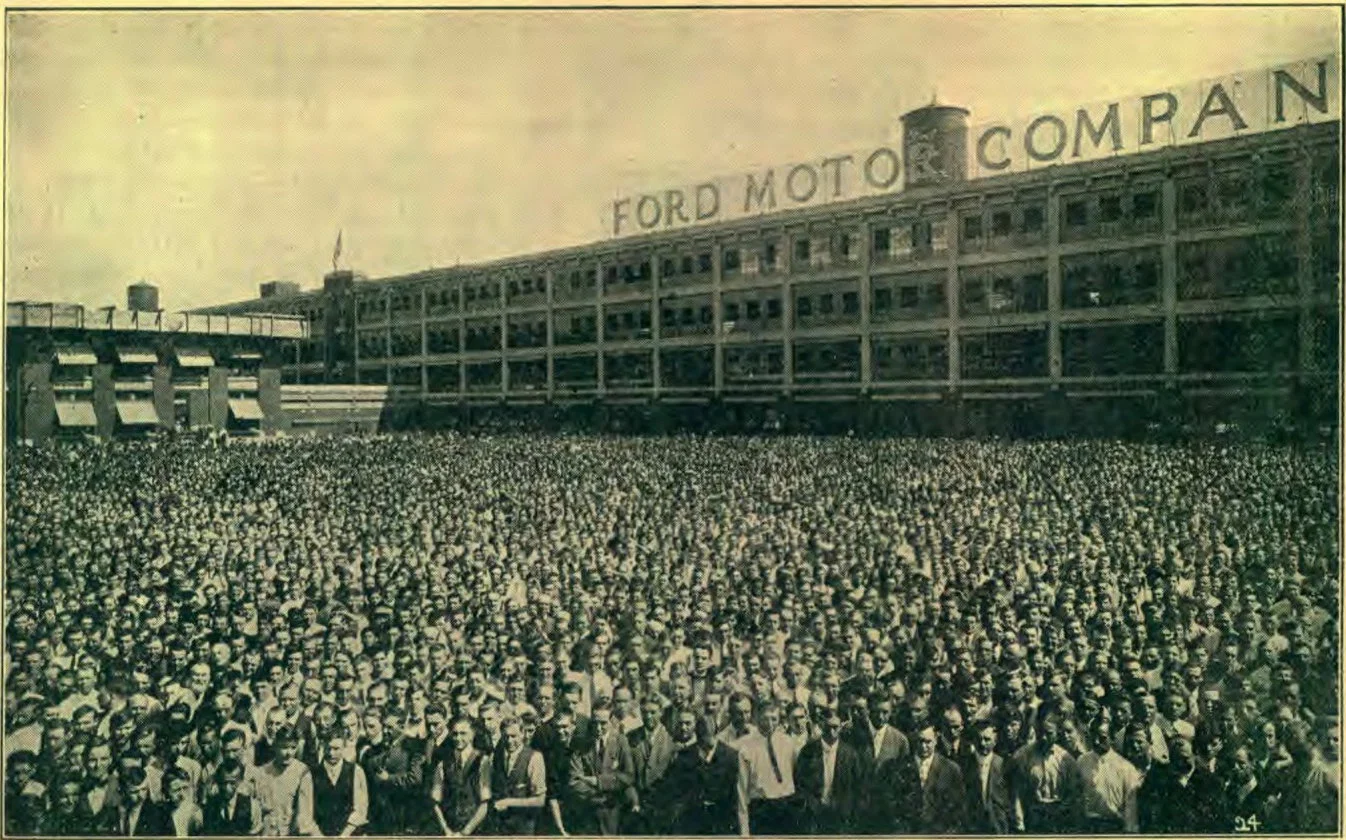
Some of the 24,000 employees of the Ford Motor Company. Mr. Ford, who has observed the evil of the cigarette habit, has issued three attractive booklets entitled "The Case Against the Little White Slaver," which have been distributed widely at his own expense.
Many pathetic letters are received from wives and mothers asking for a “tobacco cure,” that the habit may be vanquished merely by dosing, without any effort or self-denial or suffering on the part of the victim. There is no such cure known, though tonics, restraint, and certain drugs may be used under observation to assist the patient if he is ready to cooperate. But the patent medicine man who sends a secret preparation, and at long distance guarantees a “cure,” is only indulging in the false promises of his kind. Strength of will cannot be supplied from a bottle or pill box. The football player lays aside his cigar, pipe, and cigarette, aided only by a nourishing diet, fresh air, exercise, and an overwhelming desire to get rid of every handicap. Surely any sensible boy or man, when once convinced of the dangers of the habit and the physical and mental handicap that it represents, would and could make an equal effort to make good in the game of life.
The advertised tobacco cures depend almost without exception on cathartics and on some tonic substance, such as strychnine. One picturesque product includes eight different pills and tablets of various sizes and shapes, representing a generous color scheme of brown, pink, and gray. Three different cathartics are represented, aloin, phenolphthalein, and podophyllum. Quassia, strychnine, iron, and brucine (indicating belladonna) appear to be present in small quantities for their tonic properties. Charcoal is added for the stomach’s sake, and, truth to tell, it is needed. Then, with a due respect for the subjective effect, asafetida, which gives a most offensive odor to the bodily excretions, and methylene blue, which colors the urine, are added, and the physical effect due directly to these
drugs is naively attributed to the elimination from the system of the tobacco poisons! Not by such hocus-pocus as this can the will be braced to forgo accustomed doping, nor the body and nerves be compensated for the “incessant accumulation of small doses of tobacco poison which finally amounts to chronic poisoning,” as one authority describes cigarette smoking. A proper dilution of nitrate of silver (a poison) has, however, been used to destroy the desire for tobacco, but the treatment is drastic, and cannot be attempted without a physician.
Can nothing good be said about tobacco? When old Hans Schmidt, who was acknowledged to be the meanest man of the neighborhood, had been placed in the grave, and the audience, according to the good old Pennsylvania custom, had waited long for some neighbor to say something good of him so that the grave might be filled, Gustave Schultz ended the embarrassment by walking to the edge of the grave, taking off his hat, and saying, “Well, I can say joost one good ting about Hans: he wuzzn’t always as mean as he wuz sometimes.” So can I say one good thing about tobacco: A decoction of tobacco is speedy death to lice and ticks, and makes an ideal dip for pigs and poultry.
Finally, you mothers whose boys are just beginning at the age of ten to find opportunities to acquire the cigarette habit, what may you expect if they do? Here are a few of the possibilities:—
They will acquire a habit which may bring them into sympathetic associations with the boys who are going to the bad.
They will be slaves to a habit which segregates them from the common crowd of travelers and spectators.
They will join the procession that is made up of marchers with hesitating steps, shaky hands, and palpitating hearts.
They will unfit themselves for athletic sports and high attainments in their studies.
They will weaken their resistance to disease, and fall easy victims to infection.6
They will exclude themselves from many activities leading to higher pay and preferment.
They will waste large sums of money while doing themselves lasting, perhaps even fatal, injury.
They will more readily become victims of alcohol, cocaine, opium, and other narcotic drugs.
They will mar the efficiency of their work.
They will shorten their lives.
Their presence will disclose itself to the nostrils of all their associates.
LUTHER BURBANK, THE PLANT WIZARD
A last word: Of those of maturer years I ask, Is the comfort which the use of tobacco gives real happiness? and I answer, No, it is illusory. A man should so order his activities that he needs no comforter except wholesome food, illuminating literature, a fond family, and a progressive community. He who has to seek consolation in a drug is going wrong. There is something out of condition in his make-up. He has a false view of life. Happiness consists in accomplishment, contentment, in satisfaction with the environment, not in Lethean passivity. There is no place in the normal life for an illusory delight nor a drug-provoked contentment. Tobacco never has brought and never will bring any real happiness to humanity.—Good Housekeeping.