Leech Killers

8%

Review and Herald Publishing Assn. · Takoma Park Station, Washington, D. C. · Mar 7, 1916

FromThe Youth’s Instructor, Vol. 64, No. 10.

Read the full edition
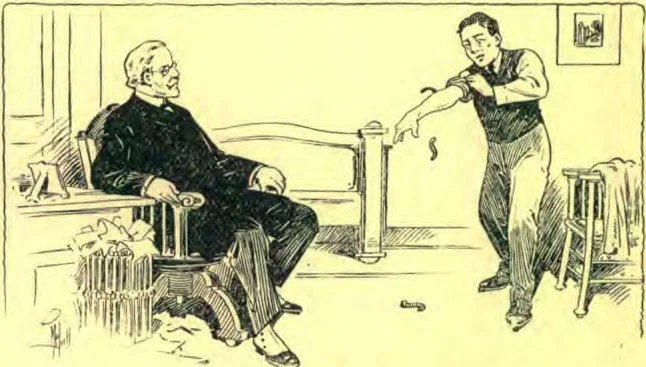
“I assure you my leech-killing days are ended.”

Leech Killers

It was Saturday evening in one of the oldest military academies in the United States. The boys of the Second Room Company had returned from the swimming pool, and were preparing for the weekly debate before retiring to the dormitories. This was to be an impromptu discussion. No question had been selected. Captains were chosen and sides drawn. Then came a period of casting about for a theme. The discussion which followed several suggestions made by the boys themselves, led to a more earnest approach than on other week-end discussions to a consideration of the evil effects of habits formed in early years.
The teacher in charge saw the opportunity for which he had been waiting for many weeks. There had been an unexplained but very real tendency on the part of several of the boys of this company to break the rules of the school by smoking cigarettes.
Suddenly one of the disputants turned to the teacher with a challenge for his opinion on the effects of smoking upon boys. The young man arose, spoke moderately of the undesirable methods used in many factories where cigarettes are made; he mentioned the uncleanly habits of workers in cheap tobacco, the apparent necessity for treating the “filler” of the paper tubes with drugs to disguise its unfitness for human consumption. He distributed an outline of the evil effects of smoking of all kinds upon boys of growing age, and told of an experiment he had witnessed in the office of a prominent physician. A youth of sallow complexion, who would not heed the advice of his physician, was plainly in need of convincing proof of the doctor’s wise counsel. The physician therefore put three leeches upon the arm of the lad, and told him to watch them. They buried their noses eagerly in the flesh above the elbow; but one by one they released their hold upon his arm, and fell to the floor.
“What are they doing, Doc?” said the astonished boy.
“They are dying,” replied the doctor; “they have been poisoned by the nicotine in your blood.”
“Well,” said the fellow, serious at last, “if I am as much of a leech killer as that, they must have got me pretty bad.”
“Yes,” said the physician, “you will be as they are pretty soon if you don’t take my advice. Nicotine will kill boys as well as leeches, if they get enough of it in their blood.”
“Forgive me,” said the young man, as he picked the leeches from the floor. “I was too wise in my own conceit to take advice; I assure you my leech-killing days are ended.”
“Give me some medicine, Doctor,” said he, turning to the physician. “I want to drive this poison from my system.”
“This first,” answered his adviser, and he handed him a pledge card to sign; “when you have put your name to this, I will help you.”
The lesson was evident. From his desk the teacher of the cadets drew a parcel of pledges, which he had purchased so as to be ready for the opportunity for which he was waiting, and he passed them to the boys. They signed them, every one, and sent them to their parents for safe-keeping. The teacher does not know that they ever broke their word of honor.—Charles H. Rominger, M. A.