When a Town Goes Dry

3%

Review and Herald Publishing Assn. · Washington, D.C. · 1916

FromThe Youth’s Instructor, 1916 Temperance Annual

Read the full edition

When a Town Goes Dry

Listen, men and women, we've got to have it dry. If it's wet, drink will sure get some of us. Mr. Voter, just put your hand on the one you would like to make a drunkard of. Not one of us? Then don't vote wet.
WHAT really happens when a town goes dry? Do the dire prophecies of a “dead town” actually come to pass? or do millennial conditions really materialize? There are thousands who are in honest doubt as to the answer, who want the plain facts of the case, and here they are:—
Our town is a snappy city of fifty-four thousand inhabitants. For years it was wet—very wet. Then came an almost unaccountable revulsion, and we had “high license, early closing, and a strictly regulated traffic,” and for two years we were perhaps the most strictly regulated wet town in the West. Apparently many of our solid citizens were convinced that the best “practical solution of the liquor question” had been found in high license, a small number of saloons, and a large number of handicaps strictly applied.
But two years ago the pendulum swung to the dry side of the clock, and it hit with a bang so loud that everybody could hear it.
So, you see, our town has had her wild, “wide-open” days; she has had her period of “drought tempered with mercy and enforced with indifference;” and right now she undoubtedly is the driest city of her size in the United States.
Now what did really happen when the town went dry—real bone dry?

Meat Market Operator Tells His Experience

Our town has a most remarkable meat market operator, and he has six markets in different parts of town. He gets the trade of the millionaire factory owner, of the cheapest laborer, and of all between them. I brought up the subject of the saloon with Jerry, the market man, because I happened to know that he had been strong for high license, and because nobody would ever accuse him of being narrow, bigoted, strait-laced, or anything of the sort.
“Would you put the town back on a wet basis, such as we had before, if you could, Jerry?” I asked.
“Never!” came the quick answer. “It’s a plain matter of business, mainly. My profits are fifty per cent greater today than when the town was wet. Not that the difference between saloons and no saloons has increased my trade fifty per cent, but there are families buying meat of me now regularly whose trade amounted to practically nothing when we had saloons. The money didn’t get home. Of course the man had some meat at the free lunch counter in the saloon, but the wife and the children tasted very little meat. Some people of this class are now good credit customers. Others pay cash.
“There is a remarkable difference in the collection end of our business. On the whole volume of our trade the losses in bad debts amounted to a large sum when our town was wet. When this town went dry, we began to collect the bad debts. Our percentage of credit loss on current business began to shrink soon after the saloons went, and now it is so small that it really amounts to very little.
“Then with the saloon wiped off the map, my help became more efficient in every way. I have one man working with me now who was with me through the high-license period. He drew good wages, but he was never thirteen cents ahead of the game—never! Part of the time he was so badly ‘soaked’ that he was almost useless. He had ‘tabs’ at the saloons, and those had to be paid first before his store accounts were settled; so he was always behind. When the town went dry, he took a few pay-day trips to the nearest town where booze is sold. But he soon dropped that; it was too much trouble. What has been the result? That man has more than thirteen hundred dollars in a savings account in the bank—saved in two dry years. He is a fair example of thousands in this city.
“What really pushed me over into the dry line, however, was watching my delivery men. I could tell as soon as one of them was initiated at the bar. His work would begin to fall off; he would require a lot of watching. You see booze makes any man more careless with your property and your money, less watchful and less dependable. My workers—from delivery boys up—are immensely more efficient than when they could run into saloons.
“I’m a lot more efficient myself, too. Perhaps you didn’t know that I drank at all. Very few of my acquaintances did know it. But generations of my ancestors have cultivated a taste for smoky Irish whisky, and it came easy to me. If any man had told me at the time that I was taking enough to hinder my efficiency, I should have resented the suggestion. My nips were very moderate. It took the contrast of no nips at all to show me that the stuff was having an effect on my ability to work and plan with a clear head. Nothing else would have convinced me. I know that it cuts down efficiency, no matter how well a man has his thirst under control.
“On the score of its effect on business, there isn’t a single justification for the saloon. I always thought there was until experience pounded a change of conviction into me, just as it has into hundreds of business men in this town. We all know better now.”

Lumber and Coal Merchant and Jeweler

I talked with our lumber and coal man, whose trade is mainly from families of the working class. He is a conservative man, always careful in his statements.
“There is just this difference,” he declared: “Since the city went dry, we have been collecting accounts that were deadwood. They would have been utterly worthless had the city remained wet.” Reaching for his ledger, he pointed to an account, and continued: “There’s a case of a man. He couldn’t get credit for a bundle of laths when we had license. But when the town went dry, we saw that after a little he quit chasing out of the city for booze, and finally settled down to steady work and to taking care of his family. He came in and said he wanted to build on his lot. We told him he could have credit for all the material that he needed. Now he has bought several hundred dollars’ worth of stuff and paid promptly. That man is just a fair representative of a lot of others—perfectly good pay when the town is dry, and good for nothing when the town is wet.”
Near by, on the street car line, is a jewelry store catering to the working people. The jeweler who owns it said:—
“Certainly business is better than it was when we were wet, better in every way. It’s just like the difference between good times and bad times.”
Said the dry goods merchant four doors beyond: “He’s right. It’s the same with me. My business has increased threefold.”

Owns Store in a Dry and One in a Wet Town
A large clothing and shoe merchant in the center of the town had this to say: “Business under the best wet administration this town ever had was not to be compared with what it is now that it is dry. I’m collecting accounts right along that are outlawed; just as long as we had saloons, they were absolutely uncollectable.”
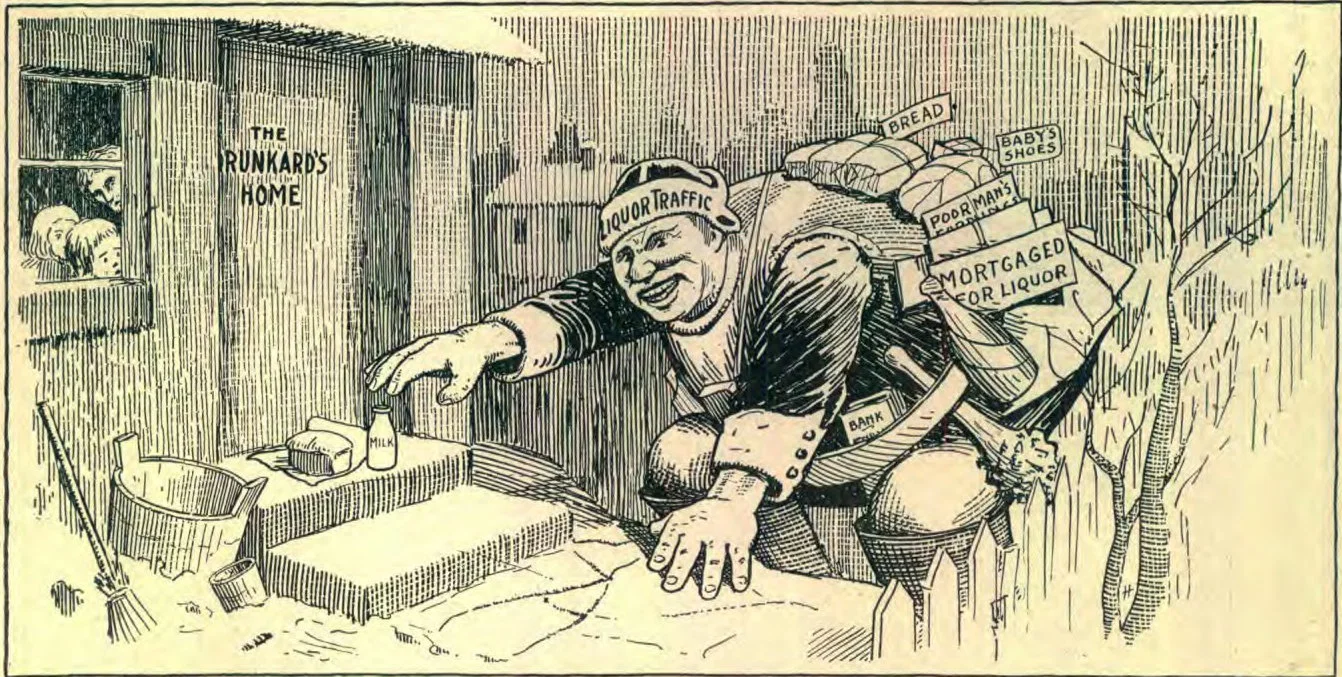
The liquor dealer in his “personal liberty” argument for the maintenance of the saloon claims that he has no other way of getting bread and milk for his wife and children; but have we a right to license a man to win bread and milk for his children by taking the bread and milk out of the mouths of another man's children?
“You hear a lot of talk to the effect that when a town goes dry, men who like their drink and are strong for personal liberty will go to some other town to spend their money, and the merchants there will get it. I happen to know how much truth there is in that theory, for the reason that, I own another store in the town that gets about all the trade that goes out of our town in order to get booze. I carry the same line of goods there as here; my store there is run by two young men who are uncommonly popular; rents are cheaper there than here, and so are some other expenses. I give close personal attention to the business there as I do here. If that doesn’t furnish a sound basis of wet and dry comparison, I don’t know where you will find one. My store in the town that gets our booze pilgrims—several hundred of them every pay night—is not only steadily dropping in profits, but also in volume of trade. The store here is as steadily going the other way. The facts shown me by my ledger and my cash book have forced me to the conviction that there was never a more childish theory palmed off on a credulous public than the theory that saloons help business. I’m ashamed whenever I remember that I once believed it myself.”

Real Estate Men Scared Stiff

Jones, the real estate man, laughed when I asked him if he had found a wet town better for real estate than a dry town.
“One of the business associations here,” he remarked, “took a straw vote, the other day, on the wet or dry question; out of the two hundred and ten men voting, how many do you think wanted to go back to a wet town? Just ten! When our town went dry and about fifty store locations were thrown on the market in one day, property owners and real estate men were scared stiff. It really looked as if property values were going to drop. But just as soon as dry conditions had a chance to demonstrate themselves, rentals and real estate values not only came back to where they were, but they became still better.
“Our town, as you know, has added thousands to its population under dry rule; and who is the best buyer of lot property—the man who is spending his money in the saloon or the man who is keeping sober? There is only one answer to that, as we real estate men know.
“And how about the factories? Dry territory looks mighty good to them—make no mistake on that score! Booze is one of the big troubles in factory management.”

Saloon Keepers Like the Dry Regime

I asked the chief of police to look over his list of former saloon keepers and give me an idea of their present occupations.
“Well,” he said, “there’s one man who is running a big farm—and there’s another. There’s a third one who is raising crops instead of selling booze. Here’s one who has gone back to work in one of the big factories. Four or five are in the restaurant business, and about the same number are running billiard halls or amusement places. There’s a live one who opened a candy store, and did so well that he began to make his own goods; now he runs a candy factory, and has several retail stores of his own as outlets for his product. He wouldn’t go back behind the bar if he could have the best location in our town.”
Before the last election the local saloon keepers of our town met in a council of war. The saloon keeper who kept the best “place” in town and was looked upon as the “biggest man in the business” was asked to talk. He talked right out in meeting, and said:—
“If this town goes dry,—as it probably will,—you’ll put up an awful howl. But cheer up! You’ll be better off when you’re driven out of the business. I can count on the fingers of one hand all of you who are really making more than wages. The breweries are getting the money. You’ll not lose anything financially by being forced into other business. Most of you will gain by the change. Nearly every one of you is going downhill physically. Your saloons are a long way from being health resorts. You get about as much bad air in the course of a day as any set of men in this town. Then most of you take too much of your own medicine and too little exercise. But you’ll keep on just as long as you’re in the business, and you’ll stay in it until you are driven out. And I think the time has come.”
It did come, and the town and everybody in it are happy and satisfied.—Forrest Crissey, in Ladies’ Home Journal,