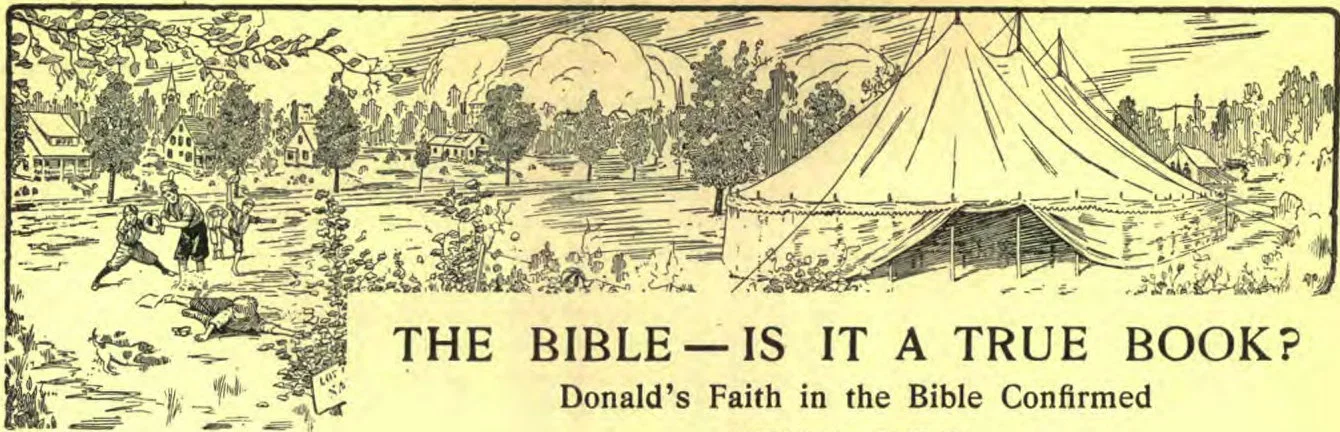
It was easy to be seen by the large number that gathered at the tent on Tuesday night to hear the talk on the inspiration of the Bible, that these meetings were the most popular religious services in town. Fully eight hundred persons were present during the song service, and their enthusiastic singing of some old favorites could be heard for blocks. As Donald Hunter looked around on the audience he saw some of the ministers of the town.
After an earnest prayer, Brother Harris began his sermon. He dealt in a most vigorous way with what he called “the poisonous evils of the destructive higher criticism, Spiritualism, Christian Science, and evolution,” which, he said, “were leading the people of God away from the great truths of the Bible, to put their trust in solely man-made teachings.”
It was one of the most forceful sermons Brother Harris had yet delivered, and the big crowd seemed thoroughly to enjoy it. The speaker said:
“The drift in the Christian world today is away from the simple truths of God’s Word. This is due to the fact that many false teachings have come into the church during recent years, all of them of purely human devising. These led men to place their trust and confidence for salvation in men, in human efforts, in man-made systems, instead of in God and his plan of salvation. In the minds of many persons these new theories take the place of the pure gospel of Christ. Among them are the teachings of Spiritualism, evolution, the destructive higher criticism, new thought, and Christian Science.
“These teachings are sweeping away the faith of the people in the Bible as the inspired word of God. And this attack upon the fundamental principles of Christianity is not, as in the past, from outside the church. It is from inside the church. Those who occupy positions of influence and power in the pulpits, in the theological seminaries, in the great religious publishing houses, are the leaders in this apostasy. Sapping the very foundation of its power, poisoning all the springs of its life, these forces are engaged in wrecking the church of Christ, while at the same time professing to be its friends. Like its divine Master, the church today is being ‘wounded in the house of its friends.’
“It therefore becomes important for Christians to become familiar with the teachings of the Bible, and learn the reasons for their belief that the Bible is inspired. The evidence of the inspiration of the Bible is so vast that it would take many nights to present it all, and we shall attempt to give only a small part of it this evening.
“In 1901 a Book was issued from the press, called the American Standard Version of the Bible. This was immediately circulated from end to end of the land. Yet it was not a new Book at all. When one came to examine it, he found that it was just the same as a Book which had been issued in 1881 called the Revised Version of the Bible. It is true there were some changes, some minor corrections, a little difference in punctuation, but the Book contained the same stories, the same epistles, the same gospels, and the same teachings as the earlier Book.
“On closer examination it was discovered that this Book had not been issued first in 1881, but it was the same Book that had been issued under the authority, by the command, and in the reign of King James of England, in the year 1611.
“So this Book printed in 1901 was not a new, but rather an old Book, more than three hundred years old at least. But when we get back to 1611, we have not reached the beginning of it. There are older copies than that. Before the great war there stood in the museum in Antwerp in Belgium the first printing press ever made, and alongside it a copy of the first Bible ever printed, which was in Latin. But even this is not the beginning of this Book. In the British Museum in London is a copy of Wycliffe’s translation of the Bible, made about 1380, before the art of printing was invented. While you would have some difficulty in reading your own language as it was then written, yet if you did read this translation, you would find in it the account of the wise men who came to Bethlehem, the shepherds feeding their flocks, the parable of the lost sheep, the true vine, the prodigal son, and all of the parables, miracles, and teachings of the Son of God, just as you have them in your Bible at home. So we know that this Book is more than five hundred years old.
“But it is much older than that. It was copied in other languages, and we now have many ancient manuscripts of the Bible, some in Greek, some in Coptic, some in Syriac, and some in Ethiopic. Many of these manuscripts are very, very old. ‘How do you know,’ you ask, ‘that they are not much more recent than they pretend to be?’ Well, in such things as writing books it is not easy to deceive. Let me illustrate.
“Away back in the year 79 after Christ, Mt. Vesuvius blew off its head, covered the cities of Pompeii and Herculaneum with lava and ashes, and for eighteen hundred years these cities have lain buried. During the past century scientists have made excavations in Herculaneum, and uncovered a large part of it. Among other things they found the library, and in it many thousands of books were discovered. These books were written in a peculiar way, a way in which we do not write books now. All the letters are capital letters, or what the scientists call uncial letters; the words all run together, there is no punctuation between the sentences, and there are no paragraphs, chapters, or verses.
“That is the way they wrote books eighteen centuries ago. We know they did, for these books have6been buried that long. Now, we have copies of the manuscripts of the Bible, especially of the New Testament, written in this same peculiar way, with capital letters, no separation between the words, sentences, verses, and paragraphs, and therefore we know that we have manuscripts which are very, very old. In the Hebrew manuscripts of the Old Testament even the vowels were omitted, as if we should write Genesis 1:1 thus: NTHBGNNNGGDCRTDTHHVNNDTHRTH.
“Some infidels are foolish enough to claim that the New Testament was compiled at the Council of Nicæa in 325 A. D., as if the Bible did not exist before that. The chief fault I have to find with that statement is that it is not true. Twenty-two years before this council, in 303, Diocletian, the emperor of Rome, issued his famous decree to destroy the churches and burn the Bibles. So the Bible dates farther back than the Council of Nicæa. And the emperor did not succeed in destroying the Bible. It still lives, though he is scarcely remembered.
“In the second century after Christ, a heathen philosopher by the name of Celsus wrote a book to prove that the Bible was not true; but about all he did was to prove that the Bible was then in existence.
“Now we have got back to the days of the men who wrote the Bible,—the days of Paul, Peter, James, and John. And as we study their writings we find each upholding the others. For instance, Peter declares that Paul had written certain epistles, and he compares them to the writings of the ancient prophets, and calls them all ‘Scriptures.’ 2 Peter 3:15-17. Paul (1 Tim. 5:18) quotes from the gospel by Luke (Luke 10:7), ‘The laborer is worthy of his reward,’ and says, ‘The Scripture saith.’ And Luke says (Acts 1:1) that he had written a ‘former treatise’ before he wrote the Acts, and in this former treatise he says he gave an account ‘of all that Jesus began both to do and teach.’
“When we turn to this former treatise, which was the gospel by Luke, we read that Luke there says (Luke 1:1-4) that others who were ‘eyewitnesses’ of the things they recorded, had ‘set forth in order a declaration of those things,’ meaning the writers of the other gospels.
“Thus the writers of the New Testament substantiate one another. They quote from one another, and acknowledge the others’ writings as Scripture. And they also substantiate the Old Testament, for they constantly quote from it. There are only three quotations in the New Testament from heathen writers. These are in Acts 17:28: ‘We are also his offspring;’ 1 Cor. 15:33: ‘Evil communications corrupt good manners;’ and Titus 1:12: ‘The Cretians are always liars, evil beasts, slow bellies.’ But there are in the New Testament hundreds of quotations and references from the Old Testament, taken from every book except Ezra, Esther, Nehemiah, and the Song of Solomon.
“When we get back to the Old Testament, we find the later writers quoting from the earlier, the prophets and the psalms quoting from the books of Moses. The last admonition in the Old Testament is, ‘Remember ye the law of Moses.’ Mal. 4:4. So they all stand together, each substantiating the rest, until we come to the very first book in the Bible. Here we find the account of creation, the beginning of man and the world. It is just like standing before some great building upon which many workmen had wrought, but over the entrance to which is written the name of the great Architect himself, in the first words of the Bible, ‘In the Beginning, God.’
And so it is, God in the beginning, God all through, and God in the ending of this old Book. No man without inspiration of God could have written the laws of Moses, the psalms of David, the poetry of Job, the proverbs of Solomon, the prophecies of Isaiah and Daniel, and the epistles of Paul. According to its enemies, this Book has been exploded, demolished, and shown to be all that is evil, untrue, foolish, and absurd; and yet it outlives those who fight against it, and marches in triumph over their graves. With all their assaults, those who oppose the Bible have made just about as much impression on it as a man with a pea shooter would make on the great dreadnaughts of the ocean.
“This Book is God’s Book. Study its principles, accept its teachings, obey its commands, bring your lives into harmony with it, and it will become the gateway to eternal life to you.”
Donald Hunter had believed the Bible before, but he went home that night with his faith in it strengthened and confirmed, as did hundreds of others.