and whose outdoor life and home conditions are such as to offset to a degree the evil effects of the nicotine poisoning, may smoke apparently with much less serious injury. I do not say without injury; for it is impossible for one to be continually taking a strong poison like nicotine into the system without its producing a decidedly ill effect. But it may attack some internal organs which year by year grow less capable of doing their work though they are not entirely disabled, and may not disclose their real condition until in some time of special strain or illness.
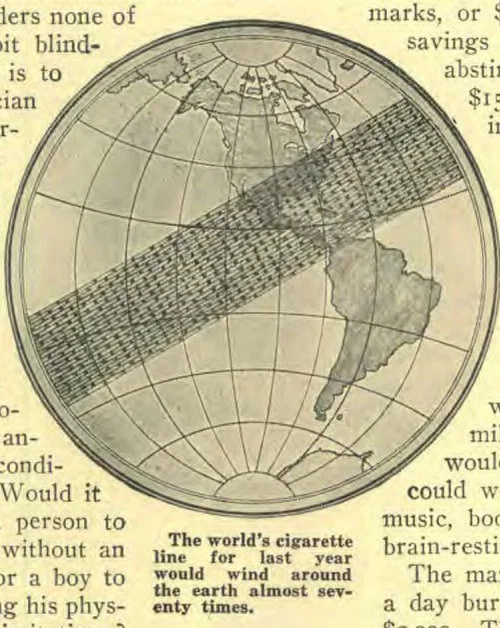
The world's cigarette line for last year would wind around the earth almost seventy times.
The boy who begins smoking considers none of these things. He takes up the habit blindfolded, as it were. When a person is to have a serious operation, the physician tests his heart, kidneys, and other organs to discover whether they are in a condition to be affected unfavorably by the anesthetic. Some persons undergoing a simple operation have died on the operating table because the physician failed to give a thorough examination. The ether or chloroform is no more poisonous at one time than at another; but it proves fatal to one patient, and produces no permanent ill effect upon another, simply because the physical conditions of the two are not the same. Would it not be unwise, even criminal, for a person to insist on taking a strong anesthetic without an examination? Is it not as unwise for a boy to take up smoking without understanding his physical condition and other personal limitations?
One of the most serious phases of the cigarette problem is that it continually tightens its grip upon one, and continually demands more and more of one. Having once made friends with it, it fastens itself like a leech upon one, and will not be shaken off without energetic effort. But the boy who really means to make a place for himself worth while in the world, must be free from any such serious handicap as the “little white slaver.”
Happy is the boy who has enough good sense to refuse absolutely to begin a habit that is denounced by states, churches, educators, judges, business men, and business firms. In fact, there is not a man or woman of true worth in all the land who would advise a boy to begin smoking. Then why do half a million boys take up the habit every year? It is only because of ignorance, or because the spirit of evil which is in the world desires the destruction of humanity, and boys do not resist the evil tendency. John B. Gough, one of the world’s greatest temperance orators, said: “A man who overcomes an evil habit is a hero.” This is true; but we are even more willing to grant the gold medal to the boy who refuses to acquire an evil habit. He is the real hero.