I prefer the strength of abstinence to the waste and weakness of indulgence.
“Smoking cigarettes,” says an imploring mother, “has made a wreck of my son, once bright and full of brains and ambition. Now he can’t think; he can’t hold a subject in his mind. He was a stenographer, but now he is nothing.”
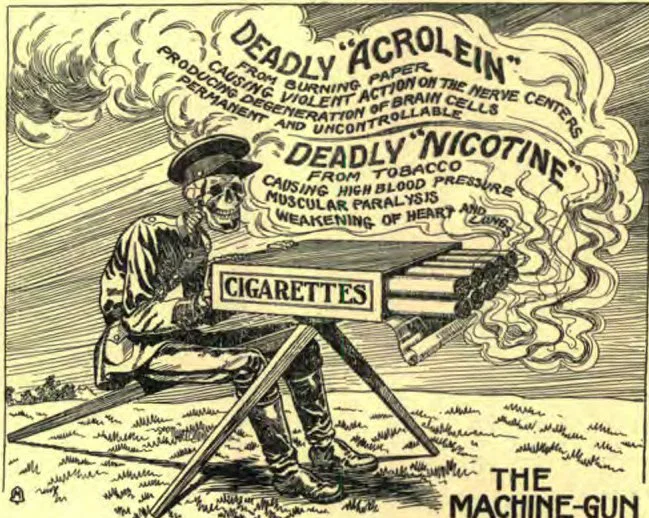
I have no right to use that which injures body, mind, and soul.
Judge Gemmill, of Chicago, says: “Cigarettes harden the heart for terrible deeds, and unfit the mind for any useful service.”
The fact that cities, states, and nations legislate against the use of tobacco by minors; business firms refuse to hire boys who smoke, or discriminate in favor of those who do not smoke; schools taboo smoking; educators denounce it; and large publishing houses refuse even to advertise cigarettes, is a hint sufficiently broad for me to refrain from using tobacco.
Japan and China, together with several of our States, have prohibited the sale of cigarettes to minors.
I do not like to be a public nuisance.
I have seen women made ill, and many others made decidedly uncomfortable, by the public smoker.
Smoking does not enhance my looks.
I have come to this conclusion by watching men and boys in all positions and conditions of life, when they were smoking. A man on a bicycle, with a pipe or a large cigar in his mouth, is not much more attractive than the Filipinos shown on the last page of the cover.
I would not be a patron of the tobacco trade if for no other reason than its close connection with the liquor traffic.
Ginger, an organ of the liquor business, says: “The prohibition movement is as dangerous to the tobacco business as it is to any other, outside the liquor business itself; for the two trades are definitely ‘interlocked,’ and have been for years.”
I am not selfish enough to run the risk of wrecking even one person’s life by my example and influence, just for the sake of a questionable indulgence on my part.
I should rather lead one away from than toward a questionable habit. W. H. Coppins says: “Twenty-three years of my life have been spent in business college work, and I say without hesitation that the cigarette has been the one thing which has caused more failures on the part of the boys using them than any other thing I can mention. Not one that I know today, who has continued in the habit, amounts to anything.”
My use of tobacco would line me up with the ordinary person, and with drug fiends and alcoholics.
I prefer to be among the extraordinary—such as are shown on pages eight to eleven of this issue.
I am not willing to use that which would place me at a disadvantage in seeking employment.
Mr. E. P. Tully, manager of the New York District Messenger Service, says: “In selecting candidates for our work we pass by the ones with nicotine-stained fingers, the dull eye, and the nervous manner. I don’t know any business man who wants in his employ a cigarette dope.”
Smoking is a needless waste of money, since it is of no moral, physical, mental, spiritual, financial, or social benefit.
A conservative estimate gives the value of the tobacco annually used in smoking and chewing in this country at $1,200,000,000. (See article on page twelve.)