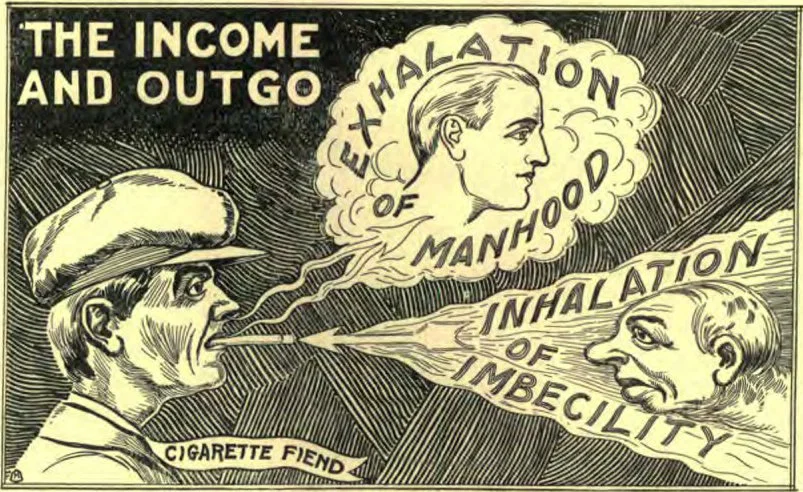
LOOK before you jump, boys. Before smoking the first cigarette, ascertain where it may land you. I know where it has landed some boys. I have seen the prospects of many a boy ruined by the cigarette. Promising boys by the hundred have made a failure of life because they took the first smoke.
The cigarette habit, when taken up by boys before the brain is fully developed, brings about a degeneracy of the brain cells, and may produce a moral insanity. It tends to develop criminal tendencies.
Ninety-eight per cent of the inmates of the Whittier Reform School in California are cigarette smokers. All cigarette smokers do not become criminals, but practically all youthful criminals are cigarette smokers. These facts are known to judges of all our juvenile courts. It is practically certain that the boy who lands in the police court smokes; and it is equally certain that many a boy would never have been there if he had not smoked.
If all boys could be made to know that with every breath of cigarette smoke they inhale imbecility and exhale manhood; that they are tapping their arteries as surely and letting their life's blood out as truly as though their veins and arteries were severed! and that the cigarette is a maker of invalids, criminals, and fools, not men,—it ought to deter them some.—Hudson Maxim.
I said to a Chicago detective during the time when the city was being terrorized by youthful automobile bandits, “Haven’t you found that in nearly every case these young criminals are cigarette fiends?” He looked at me a moment, and then replied, “In every case.” One of these cases, Teddy Webb, who was then arrested and is now serving a life sentence for murdering a policeman, was a fine, promising boy at the age of ten years. At that age he began to use cigarettes with the boys in the alleys. His downward career began at that point. At the age of eleven he robbed an old woman on the street, and began to figure in the police court. His downward career continued until he reached his present low estate.
The boy who has an ambition to excel in life, whose aim is to climb to the top, cannot afford to take chances. He will leave cigarettes alone. The cigarette has never yet placed a boy in the chair of the President of this nation. Lincoln was a poor boy, and had few advantages educationally, but he is said to have been “a man of no vices.” He did not use tobacco in any form. Had he at the age of ten or eleven or even fifteen become addicted to the use of cigarettes, he would not have reached the President’s chair. No cigarette smoker ever has succeeded, or ever will succeed, in reaching the topmost round in the ladder of progress.
Boys, do not be grasshoppers. Look where you expect to land before you jump. ’If you have high ideals and noble aspirations, have nothing to do with the cigarette.
Boys who smoke cigarettes but who are not fiends may sometimes be led to renounce smoking. I talked with two who gave evidence in their lives of the degenerating influence of the smoke. After pointing out the downward career of boys who smoked, I made an appeal to them, and knelt with them in prayer. When we arose, I placed their hands together and asked them to be a help and support to each other, and reminded them that while one could chase a thousand, two could put ten thousand to flight. One year later I was walking along the street of another city when two young men met me and said, “How do you do, Doctor.” I looked at them, and they said, “Do you not remember the two young men you prayed with at such a place?” I answered, “Yes, I remember.” “Well, we are the young men. We have not smoked since, and are both here attending school and fitting ourselves to go to a foreign field as missionaries.”
While some smokers may be reclaimed, and no case should be regarded as hopeless, yet because it is so difficult to persuade the smoker to see his danger, we should put forth every effort to prevent boys from reaching the border line, or taking even the first step toward it.