Most great movements have their origin in the faithfulness of one person or a few persons to right principles, to a definite course of action in relation to a condition or need, without counting the cost in labor or in disadvantages,—the outcome of antagonism on the part of those opposed,—or, if they have counted the cost, are willing to meet the demand without wavering.
Such movements have had small beginnings. Of such origin was the Non-Smokers’ Protective League of America, which I shall briefly recite for the encouragement of those who falter.
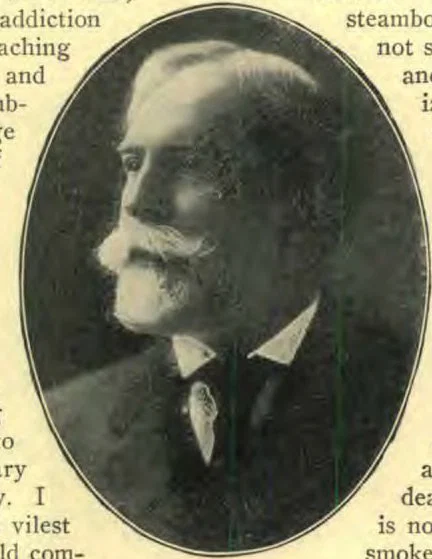
Charles G. Pease, M. D., President of the Non-Smokers' Protective League of America
In the year 1907 I began to write upon the subject of the wrong and of the injurious effects of tobacco addiction, giving much attention to the members of the clergy and of the medical profession addicted to the use of this drug, holding them to be more responsible for the enslavement of the race than any other class of men, by reason of the elevation of tobacco addiction by these men to the highest points of teaching and example—relating to spirituality and to health. My fearless writings, published in the public press, created a large number of enemies, with some of whom I measured swords in the columns of the press; but many strong men came to my support, notably Prof. Burt G. Wilder, of Cornell University, and William Lloyd Garrison, of Boston, Massachusetts, since deceased. In 1910 I began my work in the subway of New York City for the stamping out of the smoking nuisance there, making many arrests, and carrying the cases to conviction under a section of the Sanitary Code prohibiting smoking in the subway. I received many letters consisting of the vilest language the most degenerate mind could command, threatening to take my life if I did not desist. I paid no attention to the threats, except that they brought forcibly to mind the realization that a sweet, wholesome, and noble practice would have no such defenders. I also received a number of commendatory letters.
Up to April, 1910, I was doing this work alone, not supposing that any one would unite with me in any way to prosecute or support such a work. I was simply doing my duty regardless of consequences. In the third week of the month named, two gentlemen, Mr. F. B. King and Mr. Twyman O. Abbott, of the New York bar, both strangers to me and to each other, telephoned and also called upon me. Both asked the same question: “Doctor, do you not think the time is ripe for doing an organized work?” I answered both gentlemen in the affirmative, and sent out a call for a meeting which was held at my home on the evening of May 8, 1910, at which time we effected a temporary organization. And on Aug. 2, 1911, our organization was incorporated under the Membership Act of the laws of the State of New York.
The league, at present, is a men’s organization. All members abstain from the use of tobacco, although this is not a requirement for membership. The league’s membership is large, not only including the membership of the parent organization, but also of branch leagues.
The league has met an urgent need in the crystallization of the opinion of educators, lawyers, medical men, and women, and men of state, finance, and commerce, who are advocates of the rights of non-smokers and opposed to the violation of said rights by tobacco smokers.
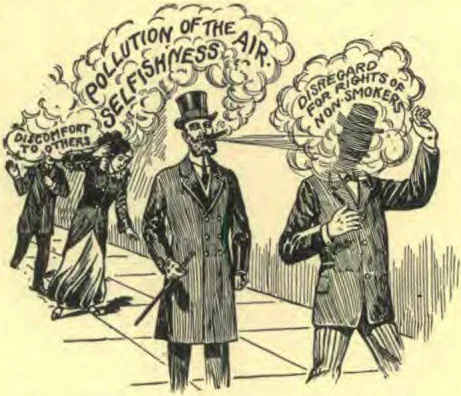
The right to breathe fresh and pure air—air uncontaminated by unhealthful and disagreeable odors and fumes—is a natural right, is one of the “inalienable rights” guaranteed by the Declaration of Independence and the Constitution and laws of the land. This right cannot be taken away by legislatures or courts, much less by individuals pursuing their own thoughtless or selfish indulgence.
Tobacco smoking and carrying lighted or partly consumed tobacco in places where nonsmokers are present or have a right to be, or where the fumes or odor of tobacco can reach those who do not indulge in the habit, is a flagrant invasion of the constitutional rights of others. We have succeeded in having smoking prohibited or restricted on various railway lines and in stations, on steamboats, and elsewhere, and although we have not succeeded in restricting smoking in hotels and restaurants, the influence of the organization is far-reaching, and is helping to shape public sentiment in this direction.
That tobacco smoke is irritating to normal mucous membrane of the eyes and air passages is well known. That tobacco smoke is a deadly poison is not so well understood; neither does the average person realize that because tobacco smoke is tolerated by the chronically poisoned, it is not, therefore, separated from the rest of this class of violent poisons which become equally tolerated by the chronically poisoned, such as opium, which, however, is not nearly so deadly as tobacco; and the smoke from opium is not so destructive of animal life as is the smoke from tobacco. Because of its poisonous character, the florist incurs the expense of burning tobacco in his greenhouses for the destruction of the animal life upon the plants. If it were merely smoke he required, he would burn the leaves of trees and ordinary plants and weeds that cost nothing.
In the case of Hadley vs. Harrison, 26 So. Rep., 294; 123 Ala., 292, a tobacco dry house was declared a nuisance because the evidence showed that it was detrimental to the health and comfort of the occupants of a near-by building, because the tobacco odors polluted the air and produced headache and other nervous disorders. Would a dry house containing the leaves of trees or filled with hay, so poison the atmosphere that people in a near-by building would be made ill?
The people need to be aroused from the lethargy, the indifference, that has permitted this great injury to the human family—this poison industry—to gain such an enslaving financial and political control of our public and official and legislative bodies. We see the political power of the manufacturers and venders of this poison exerted everywhere. As individuals we should continually demand of our official bodies the protection of the highest interests of the people, and the honoring of the principles upon which this government is founded.
There is strength in union; therefore we have organizations. But the individual members should act as committees of one, taking a fearless and positive stand; demanding the right and denouncing the wrong. The consciousness that others are united with us in a common5cause should be a stimulus to greater fearlessness and determined effort; but if the individual is lacking in positive conviction and has not the quality of fearlessness, then that one adds little to the strength of an organization.
We need to look away from self-interest, and to seek the highest interests of the race, the community, the organization that has for its purpose the good of the people, and thereby advance our own interests in the proper way.
The Non-Smokers’ Protective League of America has been organized to protect the air we have to breathe, from the poison, the malodor, and the irritating quality of tobacco smoke, and we ask the coöperation of all persons who have the highest interests of all mankind at heart.
If it is a crime to pollute the atmosphere with the poison of tobacco smoke, then it is a crime to keep silent and thus give protection to this needless and grossly sensuous practice, that is obtruded upon those of us who desire to be and to remain unpoisoned, not only for our own sake, but also for the sake of posterity. The legal rights of the non-smokers must be defended and maintained; therefore the Non-Smokers’ Protective League of America has been brought into being.