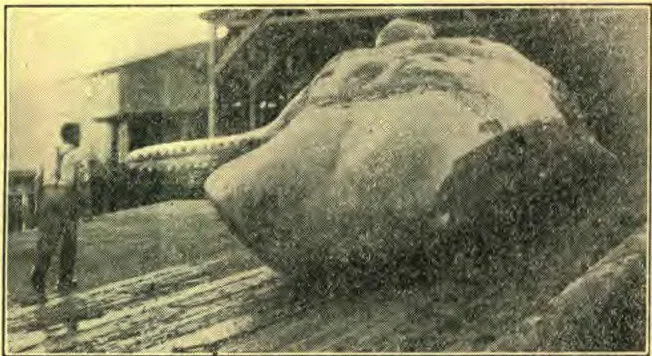
THE whale fishing of today is far different from that of the past. The boats used a century ago were little sailing ships of three hundred or four hundred tons, which carried a number of dories, or small boats. When a whale was sighted, the men went out in their whaleboats and threw the harpoons by hand. Each harpoon had a long line attached to it, and at the end of this was a float. After the whale died, it was dragged to the vessel, where the oil and bone were saved, the carcass being thrown away.
Today the whaling vessels are small steamers, and the harpooning is now done from the steamer, and that by means of a gun invented by a Norwegian sailor named Svend Foyn. He used his gun first about the year 1866, and fifteen years later he is said to have made as much as $2,000,000 out of his invention.
The gun is a short tube cannon on swivel bearings, with a muzzle as big around as the largest teacup. It is discharged with a Krupp firing screw. The explosive used is black gunpowder with a bunch of waste as a wad. On the top of this is the harpoon, which is attached to a long line connected with a steam winch on the deck. The harpoon ends in a sharp point, which consists of a hollow iron cap filled with blasting powder. To this cap a time fuse is attached, and the bomb explodes inside the whale. The harpoon has expanding arms which spring out after it enters the whale and holds it while it is fighting for its life. The cable consists of about two thousand feet of Manila rope as thick as a man's arm.
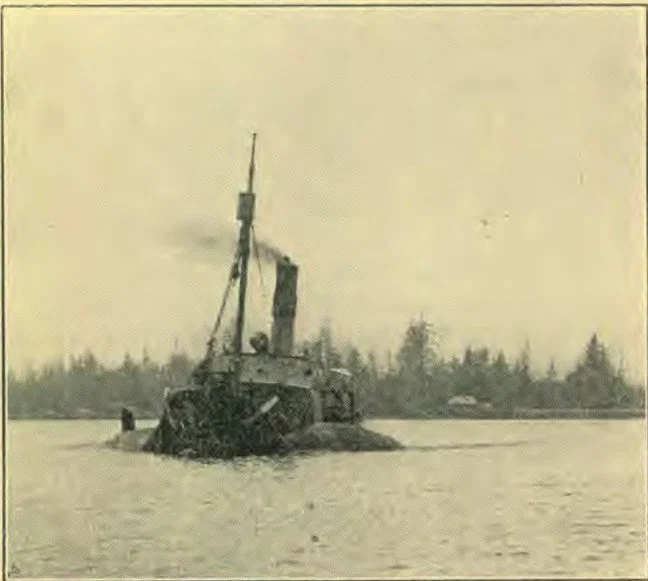
When the animal is dead, this rope is reeled up by the steam engine on board, thus dragging the whale to the ship. The great mammal is now filled with air from the air compressor on board. This makes the carcass so light that it will float. It can then be towed to the nearest harbor and anchored, or it may be towed direct to the station. Some of the whales weigh as much as ninety tons, but they are easily carried along through the water in this way.
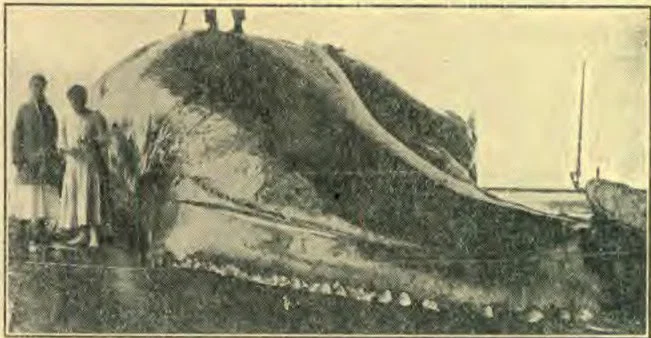
After the whale arrives at the plant, it is hauled up an inclined plane onto the wharf by means of a donkey engine. The men then get on the whale, and cut the fat into long strips. They use axes and knives. A hook is attached to the end of one of these strips, and the engine pulls it off the body by means of a wire cable. At the same time two men walk along and chop the blubber loose with heavy ax blades. The blubber is cut up by revolving knives and put into steam cookers to get out the oil. It is cooked again and again in order that none may be lost. The next process is cutting up the carcass. In this the workmen use long knives and chop the meat into thirty- or forty-pound chunks. They then throw it into boilers where it is cooked eight or ten hours. The oil rises to the top and is drawn off, while the meat left goes into the drying tanks for conversion into fertilizer.
The bones also are cooked. They are rich in oil and valuable as a fertilizer. They are crushed, and then dried and sacked for the market. There are different varieties of whales—sperm, sulphur-bottom, finbacks, and humpbacks. These varieties are among the most common to the whale fisheries of today.
The right whale is the most valuable. A single one may yield bone to the value of $10,000, and at the same time produce fifteen or more tons of excellent oil. The right whale is one of the greatest giants of the seas. It is from forty to fifty feet long, and sometimes weighs ninety tons. It is not the largest of the whales. The sperm whale often reaches sixty feet, while the rorqual sometimes runs up to eighty feet. The blue rorqual is the largest of known animals. A single sperm whale will produce from fifty to sixty barrels of oil, most of which comes from a hole in the head. The first step in butchering sperm whales is to sever the head and take out the oil.
It is from the sperm whale that ambergris comes. The word means gray amber, and the substance is a gray, waxlike, solid mass, that is found in the abdomen of the sperm whale, in lumps weighing from a half ounce to one hundred pounds. It is sometimes found floating on the sea, or lying on the sand near the sea-coast. Ambergris is very valuable. It is worth in the neighborhood of $300 a pound, and two pieces recently taken from a sperm whale sold for $10,500. They weighed about thirty-eight pounds. The stuffp. 9 is used largely in perfumery and also in medicines. It is formed by the bile of the sperm whale, and when first taken out it has a disgusting smell.
J. W. BOYNTON.