ABOUT fifteen miles west of our home is the spot where gold was discovered in 1848 by a Mr. Marshall. This discovery was the cause of the rush to California in the “days of ’49.” Even yet, following some distance by the Lincoln Highway on the way to our nearest city, Placerville, may be seen the remains of the old immigrant trail.
Fifty miles to the northeast is the beautiful Lake Tahoe, on the main line of the Highway. Thousands of tourists pass over this trail every summer on their way to this resort. About five miles north is the cable stretched across the American River Cañon at such appalling length and height as to be compared with the new aerial line at Niagara Falls. The cable is operated by a large lumber company and is principally used for carrying lumber across the cañon. When a train of lumber arrives from the lumber camp at Pino Grande, a car is unhooked, run into the cage, fastened securely, and carried across, and then the cage returns and another car is fastened in and transported.
When a passenger ventures, he is not fastened in, but hangs on to a thin iron rail on the side of the cage, and standing up he can look over the side and out at the ends, and through the bottom if he is brave enough, for there is a great open space in the center of the cage floor. When everything is in readiness the signal is given to the engineer. The passenger’s heart almost makes its way to his mouth, as the great timbers creak and groan, and he begins to move out of the little building that houses that great cage. Then down he goes at a terrific pace, but still he is not very far down, for he is hanging by three large twisted iron cables between eleven and twelve hundred feet above the river. That river surely looks beautiful tumbling along its turbulent and treacherous course and round the bends as if it were longing to be free, but finding no way out.
If the passenger has thought to wrap a large rock in white paper, he may drop it now, but it will very seldom reach the water. Now, brace yourself and “pull for the shore,” for the cable seems to be pulling you up so steep a grade that it is like standing on the steep roof of a house, and then, crack, groan, a good bump, and he is safely landed, to find his heart still beating, although he may have thought ten minutes ago that it never would beat again.
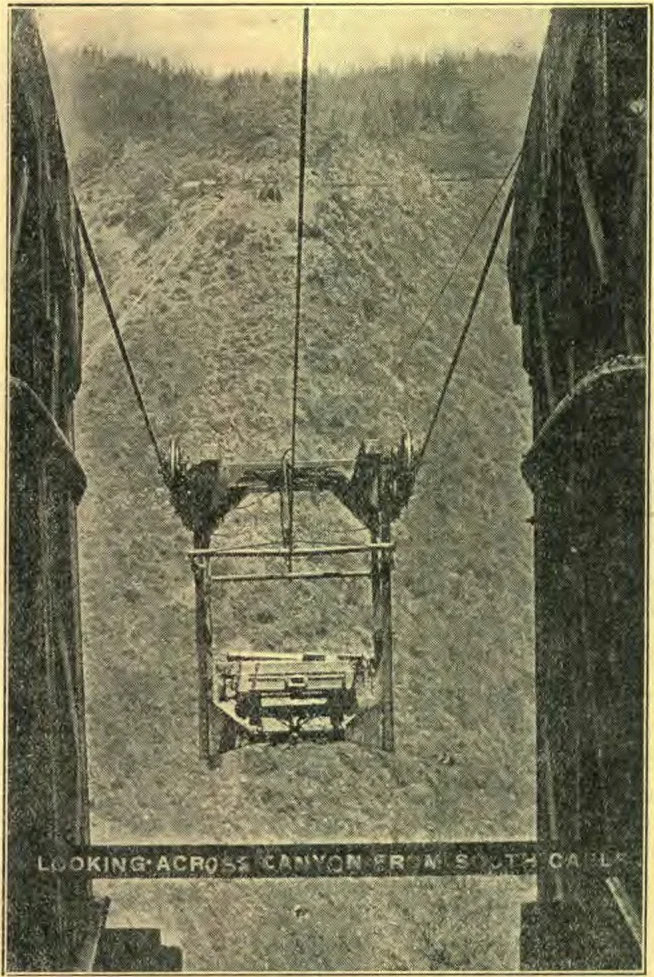
After he has taken a few snapshots, and a good look at the home side of the cañon, with perhaps a short walk and examination of the old chutes, he may go through his former experience, if he did not get used to it the first time. When he comes to his starting place, the lumber train is ready to leave for home, so he may clamber up the cars and sit on the lumber and have a jolting ride home. He can enjoy a hearty meal of mountain strawberries and mountain potatoes with a dessert of some of the finest pears ever grown. if he has enough vigor left to walk to the opposite hillside and pick them.
ELMINA HICKS-HARTWICK.