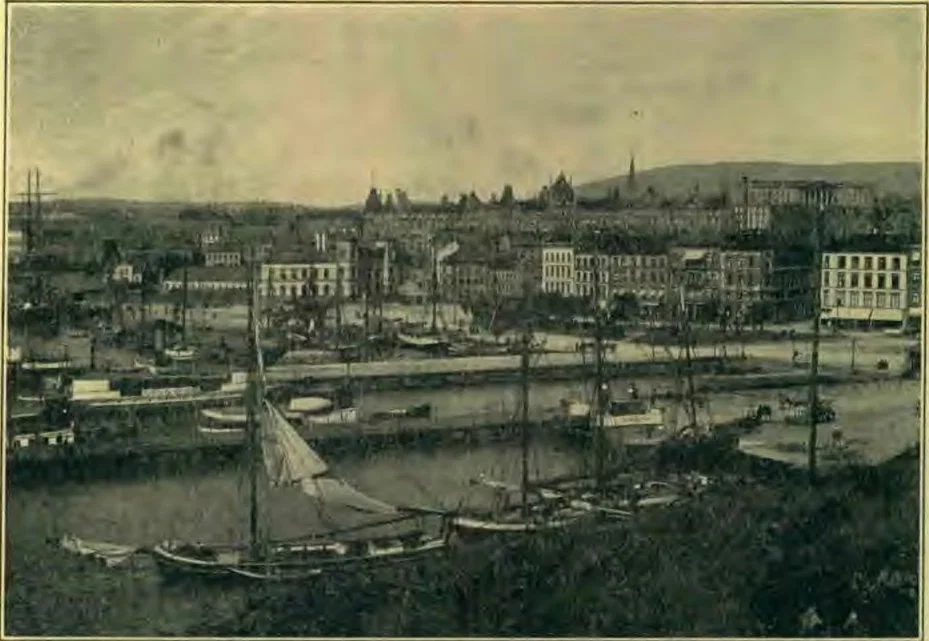
NORWAY in summer! No pen can describe the beauty and majesty of nature. The mountain peaks covered with eternal snow; the glaciers, formed at the time of the deluge, working their way down the mountain side toward the ocean; the beautiful fertile valleys spotted with red and white painted farmhouses; the green and flower-covered hillsides where the herd girls watch their sheep, goats, and cattle; the extensive forests where wild animals roam and the mirrorlike mountain lakes thousands of feet above sea level; the long and narrow fiords and the hundreds of islands scattered along the coast line, making a fence against the wild waves of the Atlantic,—all these add to the loveliness of the scene.
Mr. M. W. Stroup, an American traveler, says: “Persons who have gone to Switzerland once, go to Norway a score of times. Tourists who have circled the globe exclaim that other places are grand, but none excel this paradise of nature,—Europe’s Eden, where kings visit and royalty reigns.”
The Geography
Norway is not a large country. The area is estimated to be about 124,495 square miles. Most of the European countries are small in size. Norway, Italy, and England are about the same size. If we look at the map, we find that Norway is a part of the Scandinavian peninsula. Its eastern frontier is contiguous to that of Sweden and Russia. On the north, northwest, south, and southeast the boundary is the sea—the Arctic Ocean, the Norwegian Sea, the North Sea, and the Skagerak, respectively. Measured in a straight line from north to south, Norway is nearly 1,700 miles long. The extreme breadth is 270 miles, but in the north it is much less—about sixty miles on the average.
The Topography
The coast consists for the most part of bold, precipitous cliffs. It is remarkable for the vast number of islands by which it is lined, and the bays and fiords which, narrow, deep, and winding, cut into it in all directions, providing a series of excellent natural harbors of refuge.
Norway is a mountainous country. Particularly in the west and north the mountain masses assume the form of great plateaus or tablelands, and are called fjelds. In general, the valleys are short and abrupt; and the streams dash down impetuously through the rocky gorges, forming numerous cascades.
The Fauna
The great forests are still the haunts of the bear, lynx, and wolf. The elk is found in the eastern forests. The red deer is found in the west coast districts. On the high mountains roam the reindeer, glutton, lemming, and fox. Hares are very common in all parts of Norway, and the beaver is found in the Christiansand district.4The common seal is also frequently seen in the surrounding waters, and the walrus visits the northern coast. A large number of fisheries have been established along the coast where there is cod, herring, mackerel, and coalfish. Various species of whale visit the coast, and salmon, perch, pike, and eel are common in fresh-water streams. Game birds are fairly abundant in most districts. Willow grouse, woodcock, snipe, and geese are common. Sea birds are exceedingly numerous.
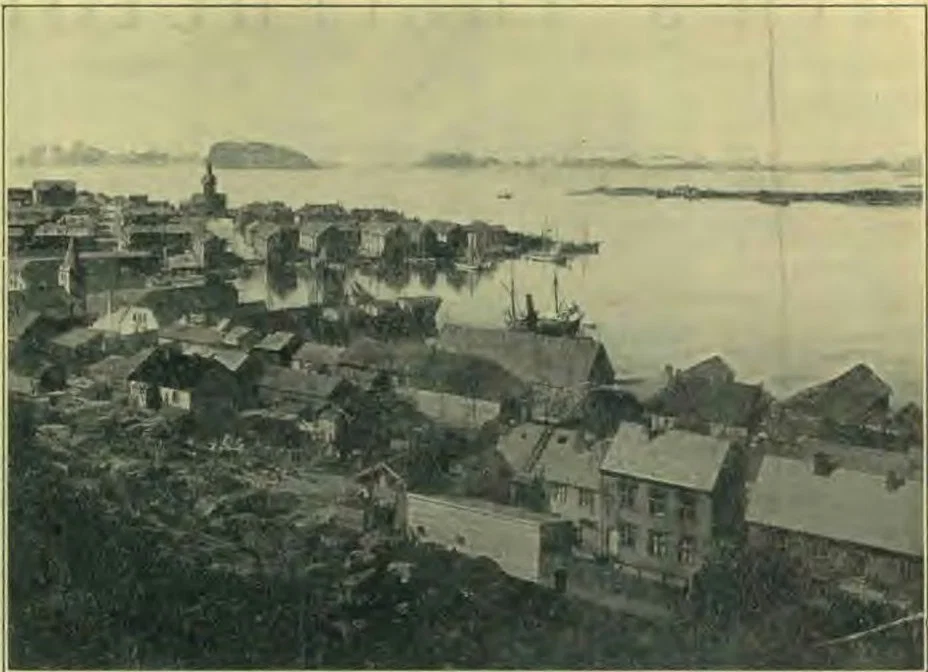
HAMMERFEST, NORWAY
Industries
The fisheries contribute mainly to the support of the inhabitants along the seaboard, as more than 100,000 people are employed in this work.
The farms are generally the property of those who cultivate them. Among the crops cultivated for food are barley, rye, wheat, and potatoes. Some hemp, flax, and tobacco are produced in the southern part. Fruit, too,—particularly the apple, pear, and cherry,—is raised in southern and central Norway. Cattle, horses, sheep, and goats are kept in large numbers.
Norway has a great mining industry. Among the minerals are silver, copper, pyrite, iron, and marble.
Lumbering is another great industry of this north country.
Before the war the mercantile navy of Norway was fifth in size as compared with other merchant marines, and her ships and sailors were found in every country.
Among the manufacturing industries we find the saw and planing mills and machine shops. There are large iron, carriage, and car works. The textile industries, such as spinning and weaving mills, jersey factories, and roperies employ thousands of workmen. Canneries and flour mills are scattered throughout the country. The potteries, china factories, and nail-rolling and wire mills have a large output. During the last few years there has been a great growth in manufacturing lines in Norway. Perhaps the greatest industry at the present time is the saltpeter factories.
Education
Free compulsory education obtains in Norway. Parents who neglect to send their children to school, either public or private, are fined. The subjects taught at the primary schools are reading, writing, religion, geography, natural science, history, arithmetic, singing grammar, drawing, and gymnastics. In the cities the young people flock to the high schools, and many speak English and German as well as their own language. The university, located at Christiana, is fully modern in every respect.
Renowned Men
Norway has produced many renowned men. In literature we have the names of Björnson and Ibsen. In music we have Edvard Grieg and Ole Bull. Every one has heard about Fridtjof Nansen and Roald Amundsen, who discovered the South Pole.
Religion
Norway remained a heathen country until about 1000 A. D. Then the people were forced to accept the Catholic religion, and Norway was a Catholic country for five hundred years. During the Reformation the country became Lutheran, and this is still the religion of the state church. It is a curious fact that the Scandinavian countries have been among the last to grant religious liberty, and full rights are not yet extended freely to all denominations. Public offices are open only to Lutherans. There are probably few countries in Europe where the ministers have so great an influence in the administration of affairs as in Norway. The Norwegians are a church-going people, but their adherence to churchgoing is mostly a ceremony. Most of the priests attend theaters and dances, and smoke and drink.
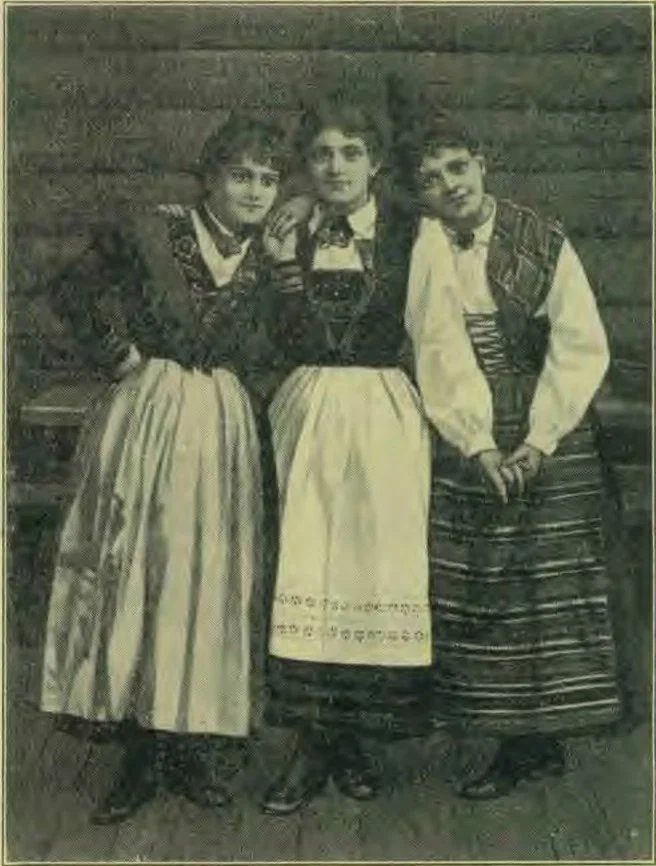
A TRIO OF NORWEGIAN GIRLS
Elder J. G. Matteson was the first Seventh-day Adventist missionary to Norway. At first he met5much opposition, but finally a good work was started in Christiana, and a church organized. We now have three local conferences in Norway, with a total membership of about one thousand. There are also four or five treatment-rooms and one printing house.