SIR HENRY RAWLINSON, who found in the Behistun group of inscriptions the key to the ancient Babylonian and Assyrian languages, was not content to use his important discovery in translating the findings of others, but he himself took part in excavation work.
Critics of the Bible had long taken occasion to discredit the Bible record concerning Belshazzar, since there was no such name to be found in all “Chaldean or other ancient history,—nor indeed in all literature,—although there existed an apparently complete list of the Babylonian kings, leaving no gap for the insertion of any other. And, to make matters worse, this list gave the name of the king—Nabonidus—who was actually reigning at the very time when the Bible account claimed that Belshazzar was king.
“But here again time and the spade did their work well. In 1854 Sir Henry Rawlinson discovered in ‘Ur of the Chaldees’ some terra-cotta cylinders containing an inscription by the above-named Nabonidus, in which he makes mention of ‘Belshazzar, my eldest son.’ This proved two things: (1) That there was a man named Belshazzar, and (2) that, being the son of Nabonidus, he lived in Babylon at the very time Daniel said he did. But there still remained this difficulty—how could he be king of the Chaldeans, while every ancient record showed that his father, Nabonidus, was the last reigning monarch?”
“A little more time and a little more spade, and the seeming contradiction was all cleared up, confirming to the letter this lonely Scripture record.”
Cyrus's Own Account of the Taking of Babylon
“In 1876 Sir Henry Rawlinson made one of the most remarkable discoveries ever known up to that time. His workmen were excavating on an ancient part of Babylon when they came upon some jars filled with more than two thousand cuneiform tablets; i. e., tablets bearing inscriptions in the wedge-shaped characters of ancient Babylonia and Persia. One of these was found to contain an official account, by no less a personage than Cyrus, king of Persia, of the invasion of Babylon, in which, after stating that Nabonidus first fled and then was taken prisoner, he adds that on a certain ‘night . . . the king died.’ Now, seeing that Nabonidus, who was taken prisoner, lived for a considerable time after the fall of Babylon, this ‘king’ could have been none other than Belshazzar, of whom the old discredited Bible recorded long ago that ‘in that night was Belshazzar the king of the Chaldeans slain.’ Dan. 5:30.
“It is now evident that Belshazzar was acting as regent during his father’s absence—indeed, he is actually referred to as king in another ancient inscription of a legal document, which is dated in the third year of King Belshazzar, only the name is spelled in a slightly different way.
“Moreover, the fact which has thus come to light, that Nabonidus and Belshazzar his son were both reigning at the same time, explains, as nothing else could, Belshazzar’s offer to make Daniel the third ruler in the kingdom (Verse 16), Nabonidus being the first, and Belshazzar, the regent, the second; otherwise Daniel would doubtless have been made second ruler, as Pharaoh made Joseph.
“This is another case in which two apparently contradictory accounts were both equally correct. The Chaldean historian was correct in saying that Nabonidus was king, while the old Bible was equally accurate in saying that Belshazzar was king.”
It is interesting to note in this connection that the Lord, in speaking of Nebuchadnezzar in Jeremiah 27:7, says: “All nations shall serve him, and his son, and his son’s son, until the very time of his land come: and then many nations and great kings shall serve themselves of him.”
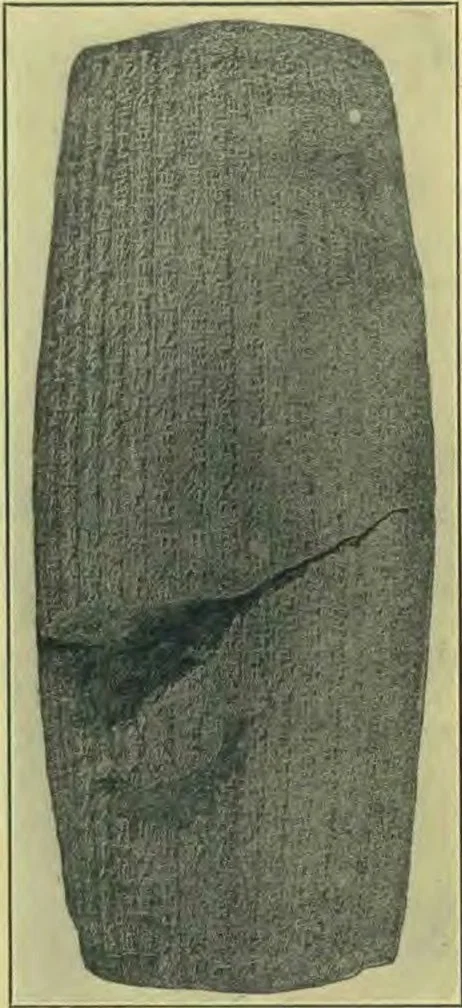
A clay cylinder written by Cyrus giving an account of the taking of Babylon, and one by Nabonidus, the reigning and vanquished king, have been found. These two agree with the Bible record in the statement that Cyrus took the city easily.
Palestine Excavations
Explorers in Palestine have found at Samaria what is believed to be the remains of the royal palace of Omri (1 Kings 16:24), father of Ahab, king of Israel. Above this were the ruins of a larger palace, the walls of which were faced with white marble. This is believed to have been Ahab’s ivory palace. The ancient cities of Lachish, Bethshemesh, Megiddo, Taanach, and Jericho have been excavated. At Megiddo the excavators brought to light seven different strata, each revealing a different period of the city’s history. Dr. George Barton says:
“In the lowest stratum of the mound Dr. Shumacher found traces of a settlement the houses of which were constructed of mud bricks. Over the ruins of these a second series of houses had been built of stone. In the same stratum some tombs were found containing skeletons, some pottery of early forms, a bronze knife, and some scarabs set in gold. The walls of the city were in part built of brick. The settlement represented by this stratum antedated 2000 B. C.
“In the next stratum a large structure, probably a palace, was found, which had been occupied through the periods represented by the stratum in which its foundations were laid and the stratum next above it. The building was of stone and was large. In one part of it was a ‘pillar’ apparently used for worship. Various types of pottery, knives of flint and bronze, many stone household utensils, an Astarte figure, and some scarabs of the period of the twelfth Egyptian dynasty were found. This stratum, then, belonged to the period 2000-1800 B. C.
“Next above this stratum was one in which types of painted pottery similar to that of the Philistines came to light. In the fifth stratum from the bottom a palace of the Hebrew9period was discovered. In this palace a seal was found bearing a lion and the inscription ‘belonging to Shema, the servant of Jeroboam.’ It is impossible to tell whether the Jeroboam who was Shema’s master was Jeroboam I or Jeroboam II. In this same stratum a temple was found containing three ‘pillars.’ “In another part of the mound in a sixth stratum, which seemed to be late Hebrew, three ‘pillars’ were found in an open space near the south gate, a stone religious emblem, and a decorated incense burner. Elsewhere this sixth stratum yielded a blacksmith’s shop. In a seventh stratum, just under the soil, remains of the Greek period were found, among which was an Athenian coin. This was the last occupation of the tell, and was pre-Christian. At the beginning of the Roman period the town was moved from the high land of the mound down nearer the water supply. On the slope of the hill a native-rock altar was found which had been used in prehistoric times.”
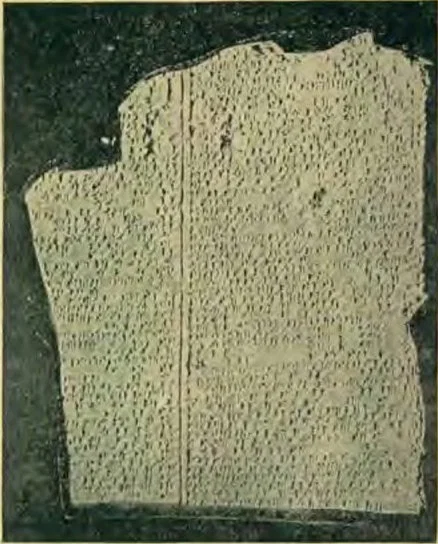
A Deluge Tablet, found in library of Assurbanipal, King of Syria
At what is supposed to be the site of Capernaum the explorers found the remains of a once beautiful synagogue which was probably built in the fourth century after Christ. Beneath it is the floor of an older building, which some have thought to be the synagogue built by the centurion whose servant Jesus healed, and which Jesus so often visited.
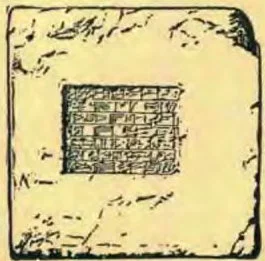
Brick Stamped with Nebuchadnezzar's Name
Revelations Made by the Nineveh Tablets
Dr. Edgar J. Banks in his little book, “The Bible and the Spade,” makes some interesting observations on the points given to us by these ancient tablets. He says:
“That the Babylonians possessed the story of the garden of Eden, similar to the Biblical story, is certain; a few fragments from the Nineveh library, so small and mutilated that they are almost illegible, are supposed to be a part of a tablet recording it. However, during the excavations at Nineveh, there appeared an impression of an ancient seal distinctly referring to the story. In the center of the little picture is a date tree; to the right of the tree is a man; to the left a woman, and behind the woman is a serpent standing erect on its tail. It is possible that in some Babylonian ruin a tablet containing the complete story may be found.”
“In the year 1872, after the tablets from the Nineveh library had been taken to the British Museum, George Smith, who in his day was the greatest of Assyrian scholars, took up the fragment of a broken tablet and read these words:
“‘I released a dove; it flew about, but finding no resting place, returned.’
“They were familiar words, and so significant that their appearance on the little fragment of clay overcame Mr. Smith; he recognized all that the words meant, and fell senseless to the floor. He had discovered a Babylonian story of the flood!
“The discovery was heralded throughout the world, and at once a London paper, the Daily Telegraph, provided funds to send Mr. Smith to Nineveh in search of the missing fragments of the tablet. In the chamber of the palace of Assurbanipal, where the library was stored, Mr. Smith found the fragment he most desired. Since then other excavators have discovered other copies of the same story, and at last the narrative has become fairly complete.”
The Babylonian account is not intended as a historical account of the flood; but it is evident that the Assyrian poet knew the story of the flood; and in his great epic merely appropriated incidents of the flood for his imaginative story. But even this is an interesting comment on the verity of the event.
Dr. Banks says further:
“Among the tablets from the royal library at Nineveh, was a Babylonian calendar of clay, covering a month of twenty-eight days; it was a copy of a more ancient tablet, or perhaps one of a series of tablets covering the entire year. According to the calendar, on each day of the month some religious duty was required of the king or of the people. The seventh day was a day of prohibitions, bringing to mind the Puritanic Sabbath of early New England. A translation of the calendar for the seventh day is as follows:
“‘The seventh day is a sacred day; the king of the nations may not eat meat roasted by the fire, or food prepared by the fire. The clothes of his body he may not change, nor may he wear fine clothing or ride in his chariot. He may not hold court, nor may he call in a physician. At night the king should offer his sacrifices that his prayer may be acceptable.’
“Such were the Sabbath laws of Babylonia even before the time of Abraham. The calendar, it is true, was for the king’s use, yet the same or similar laws must have applied to the people.
“One peculiarity of the calendar is that it calls the seventh day limmu, a word which in itself does not mean sacred, but evil. If we should translate the first line of the calendar literally, we should read, ‘The seventh day is an evil day,’ a day when it is evil to feast, or drive, or transact business.”
The Ancient City of Gezer
Gezer was an ancient city of Palestine thirty or forty miles northwest of Jerusalem. It was a city of great military importance, and “was a wedding gift to King Solomon from the Pharaoh of Egypt.” The explorations of the archeologist here are the most extensive and thorough of any in Palestine. Merneptah, the Pharaoh of the Exodus, says of Gezer in the same tablet in which he speaks of Israel, “Gezer is taken.” Two of the Tel-el-Amarna letters were written from Gezer; and in harmony with the line in Merneptah’s tablet, there has been found at Gezer an ivory breast ornament with the figure of Merneptah upon it, which may be indicative of his invasion.
Why the High Places Were Destroyed
It was at Gezer that a row of tall stones from five to ten feet high were unearthed. These, it is thought, formed the remains of an ancient Canaanitish high place. “It seems that among the standing stones human sacrifices were offered, for in a cistern near by were the skeletons of fifteen men and of one little girl who had been sawn in two, or sacrificed to appease the wrath of the local god.
“Near the standing stones and beneath the floor of the temple were jars containing the skeletons of newly born infants, and built into the walls of many of the houses were the bodies of other infants. It seems to10have been a Canaanitish custom when a house was built, to sacrifice a child and bury its body in the walls to bring good luck to the rest of the family. As gruesome as the custom was, it still survives under various forms throughout the East, for animals are still sacrificed on similar occasions.
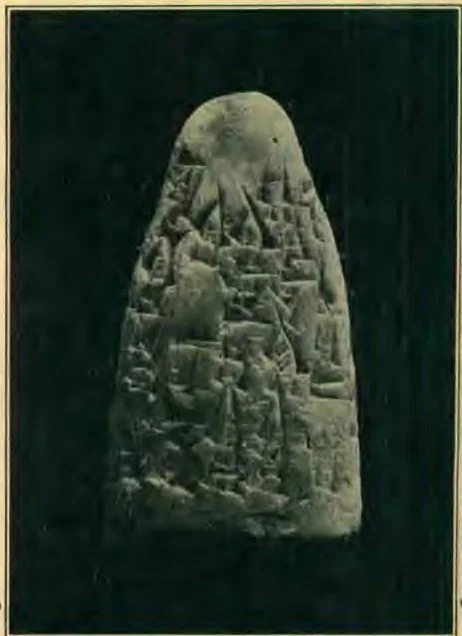
This tablet is from Warka, the Biblical Erech of Genesis 19:10. Date, about 2500 B. C.
“Thus we are beginning to learn the religious practices in which human sacrifice formed a prominent part, and to understand why the Hebrew prophets of every age so severely demanded that the high places be utterly destroyed.”
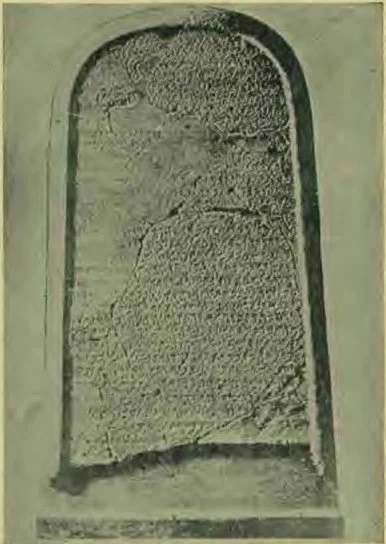
The Moabite stone — inscribed by Mesha, of Moab (2 Kings 3:4, 5). It makes reference to Omri and Ahab, of Israel.
Part of Solomon’s Temple, old wells, and many other interesting things have been found through Palestine explorers.
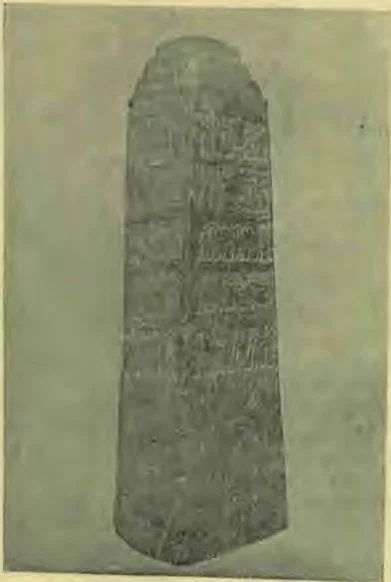
The Black Obelisk containing the name of Jehu, King of Israel
Almost every year suffices to add some interesting or remarkable bit of knowledge to the great library that has already been unearthed by the excavators and translated by the archeological linguists. May the humble spade continue its research work, until the mouth of every Bible critic is stopped. P. D. C.