The pantograph is a framework that carries a pencil and a tracing point so arranged that when the tracer is passed along any line of a map or picture the pencil draws an exactly similar line, but to any scale desired. It requires no skill to use it, yet with it one can copy not only maps and plans, but line drawings from newspapers, magazines, or books.
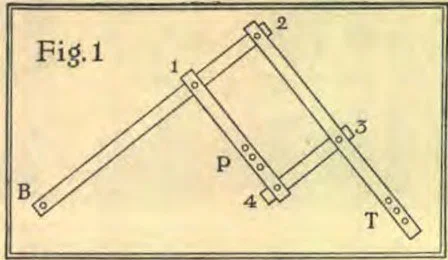
To make a pantograph, get four thin strips of hard wood about three quarters of an inch wide, and put them together as they appear in Fig. 1. The length of the two longer pieces is not important, but for convenience let it be about eighteen inches. The piece 1-4 should be twelve inches long; and the piece 3-4, eight inches long. Bore a small hole near each end of all four pieces. Lay the eight-inch piece on one of the eighteen-inch pieces so the holes at one end of both are directly in line with each other; mark through the center of the hole at the opposite end of the eight-inch piece; that will give the position of hole 1. Then place the twelve-inch piece on the other long arm, and find the place for hole 3 in a similar manner. Bore the holes shown at P and T for pencil and tracer points respectively, and put the apparatus together by slipping wooden pegs or copper rivets through the holes 1, 2, 3, and 4. If the four pieces, when combined as in Fig. 1, will form a perfect rectangle, you may be sure that your work is correct.
Bore a three-eighths-inch hole in one long arm, at B, and a hole of the same size near the edge of the drawing board or table. Get a three-eighths-inch stove bolt, about an inch and a half long, with nut and washer, and slip the bolt through the table and the leg of the pantograph. Do not screw the nut down tight, for the leg must move freely on point B. The pantograph fixed to the table will now appear as in Fig. 2. The arms should move easily, but not loosely, about the joints 1, 2, 3, and 4, as well as at B.
To use the pantograph, put a sharpened wooden peg through one of the holes at T, and a pointed pencil through the corresponding hole at P. Put the drawing to be copied on the table under the pantograph, so that the point of the peg T rests near the center; put a piece of paper under the pencil point, and fasten both paper and picture securely. When you move the tracer, T, along the lines of the picture, the pencil will make corresponding lines on the paper.
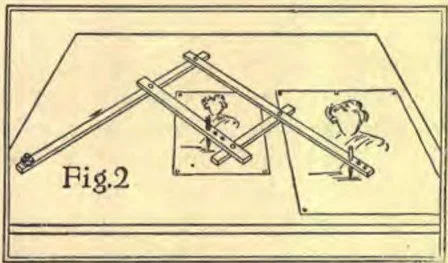
Arranged as in Fig. 2, the pantograph will make a drawing smaller than the original. If you wish to make an enlarged copy, put the pencil at T and the tracing point at P, and change the position of paper and drawing to correspond.—The Youth’s Companion.