It was beautiful weather. The sun shone clear and bright, just a fleck of cloud here and there in the sky, and the habitual haze which fails to more than slightly obscure the sky at the horizon’s rim, because of the intense brilliance of the sunlight. We had journeyed up from the plains and had alighted at the terminal station, Kotdwara, at the end of the short branch of the railway running from Najibabad to this place. By ekka we made the next ten miles, through a beautiful mountain valley with overhanging rocks, while beneath was a pretty little river, to Dogada, where we needs must change to horses for the sixteen miles yet ahead of us. Having lunched under a tree from our tiffin baskets, and seen our luggage safely loaded on the pack ponies, we mounted our steeds and started up the bridle path toward Garhwal.
At one side of us for about six miles ran a pretty mountain stream. Where the river passes through a cut in the hills, having hewn its way in past centuries through about forty feet of solid rock, we essayed a bath in some beautiful pools hidden from the road.
At Dwarikhal, where is the post office which serves our school and the surrounding villages, and where the road caps the ridge for the first time in its winding toward Pauri, the seat of the Garhwal deputy commissioner, we paused a moment and listened, for from the ridge above us was heard the roll of drums.
It is a weird sound when first heard, these drumbeats of India. We all know how, when the drum and fife roll out their message in the West, it stirs the blood and brings the martial spirit into being. Even without the other instruments the drum sends its soul-stirring call upon the still air, and it some way strikes a chord in the martial nature of the race. Here in India, as in all central and southern Asia, the drum has ever been the means of calling the people together. Yet here it seems more than elsewhere to have its message. Oft in the stillness of the shadowy night, as one sits in somep. 10 quiet corner on the plain, or on the mountain top, listening to the night sounds, there will come rolling in from some neighboring village the stirring note of the drum, or the low moaning of its hushed voice from a distant hamlet across the valley. It is said that all the great raids of the past years were signaled by such drum calls. And if ever the central Asiatic band should send forth its hordes upon the West as in the days of Ghengis Khan, the call would come through the message of the drums, each stroke of which is known and heeded by the wild tribes of central Asia and the Indian frontiers. How quickly the call could be sounded can only be realized by one who knows how soon such calls are heard and heeded throughout the length and breadth of the East.
But in these hastening hours of the day, when the sun had already disappeared behind the intervening peaks, the roll of the drums were sending us a message of welcome, for on the ridge above us the masters and boys of the school were waiting the coming of our party; and during the intervening mile of difficult mountain road we strained our eyes to catch the first glimpse of the waiting school.
As we came up to them, we were requested to dismount, and in accord with the custom of these quaint and ancient people, we were garlanded with flowers. Remounted, we started along the ridge to the school, three miles distant, the drums leading, followed by our party and the two head teachers on horseback, and behind us, double file, marched the boys of the school, cheery, disciplined, and making light of their long tramp and longer wait. They are hardy chaps, inured to the heights of the Himalayas and the tedious climbs up the precipitous mountain sides.
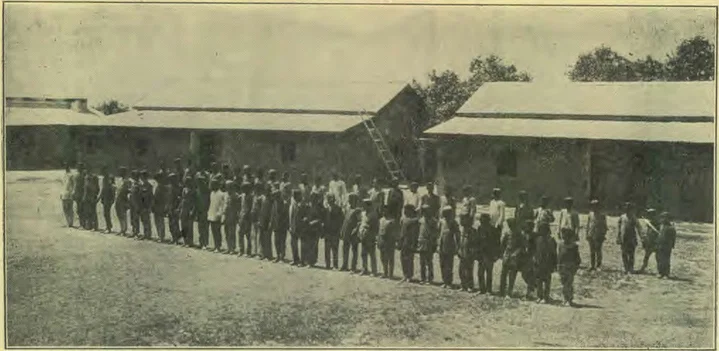
Arriving at the school at sunset, we were treated to a series of physical drills by the school, under the leadership of the head master, all of which showed the excellent training the boys had received. The accompanying picture shows the school just after these drills were completed.
The school yard itself was neatly and tastily decorated, with “Welcome” over the front entrance, and the avenue to the bungalow in which the principal lives arched with bent bamboo. But to us the most precious memory lies not in the decorations themselves, but in the spirit of good will and hospitality which prompted the work and urged to the effort. Such a spirit is found everywhere in India by one who is looking toward understanding this people, with their long centuries of curious customs and their inherent hospitality.
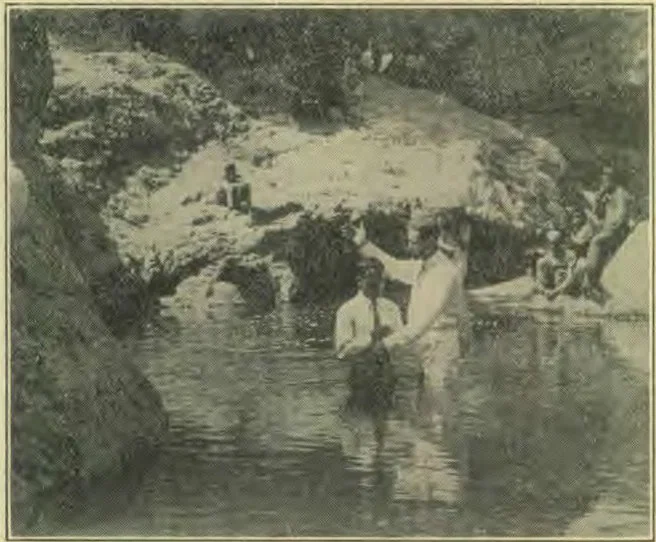
Three nights and two days were spent with the school, the first day in an inspection of the school and property by Professor Salisbury, and in consultation with the teachers regarding their work. The second day we prepared to go to one of the mountain streams about nine miles distant, for the baptism of the head master. Leaving the school in the early morning, we descended into the valley, several miles of the road being steep and rough, then along the bottom of the valley, up another ridge and over, deep again into the valley, and finally, after a slight climb, down into the valley in which flowed a beautiful stream, a confluent of the Ganges, below the falls of which a pool, beautifully situated and clear as crystal, had been selected for the rite. The boys of the school had come to witness the scene, and sat grouped on the rocks at the side of the pool, while an explanation of the meaning of baptism was made, and prayer was offered, both in their own language. Then the head master of the school, who for four years has walked and taught among them, identified himself with this people, and signified his intention of being more like his Lord, by burial in baptism. Professor Salisbury performed the ceremony. This baptism is the first fruits of the work in Garhwal,p. 11 but we believe it is the beginning of a work that will develop into strong Christian communities in coming years.
Boys in India are much like boys at home. Outside of school hours these lads of the school play games similar to those of our boyhood days, and are as honorable about their play as the majority of home lads. As the day of baptism was a holiday for the school, the time after the baptism was theirs, and they made good use of it, bathing, swimming, diving, some of them showing much skill. Like the American boy, they enjoy a joke, and many an unexpected ducking was the portion of the unwary. But it was taken in good part, and returned if possible.
The return journey, mostly uphill, rising by heavy gradients to nearly six thousand feet, was a weary trip, and when we walked into the school yard as it was growing dusk, we were eager for rest and refreshment.
In India one does not dare to drink of the streams, nor eat promiscuously from the bazaars. Milk, unboiled, is dangerous also, for from all these sources come cholera and the enteric fevers which are so prevalent in India. So in these long journeys one must either carry water and food or go without. After our long tramp and the shortness of food and drink, we gladly welcomed the water of the mountain spring, and the food found at the school, so hospitably prepared by Mr. and Mrs. Belgrave. The journey down again to the heat of the plains was uneventful.
We had enjoyed, despite the toilsomeness of our journey, the opportunities for service in a growing and hopeful work. In days to come we believe we shall see some of these bright boys wholly given to the Master’s service, and devoting their lives to the salvation of others. Several have already signified their love for Christ, and their desire to yield their lives to him.
S. A. WELLMAN.