Gleanings From Korea

3%

Review and Herald Publishing Assn. · Takoma Park Station, Washington, D. C. · Jan 4, 1916

FromThe Youth’s Instructor, Vol. 64, No. 1.

Read the full edition

Gleanings From Korea

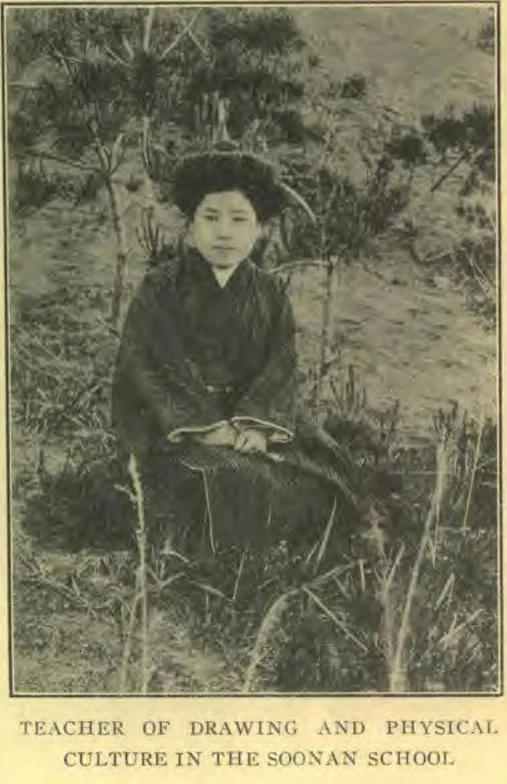
TEACHER OF DRAWING AND PHYSICAL
CULTURE IN THE SOONAN SCHOOL.
TEACHER OF DRAWING AND PHYSICAL CULTURE IN THE SOONAN SCHOOL.
It is hard to know where to begin and where to stop in writing of our work in Japan and Korea. We say “our” work, but really it is His work, and it is only as he allows us to be laborers with him, sharing the sacrifice and the joy, that we can call it “ours.” The purpose of this article is not to present a connected history, or outline, of the work in Korea, but a few pictures that will help us to understand some of the conditions in the past, and the progress that has been made.
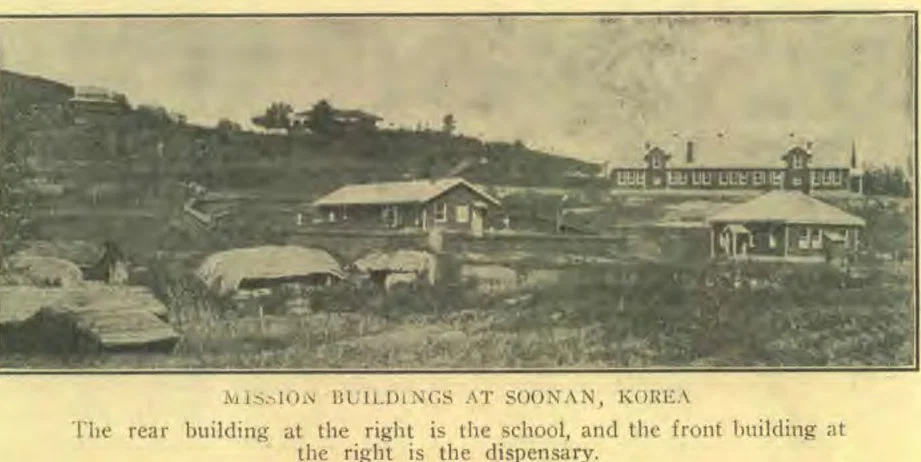
MISSION BUILDINGS AT SOONAN, KOREA
The rear building at the right is the school, and the front building at the right is the dispensary.
MISSION BUILDINGS AT SOONAN, KOREA The rear building at the right is the school, and the front building at the right is the dispensary.
Work is carried on in Korea from four central stations,—Seoul, Soonan, Wonsan, and Keizan. The headquarters for the mission have been established at Seoul, the most important city in the country. Outside the East Gate, land has been purchased, and a printing office, foreign residences, and other necessary buildings have been erected. Soonan, in the north division, has the training school and the dispensary.

Korean Industrial School

The school work was begun in 1907 by Elder W. R. Smith and Miss Mimi Scharffenberg. A year or two later Miss Helen May Scott arrived, and took charge of the girls’ department. Brother Howard Lee took the supervision of the school in 1910. Besides the central school, a number of primary schools are conducted in near-by country places.
It is not customary to have boys and girls in the same school in the Eastern countries; but as the cost for equipment and teachers is so great, the two schools are housed in one building. In the west end of the schoolhouse is the boys’ school, and in the east end the girls’. A chapel separates the two.

Subjects Taught

Ten teachers comprise the teaching force. One of these is a Japanese, who gives the required instruction in the Japanese language. Two grades of work are carried—a primary course of four years, and a higher four-year course, which may be supplemented by a teachers’ training course and a ministerial course. The subjects taught are Bible, Japanese, arithmetic, algebra, geometry, Chinese literature, botany, zoology, physics, chemistry, general history, agriculture, silkworm culture, geography, drawing, singing, and physical culture. “Korean young people who have a mind to study seem to do this amount of work in the eight years given to do it,” says Brother Lee.
The first class to be graduated from this school, consisting of four boys and one girl, received their diplomas in March, 1913.

The New Buildings

In October, 1913, the new buildings in Soonan, made possible by the Thirteenth Sabbath Offering of the first quarter of 1913, were dedicated. Only those who had struggled along during the early days, under unfavorable conditions, in small, unsanitary, mud-walled buildings, can realize the happiness that filled the hearts of the faithful teachers when the new buildings were completed. The school chapel, which seats three hundred persons and is our largest assembly room in Korea, is already often too small for the Sabbath congregations. The girls’ dormitory has in one end a suite of rooms for Miss Scott, who is thus enabled to exercise a watchful care over her charges.
When the buildings were occupied, Miss Scott wrote: “I cannot tell you how much we appreciate the new buildings. At first it seemed strange to hold school in a real schoolhouse. Noises coming through brick walls, sounded so different from what they had coming through mud walls. To hear noises above was strange, too; for Korean houses have no second story. The rooms are light and have plenty of sunshine. We use the chapel for church services.”

The Dispensary at Soonan Hill

For more than four years after his arrival in Korea, in 1909, Dr. Riley Russell conducted dispensary work in a small Korean house, mud-walled and poorly lighted. A never-ending stream of suffering humanity passed through this room. More than twenty thousand patients, in every stage of filth, poverty, and suffering, came here for help, and none were turned away. The need for a better building and a more modern equipment was presented to the friends at home, and money was appropriated for this purpose. Writing at the time of the dedication of the new school buildings and the dispensary, Pastor C. L. Butterfield, superintendent of the Korean Mission, said: “These buildings stand as memorials to the truth in this great heathen field, and they greatly improve the appearance of Soonan Hill.”
In answer to a letter from the homeland, written early in 1914, to ask Dr. Russell if he had any regrets in leaving the little mud hut, the following from Mrs. Russell was received, Dr. Russell being absent from home at the time:— “Your letter came last night, and you wondered if we could do as well with our new equipment, and if we seemed to feel a little homesick for the old ‘mud hut.’ Well, I am not homesick for it. To ease your mind, let me tell you we feel we can do very much better where we can clean up and care properly for the people. “While Dr. Russell was at Seoul attending medical meeting, I took my two babies down every day and looked after the patients. One day a Japanese officer came, bringing a young Korean student from the government school. This boy had met with an accident, and his face was cut so badly I had to put in five stitches. While doing it, several officers stood about and watched. I thought it queer they did not take him to their own Japanese doctor when they found my husband was away; but our fine white operating room, with its professional atmosphere, must have had its influence. The case has made a splendid recovery, and there will be no disfigurement.”
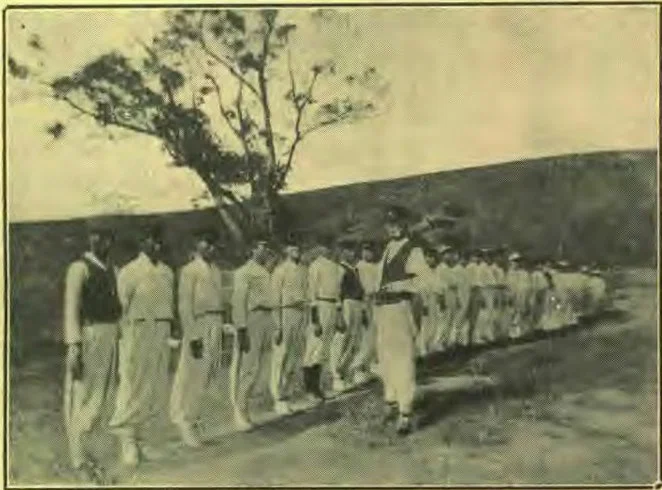
READY FOR THE PHYSICAL CULTURE CLASS, MISSION SCHOOL, SOONAN
The dispensary, complete and fenced, cost nine hundred dollars. The equipment cost six hundred dollars more. The war has seriously affected the work of the dispensary. Dr. Russell writes: “Supplies are getting so expensive that it is a question what to do. Several articles have increased in price three hundred per cent. Grain is so cheap that there is no money in the country districts, and it is hard for the people to pay their taxes. Some have pawned the deeds to their fields for money to pay their taxes.”
Dr. Russell is a firm believer in the work of the medical evangelist,—the man who will spend and be spent in the service of suffering humanity, that he may gain some for the gospel. “We treated over nine hundred patients at the dispensary during the year 1914,” he says, “and best of all, several became Christians.”

Native Workers

A number of efficient and faithful native workers have been developed since the mission was established. At the present time there are ten teachers, twenty-two canvassers, three Bible women, and twenty other workers, giving their full time to the work. Their devotion and earnestness are shown by the following incidents:— “I have just returned from Soonan, where I spent a week in the Bible class and district meeting held there,” writes Pastor C. L. Butterfield, in the Asiatic Division News Letter, for February, 1915. “At the close of each evening meeting an invitation was given to unbelievers to give their hearts to God. Our native Korean brethren did the preaching, and during the six nights that I was there, I gave the invitation. Altogether, over forty responded.” “In January,” says Dr. Russell, “fifteen church members gave two weeks each to preaching. As a result a number are reported as keeping the Sabbath. This was a great help to the men who made the effort, and also to the churches where the meetings were held.”

A Native Report

The following report from Evangelist Kim Na Chun has a sweet, familiar ring:— “With regard to the work here in Ham Heung, I wish to say that it has been my mind to visit every house, distribute literature, and preach the gospel to all who will hear. I began this work by visiting the houses nearest the church, and then those farther away. During one week I sold twenty tracts and gave away three hundred pages of literature, and had many interesting experiences. As a result of this work, one family and one brother have turned from heathenism to worship the true God. They are now keeping the Sabbath. Others are much interested. I praise God for all this. “Brother Pak Nong Hae is giving his full time to the sale of our magazine, Sei Chyensa eui Keuipyel, in this city and throughout this territory. Brother, pray much that the third angel’s message may quickly be preached in all this province. “This province is far north; and the snow and heavy winds make it hard to do much traveling at this time of year. Please pray much for this weak person.”

The Monthly News Letter

A few months ago, feeling that it would prove a bond of union among the native workers, a monthly news letter was started. Items from letters received and the monthly reports of the workers are used, with short, helpful paragraphs from Mrs. E. G. White’s writings. This little sheet is greatly appreciated.
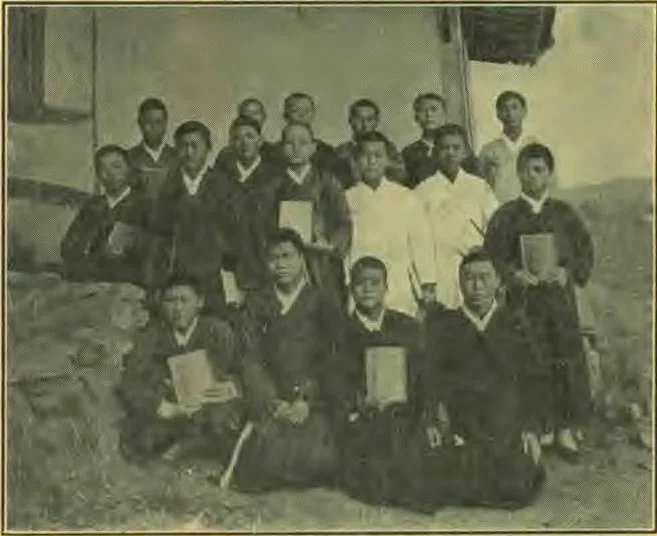
BOYS OF A CANVASSING CLASS AT THE MISSION SCHOOL, SOONAN

The Publishing Work

During 1913 more than 36,000 copies of our missionary magazine, Sei Chyensa eui Keuipyel, were placed in the homes of the people. In 1914 this number was largely increased, 57,185 copies having been sent out from the office. Including tracts, there were more than 1,500,000 pages of literature distributed, in addition to Bibles. “Our sales,” says Pastor Butterfield, “amounted to $1,235.75 in this little country, where, only three years ago, it was said we could not sell literature, for the people were too poor to buy. The year 1914 was a banner year, magazine sales being sixty-three per cent more than during 1913.”

Sabbath School Work

The first Sabbath school in Korea was organized at Seoul in 1904. The first lessons were translated into the Korean language in 1909, only 250 copies being required at that time. The membership of the schools in Korea is now nearly twelve hundred, divided among forty-two schools. The Koreans are liberal and willing givers, according to their ability. During 1914, gifts to the amount of $390.09 were taken up. Memory Verse Cards and lessons for the children have been added recently, and are doing their part in interesting the little ones.

Helping Others

A glimpse at a missionary report for one quarter of 1915 will be suggestive of the work carried on. Miss Scharffenberg says:— “There are 17 missionary societies, and during the past quarter 289 persons reported work done. There were 70 letters written and 65 letters received; 1,780 missionary visits made and 768 Bible readings given; 33 subscriptions were taken for our magazine, 472 copies sold, and 209 copies mailed. There were 28,310 tracts given away, the poor were helped 118 times, and 93 lessons in reading were given to different persons. One hundred and eighty-nine persons registered for the home study course, and 88 sent in their written examinations.”
Is it not a privilege to have a little part in this great work? Some may go, but many must stay. Let us not forget that “prayer is the rail and boat that carries us in spirit wherever we wish to go. And what we do there, in purpose, in spirit, by prayer, is woven into actual fact and life.” A. B. E.