NEARLY three hundred years ago a great many of the people in England were very unhappy because their king would not let them serve God as they liked. The king said they must worship just as he did. Many who would not do this were thrown into prison, or perhaps driven away from home.
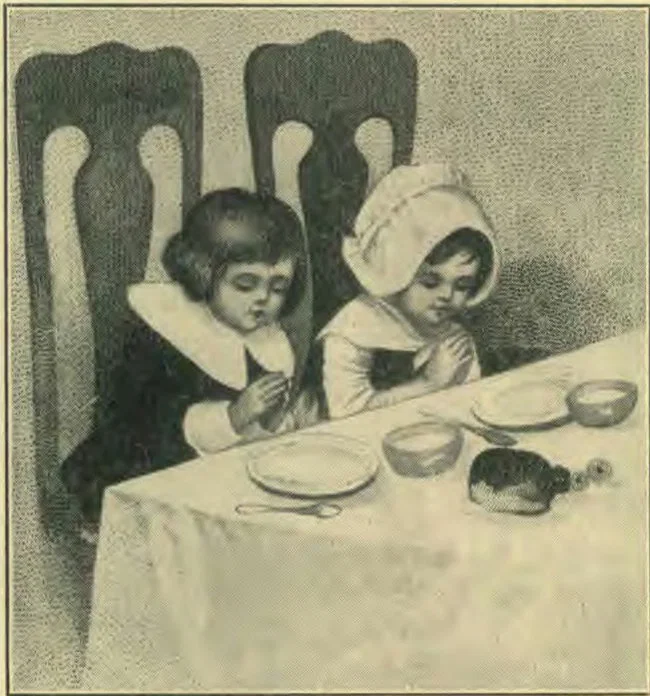
“For all thy gifts, so great, so good,
We thank thee, Lord!
For home and friends, for clothes and food,
We thank thee, Lord!
For work and play, for this dear day,
For church and Sabbath school alway,
For Jesus teaching us the way,
We thank thee, Lord!”
“Let us go away from this country,” said the unhappy Englishmen. So they left their homes, and went to Holland. It was about this time that they began to call themselves “Pilgrims.” Pilgrims, you know, are persons who are always traveling to find something they love, or to find a land where they can be happier; and these English men and women were journeying, they said, “from place to place, toward heaven, their dearest country.”
In Holland, the Pilgrims were quiet and happy for a while, yet they were very poor. When the children began to grow up, they were not like English children, but talked Dutch, like the little ones of Holland, and some grew naughty, and did not want to go to church any more.
“This will never do,” said the Pilgrim fathers and mothers; so after much talking and thinking and writing, they made up their minds to come to America. They hired two vessels, called the “Mayflower” and the “Speedwell,” to take them across the sea; but the “Speedwell” was not a strong ship, and the captain had to take her home again before she had gone very far.
The “Mayflower” went back, too. Part of the “Speedwell’s” passengers were given to her, and then she started alone across the great ocean.
There were one hundred persons on board—mothers and fathers, brothers and sisters. They were very crowded; it was cold and uncomfortable; the sea was rough, and pitched the “Mayflower” about, and they were two months sailing over the water.
At last the “Mayflower” came in sight of land; but if the children had been thinking of grass and flowers and birds, they must have been very much disappointed, for the month was cold November, and there was nothing to be seen but rocks and sand and hard, bare ground.
Some of the Pilgrim fathers, with brave Capt. Miles Standish at their head, went on shore to see if they could find any houses or white people. But they saw only some wild Indians, who ran away from them, some Indian huts, and some corn buried in holes in the ground. Later they made other excursions into the near-by country, till by and by they found a pretty place to live, where there were “fields and little running brooks.”
Then at last all the tired Pilgrims landed from the ship on a spot now called Plymouth Rock, and the first house was begun on Christmas Day. But when I tell you how sick they were, and how much they suffered that first winter, you will be very sorry for them. The weather was cold, the snow fell fast and thick, the wind was icy, and the Pilgrim fathers had no one to help them cut down the trees and build their church and their houses.
The Pilgrim mothers helped all they could; but they were tired with the long journey, and cold, and hungry, too, for no one had the right kind of food to eat, nor even enough of it.
First one of the little company was taken sick, and then another, until half of them were in bed at the same time. Brave Miles Standish and the other soldiers nursed them as well as they knew how; but before spring half of the people died.
But by and by the sun shone more brightly, the snow melted, the leaves began to grow, and sweet spring had come again.
Some friendly Indians had visited the Pilgrims during the winter, and Captain Standish, with several of his men, had returned the visit. One of the kind Indians was called Squanto, and he came to stay with the Pilgrims, and showed them how to plant their corn and their peas and wheat and barley.
When it was autumn, the fathers gathered the barley and wheat and corn that they had planted, and found that it had grown so well that they would have enough for the long winter that was coming.
“Let us thank God for it all,” they said. “It is he who has sent the sunshine and the rain, and made the corn grow.” So they thanked God in their homes and in their little church; and the fathers and the mothers and the children thanked him.
Then the Pilgrim mothers said, “Let us have a great thanksgiving party, and invite the friendly Indians, and all rejoice together.”
So they had the first thanksgiving party, and a grand one it was! Four men went out shooting one whole11day, and brought back so many wild ducks and geese and great wild turkeys that there was enough for almost a week. There was deer meat, also, of course, for there were plenty of fine deer in the forest. Then the Pilgrim mothers made the corn and wheat into bread and cakes, and they had fish and clams from the sea, besides.
The friendly Indians all came with their chief, Massasoit. Every one came that was invited, and more, I dare say, for there were ninety of them altogether. They brought five deer with them, which they gave to the Pilgrims; and they must have liked the party very much, for they stayed there three days.
The Pilgrim mothers and fathers had been sick and sad many times since they landed from the “Mayflower.” They had worked very hard; often they had not had enough to eat; and they were mournful indeed when their friends died. But now they tried to forget all this, and think only of how good God had been to them; and so they all were happy together at the first Thanksgiving party.
All this happened nearly three hundred years ago. Ever since that time, sometimes every year, and sometimes skipping a year or two,—sometimes appointed by the church and sometimes by the state,—Thanksgiving Day has been kept in our country. Since 1865 it has been an annual national holiday, appointed by the President, and announced by him in a proclamation. Then the governors of all States, when they have received the President’s proclamation, issue their own, naming the same day.
Always our fathers and grandfathers and great-grandfathers have “rejoiced together” like the Pilgrims, and have had something to be thankful for each time.
Every year some father has told the story of the brave Pilgrims to his little sons and daughters, and has taught them to be very glad and proud that the “Mayflower” came sailing to our country so many years ago.—Selected.