Shall I Vote?

9%

Review and Herald Publishing Assn. · Takoma Park Station, Washington, D. C. · Jan 30, 1917

FromThe Youth’s Instructor, Vol. 65, No. 5.

Read the full edition
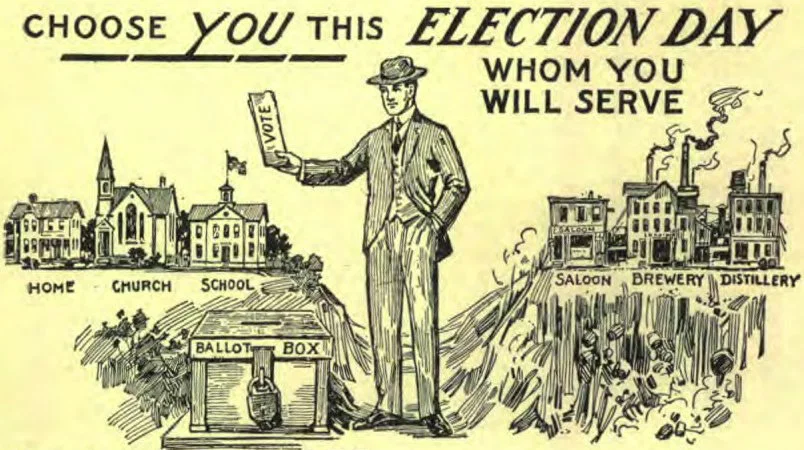
Standard Publishing Company, copyright

Shall I Vote?

Of course you should vote. Dr. Ira Landrith says that “scarcely a prohibition vote has been lost in a decade except by the indolence of the upright.” In Ohio in 1914, 160,000 men stayed at home and failed to vote on the liquor question. If you do not want to be reckoned as an accomplice in all the evil wrought through the accursed liquor traffic, then bestir yourself and vote for annihilation whenever opportunity offers.
For a generation a certain Massachusetts town had been a no-license town, and doubtless all the good people thought it would forever remain so; but thinking and voting are both necessary to keep the slimy body of the liquor traffic out of any place. However, the town forgot this, and awoke one morning to find that the liquor people, who had been awake all the time, had crowded the town hall and voted in the saloon. But fortunately the selectmen were prohibitionists, and saved the day by deciding to place the liquor license at $1,000,000, if necessary, to keep the traffic out.
The great Yukon Territory missed becoming dry for want of three votes. We are told that if the ministers who left the city of Dawson that day had remained and voted, prohibition would have won.
Bicknell, Ind., and Whitewater, Wis., according to reports, were each made dry by one vote. What sorrow and loss would have come to many in these places but for the one vote! Mr. Daniel Poling regards nonvoters as civic grafters. He says:—
“There are men who would not steal a cent, who would not misappropriate a single dollar of a trust fund, who do steal liberty, who do take the priceless institutions of freedom without paying for them, who are civic grafters.”
“It was one of these who said during the campaign for State-wide prohibition in Vermont, ‘Prohibition will carry the State all right; and if I wasn’t so busy, I should like to vote myself.’”
In the election which followed, he and his kind defeated prohibition, for, with one hundred thousand eligible voters in the State, only fifty thousand went to the polls, and a majority of the delinquents were registered in territory already dry through local option.
“Shame! Vermont of the Green Mountains! Vermont, out of which Ethan Allen came to walk with the immortals! The descendants of men who tied rags about their frostbitten, bleeding feet, and marched through blizzards to die for liberty, sat by their firesides on a day when the honor of their commonwealth and the future of her unborn were at stake, and with the supreme weapon of citizenship in their hands and the gauge of civic battle thrown down, struck not a blow. The battle went to the enemy by default; it was not won, because it was not contested. Hats off to the heroic men and women who struggled until the last minutes of the voting day against unfair odds laid on them by the indifference of those who should have been their fighting comrades; but thrice shame upon those others who sold their neighbors’ birthright and their own for the pottage of civic laziness.”
As a people we are given the definite counsel that we fail to do our whole duty unless we exert our influence, by precept and example,—by voice and pen and vote,—in favor of prohibition and total abstinence. We ourselves must grapple with this giant foe, our motto, “No compromise, and no cessation of our efforts till the victory is gained.”