“Why, oh, why does he not come? I wonder if it is that cursed liquor again. Poor Burton! he has tried so hard to stop drinking, but it seems of no use. Why will men sell a poison that can debauch so noble and good a man, and starve his little ones?”
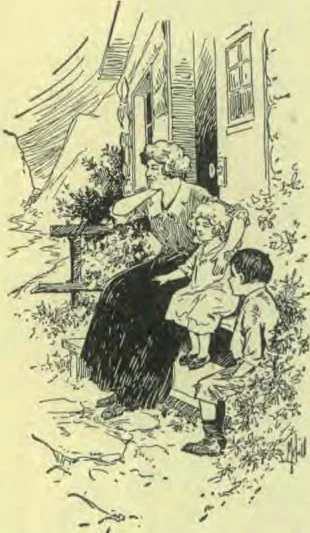
The speaker was a woman of thirty years, whose pale, emaciated countenance and wavy hair bore traces of rare beauty not long departed. As she sat in the doorway of the lonely cabin, her eyes wandered out over the familiar scene. Near the house stood a growth of scrubby cottonwood trees, which extended far up and down the cañon. On either side rose the river banks sheer five hundred feet to the level of the brown prairie. Bleak cut banks they were, destitute of vegetation except where a pale and sickly sagebrush clung to their precipitous sides. Between these banks meandered the treacherous Milk River, named from the milky hue of its turbulent waters. This was the scene upon which Alice Stanford had looked for eight years, and never during that time had she been out of the valley. There were no neighbors nearer than forty miles away on the bank of the Missouri River.
“Papa bing little May dolly when he tum! Papa said so.”
Then a moment later: “When papa tum, mamma?”
The mother smiled sadly as she looked into the animated face of the trusting child, and said simply, “I hope your father will come today.”
The little one, taking this for assurance, brushed back the nut-brown curls and seated herself at the mother’s feet, while her deep blue eyes wandered far up the frowning bank to see if papa had already started down its steep sides, with the coveted doll.
The waiting that is known only to a drunkard's family.
The day wore on as had many days before during the three weeks of the father’s absence; the shadows lengthened, but the mother stirred not. She saw not the things around her: the little house, the scrubby trees, the deep cañon, were all forgotten. She is a girl again in the beautiful Eastern home, among youthful and happy friends; books in hand, she trips up the broad steps of the old brick school-house at the end of the street; once more she sees the loving faces of father and mother as the family gather around the hearth; again she hears the lark and the thrush in the pasture lot, and hears the happy robin calling his mate to come where the cherries are ripest; once more she hears the voice of manly Burton pleading to be forgiven for his error in tipping the flowing bowl; and how plainly she hears her mother’s warning voice; how clearly she remembers her father’s words of counsel:—
“Don’t marry a man to reform him;
Don’t be by his promises led;
If he can’t be a man when he’s wooing,
He can’t be a man when he’s wed.”
Yet she believed Burton. True, he had promised the same before, but it was his companions who were to blame. If they were married and away out on a ranch in the Golden West, where every one is happy, he would not drink. Burton believed this, and Alice believed it, despite her father’s counsel and her mother’s tears. She trusted and sought the West.
“Mamma, may I have a cooky?”
The mother awoke from her reverie as the sound of the boy’s voice broke upon her ears. A look of pain crossed the pale features as, gazing tenderly into the face of her boy, she replied:—
“My son, there are no cookies.”
“Some bread, then?”
“There is no bread.”
“What may we eat, mamma? We have eaten potatoes and salt so long they don’t taste good any more. Can’t I make some bread, mamma? I know you are too sick to do it, but can’t you sit by the table and tell me how?”
This was almost more than mother-love could bear—to see her children suffering from hunger, while over the bar at Chinook, a hundred miles away, the father was freely tossing the money that would have made them comfortable and happy; but she quietly replied in a voice that was not altogether steady, “There is no flour, my child.”
The boy, who possessed a thoughtfulness beyond his six years, stood squarely up before his mother and said, “When I get big and sell cattle, I’m going to spend all the money for flour and sugar and shoes for you, mamma, and some pretty ribbons for sister.”
“Papa bing me dolly, mamma, when papa tum.” And the little face was wreathed in smiles of anticipation. “Dollies have hair, don’t they, mamma? an’ eyes, an’ teef?”
The autumn shadows lengthened into twilight; the woman rose feebly and entered the little house. What a house! Walls bare; but one chair, and that made of rough boards; a table of the same material, on which stood the stump of a candle in the neck of a bottle serving as candlestick; no stove, only a fireplace of rough stones plastered over with clay. At the opposite end of the room stood two bunks made of cottonwood poles, upon which were ticks filled with hay and covered with coarse blankets. Yet in these rude surroundings was seen the hand of refinement; everything was immaculately clean; floor spotless, windows shining, the rough board table adorned with a bouquet of late fall grasses, and the bareness of the walls relieved by tastefully arranged wreaths of green and golden forest leaves tied with knots of silk grass. With what undying tenacity does a gentle heart cling to the beautiful?
The little ones were soon divested of their scanty clothing, and after repeating their childish prayer and bestowing the good-night kiss, they were snugly tucked into bed, and soon were fast asleep. The mother sat for hours lost in thought, and her poor heart ached as she tried to look away into the future—into the future of the two dear ones now sleeping so innocently. How she longed to guide their feet, but knew this could not be. Grief over a fallen husband, starvation, and exposure had broken her once robust health, and she knew that the end was near.
“O that I might live until he comes! Why, oh why, does he not come?” broke from the pale lips; and creeping softly to the bedside, she gazed long and earnestly upon the baby faces.
“Papa bing me dolly,” came from the lips of little May.
“O poor motherless children of a drunken father! How I wanted to stay and—and—”
The chill November morning broke over the world, and at last found its way through the dense fog and down into the great cañon. The little ones, aroused by its light, began to talk in whispers that they might not wake mamma. Soon they slipped out of bed, and helping each other to dress, stole quietly from the room and were soon building imaginary houses in the sand; but hunger overtaking them, they wondered why mamma slept so late. Peering cautiously through the door, they saw her lying upon the bed with eyes open. They called; she did not answer. Little Lynn touched her hand. It was cold. Diminutive May climbed upon the bed and kissed her, but she did not smile. A nameless terror filled their hearts, and they fled from the room. All day they hovered about the door, but mamma did not move. Evening came on; they dared not enter now, but stole away to the huge haystack by the corral, where they cuddled down together, cold, hungry, terror-stricken, and cried themselves to sleep, poor innocent victims of the demon alcohol.
Another day passed, and still they waited. They were nearly starved now, but in spite of the pangs of hunger, little May talked of the wonderful doll which papa would bring.
“We ain’t nezzer seen a wealy dolly, has we, Lynn? Mamma says wealy dollies have wealy hair and wealy eyes and wealy teef, too. An’ you tan hold her half ’e time Lynn, and we’ll make a playhouse for her. S’pose papa’ll tum dis night, Lynn?”
As the little ones were talking, a huge mountain wagon with shrieking brakes was making its way down the winding trail that leads from the prairie into the cañon below. In the wagon, guiding the tandem six with the air of one accustomed to the practice, sat a man of perhaps thirty years, tall, sinewy, and strong, of blond complexion and regular features, a manly face to look upon; but just now the eyes were bloodshot, the face bloated, and a look of shame overspread the countenance. From the top of the bank and for nearly halfway down he could see the little cabin nestling among the trees—the cabin which he had built, he and Alice; the cabin where the Lord had given them the sturdy Lynn and little May, whose disposition ever reflected the sunshine of the month whose name she bore; the cabin where for three years no sorrow came to them and happiness reigned supreme.
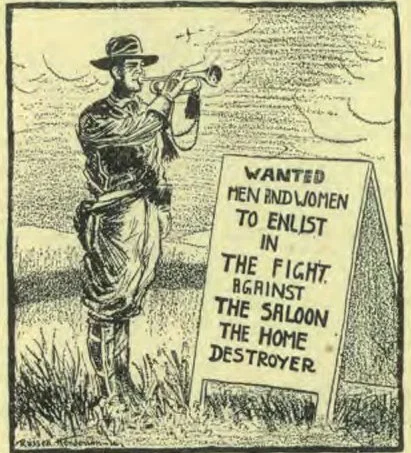
Civilization’s preparedness call
Then came the first shipment of cattle. How proudly he drove them to market; how hopefully Alice bade him good-by, and how eagerly she watched for his return with warm clothing for the babies and a few pieces of much-needed furniture for the home! Ah, could he ever forget the bright, happy face that greeted him as he arrived, or the look of disappointment at the empty wagon?
In town he had met an old friend, and together they took a social glass. From that time Burton could but indistinctly remember what occurred until he arrived home with empty wagon, and saw his wife’s disappointed face. Four consecutive years the act had been repeated. How he had struggled to overcome the appetite!7How he had tried to be a man again! But in spite of all his efforts it had occurred again; and as he reached the familiar gate, he bowed his head in shame, and the scalding tears ran down his sunburned face.
“Why, oh, why,” groaned he, “did I take the first glass? Do I love rum better than my patient wife? Do I love it better than those sweet children? God knows I don’t. I hate the cursed stuff! Then why must I drink it and ruin the ones I love?”
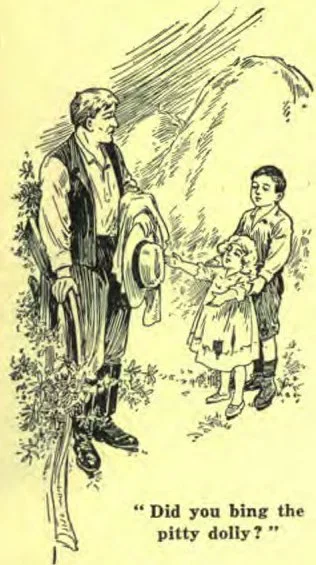
He neared the house, but Alice came not forth to greet him. He called; no answer came. From behind the haystack, two pale little figures staggered toward him. It was Lynn with tear-stained face, and looking much older than his years, who came slowly forward leading little May, who, in spite of her weakness, shook her nut-brown curls and in a hopeful voice queried: “Did you bing de pitty dolly? Is it got wealy hair, an’ eyes, an’ teef?”
“Where is your mother?” the father asked quickly, anxious to divert the child’s mind from the doll which he had promised and forgotten.
“Mamma is asleep,” said Lynn. “She slept all day yesterday and today. We kissed and kissed her, but she didn’t wake up. She was just awful cold, and we covered her all up warm. I guess she thought you’d be home sooner, for she looked and looked for you. And once when she didn’t know I was near, I heard her say, ‘Lord, keep him from the drink this time. You know he wants to be good.’ What did she mean, papa?”
Did you bring the pretty dolly?
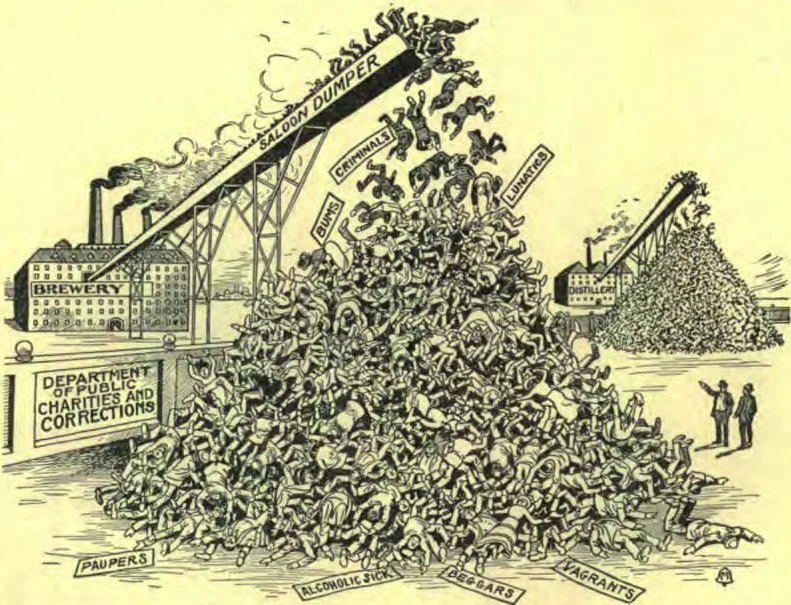
The liquor manufacturers take the profits and dump their refuse on the taxpayers.
With a sinking heart the man pushed open the door and met the lifeless stare of those beautiful eyes which through all his downward course had never given him a reproachful look.
Through the long night he worked to prepare the last resting place of her who had hoped through all; and in the gray dawn he placed the sleeping children in the great wagon, and drove up the long, winding trail which led to the brown prairie above, and out into the sunlight of a better life.
Such tragedies the liquor traffic is enacting every hour in every corner of the land where licensed saloons exist. Will your vote help to perpetuate such a traffic? God forbid! GLENN S. BUGBEE.