When this question was first put to the waiting multitude at Sinai, every man was compelled to take sides, and to do it definitely and at once.
Now in this great hour the challenge is again given, “Who is on the Lord’s side?” and men by force of circumstances are being compelled to line up for or against the liquor traffic. This is the way it is being done: In Elgin, Ill., a vote on the saloon question revealed the fact that one brewer, one distiller, one daughter of a distiller, nine ex-saloonkeepers, four ex-saloonkeepers who afterward became blind-piggers, one expressman, seven wet leaders and workers, most of whom circulated the petitions for pay, voted for saloons; while the better part of Elgin voted for prohibition.
Elgin voting is a fair sample of the general personnel of the dry and wet voting. It also shows the way things are fast tending throughout the country.
When Secretary Daniels learned of the many admissions to the hospital for alcoholism in the American navy, he concluded that if alcohol was sending so many to the hospital, it must be rendering inefficient a still larger number of men who did not get to the hospital. He therefore, for the sake of efficiency, debarred alcohol from the United States Navy.
Mayor Smith of Philadelphia barred liquor from 10,000 city employees, with the statement that “rum and efficient public service are an impossible combination.”
The Brotherhood of Locomotive Engineers in convention declared for State and national prohibition, saying that “drink and efficiency do not run hand in hand.” The New York City Board of Health has inaugurated a temperance crusade.
The United Mine Workers of America at once remove from his position any officer or employee convicted of intoxication. National parks and forest reserves have been made dry by order of the National Congress. According to Adjutant General McCain, liquor is absolutely forbidden in all our army camps.
“The National Guard is a sober organization,” said Capt. Stanley W. Root, of Company I, Pennsylvania National Guard. “It takes a good sober body to stand the strain of the service nowadays. The drunkard is the first man who becomes a straggler, and we don’t want him. The personnel of the National Guard in my time has improved one hundred per cent in this respect.”
Adj. Gen. I. Van Holt, of Georgia, says, “There will be no drinking among the Georgia troops as long as I am at their head. Woe unto the man who takes a drink if I ever hear of his having done so. Drunkenness for a soldier is an unspeakable disgrace, especially inthe case of an officer; and it is my purpose to have any such man court-martialed and subject him to the full penalty of the law.”
“General Clark, in command of Missouri National Guard, at Camp Clark, Nevada, Mo., issued stringent orders against the use of liquors by either officers or men, or even its presence on the reservation.”
The Philadelphia Quartz Company of Chester, Pa., has declared an increase of ten per cent in wages for each one who will pledge himself to abstain from intoxicating liquors.
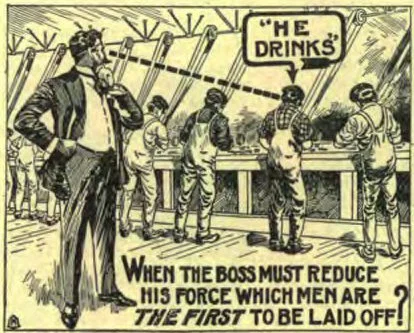
WHEN THE BOSS MUST REDUCE HIS FORCE WHICH MEN ARE THE FIRST TO BE LAID OFF!
The Cambria Steel Company of Johnstown, has also taken official steps to curb all drinking by its employees, on the principle that no man has a right to drink and expect to sell his lessened efficiency to the Cambria Steel Company. The Hershey Chocolate people, among the largest manufacturers of their line of products in America, have taken a similar step.
The Pittsburgh and Lake Erie Railroad dismissed one hundred twenty-six employees at one time for drinking.
Socialist leaders of Norway, Finland, Germany, France, Belgium, and Austria have expressed themselves strongly against the sale of alcoholic liquor. Vandervelde, one of the giants of the European socialist movement, says: “We must have the courage to tell the workers that those who are filled up with gin are not capable of marching with us to the conquest of a better future. It is the imperative duty of the socialist to attack not only the enemy without, capitalism, which exploits him, but the enemy within that gnaws his entrails and wastes his resources.”
The verdict of a commission appointed by the mayor of Chicago is that alcoholism is the greatest single cause of crime and insanity.
The rules of the barkeepers’ union forbid its members’ using intoxicating drink. “Booze is made to sell, not to drink,” said one barkeeper.12
The Rand Company, of North Tonawanda, N. Y., manufacturers of improved bank and office equipment, when asked to donate one-fourth per cent of a certain bill to aid in fighting prohibition, said:—
“We consider it an insult for you to ask us to help you in preventing the introduction and enforcement of one of the best laws that could be put upon our statute books. We would rather give ten times the amount of this bill for the introduction and enforcing of a prohibition law than one cent to fight it.”
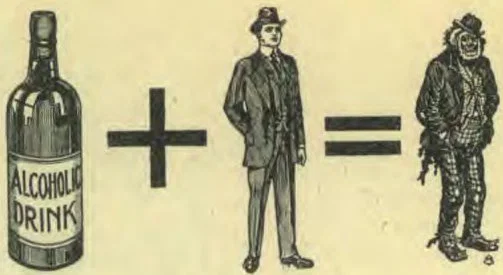
An easy problem
The Carnegie Company at Youngstown, Ohio, promotes only employees who are abstainers from intoxicants.
The Maryland Steel Company, perhaps the largest single corporation in the State, got an act through the legislature forbidding the manufacture and sale of liquor within two miles of its plant.
The Winton Motor Company, of Cleveland, Ohio, which employs about 1,200 men in Cleveland, and about the same number in other cities, has never employed any but total abstainers.
Ten large American steel concerns also employ none but abstainers.