YOU ask me why I so seriously oppose the use of alcohol in sickness. As one of my reasons I will give you the experience of a friend.
You remember meeting at our home, just before you moved West, a Mr. Lester and his wife. You thought their prospects for happiness bright, as you remarked to me that you had seldom met a couple more attractive and apparently so well suited to each other. Mr. Lester and my husband had been intimate friends for years, and when at the age of thirty-five he married and brought home a fair girl of twenty with whom he fell in love while on a business trip, we were delighted, for, as Fred said, Lester was “too good a man to live a bachelor.”
Mrs. Lester we found to be a charming woman, bright and intelligent. They went into society a good deal the first year of their married life; but during the second a babe was born to them, and of course that made a change. They seemed, however, happier than ever. But alas! the child, when about a year old, sickened and died. Mrs. Lester, who had idolized the little one, became low-spirited, and at last ill, and for some time her life was despaired of. Just at this time my own domestic affairs confined me closely. My mother was in delicate health, and our little Nellie had a long illness, so that for almost a year I scarcely left the house, and saw very little of others.
As soon as Mrs. Lester recovered, she called to see me; at first she came frequently, but since I was so absorbed in my own troubles, her visits became farther and farther apart, until sometimes months lay between them. I asked my husband one day what had become of the Lesters, as I had not seen Mrs. Lester for a long time. He said he knew little about them.
“Some unaccountable change,” he went on, “has taken place in Lester; he is totally unlike himself, scarcely ever smiles, seems to take no interest in anything or anybody.”
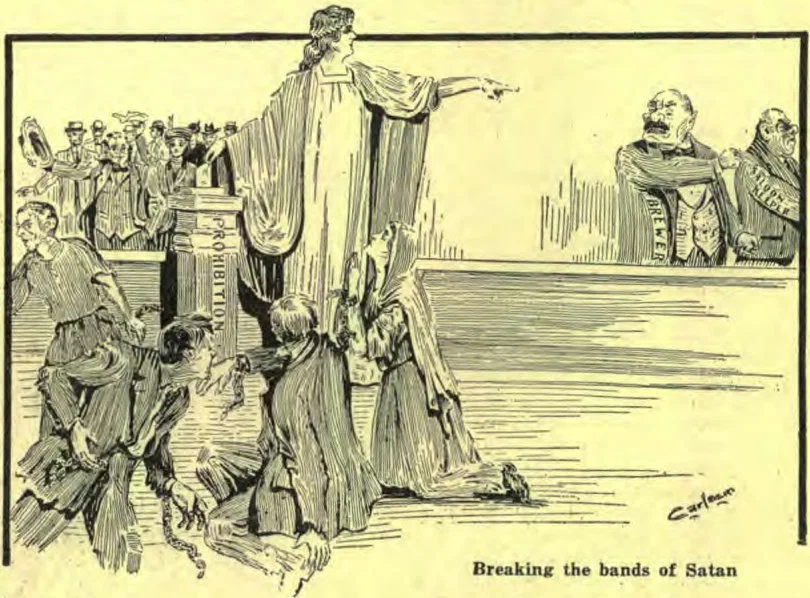
Breaking the bands of Satan
“Perhaps,” said I, “he has business troubles.”
“I think not,” said Fred, “his business appears to be prosperous.”
The subject was dropped; but I thought a good deal about it, and at last determined to visit my old friends to see if they were in trouble. I was kindly received by both Mr. and Mrs. Lester, and could detect no difference in their manner to each other or to me, and yet there was a feeling of restraint which troubled me, and an air of mystery about the house which perplexed me. I soon learned that others felt as I did, and of course there was “talk.”
Servants told strange tales of Mrs. Lester’s “hysterics” and “queer spells,” which often confined her to her room for days. During these periods no one but her husband was permitted to see her.
Mr. Lester and his wife finally left home, ostensibly to travel for the benefit of Mrs. Lester’s health.
Two years passed, when one day my husband said:—
“The Lesters are home again, Nellie. I met Lester this morning, and of all sad faces I think his is the saddest. I was afraid to ask after his wife, for I felt sure she was dead.”
“And is she?” I asked.
“No; he told me she was well and would be glad to see you.14Shall we call this evening?” he asked. “I feel anxious about Lester.”
Company came and prevented our contemplated visit. But in a few days I called at the house and inquired for Mrs. Lester. The old woman who came to the door had lived in Mr. Lester’s mother’s family until it was broken up by the death of old Mrs. Lester, and since then had lived with the son. I knew her well, and was surprised at the embarrassment she showed when I asked for Mrs. Lester. She did not invite me to enter; but after a moment’s hesitation said she hoped I would excuse Mrs. Lester, as Mr. Lester was quite sick. I accordingly returned home without seeing her.
About dark that evening I received a message summoning me to her side. Mr. Lester’s illness was violent, and proved fatal in a few days. Whatever the trouble in the family, it was not lack of mutual affection, for his dying eyes sought hers, his hand clasped hers until it was cold in death. As for her, she neither ate nor slept during the time his suffering lasted, but was constantly with him, allowing no one to assist him in anything she was able to do for him. And when all was over, her agony was terrible to see. It was with difficulty I persuaded her at length to leave her dead, in order that the body might be prepared for burial.
About midnight I prevailed on her to lie down, and, exhausted in body and mind, I threw myself on the bed by her side and fell into an uneasy slumber, from which some slight noise aroused me.
Looking around, I saw, by the dim light, Mrs. Lester standing in front of the dresser with what appeared to be a bottle in her hand. I spoke to her, asking if anything was the matter. She seemed confused, and put her hand to her head, then replied that her head was aching badly. I offered to get up, but she begged me to lie still, and in a short time returned to bed and apparently fell asleep. After this I must have slept soundly, for when I awoke it was daylight.
Dressing myself quickly and quietly, to avoid disturbing my companion, I was about to leave the room, when my eyes fell on her face. The eyes, half open, were bloodshot, while the whole countenance was flushed almost to a purple hue.
“Dear me!” I exclaimed, “she is very sick.”
Hardly ringing the bell, I tried to arouse her. As I did so, the fumes of alcohol surprised me. I did not know what to think, but I proceeded to bathe her head in cold water and comb the tangled locks away from her face. While I was thus engaged, old Rachel entered the room.
“Just let her alone, Mrs. C——,” she said; “she is drunk, and that’s all there is to it. O you wretched creature!” she continued, addressing the unconscious woman, “couldn’t you wait until he was under the ground to make your shame known? Now,” she cried, turning to me, while tears streamed down her wrinkled face, “you know the life he led; do you wonder he was changed? O ma’am! if ever there was a saint on earth, that poor man that lies a corpse downstairs was one.”
Let your vote be for the protection of my boy and not for his destruction.
I was so surprised and horrified I could scarcely speak. “O Rachel!” I said at last, “I never dreamed of this; how long has it been going on?”
“Why, almost ever since her baby died. She was so feeble, you know,” said Rachel, “that the doctor said she must have wine every day. Of course, nobody thought of harm until it was too late. Poor thing! she did try to break herself of it, but it seemed she couldn’t. I thought Mr. Lester would go crazy. He would try to scold her sometimes, but more times he would coax her. I have seen her get down on her knees before him and promise, with tears running down her cheeks, never to touch the stuff again; and I believe she meant it, for she loved him dearly.”
“It seems strange, Rachel,” said I, “that, loving him as she did, she would persist in doing what she knew, or at least what she might have expected, would drive him from her. There are few men, I think, who would prove faithful to a drunken wife.”
“That is the truth,” answered the old woman. “Women are expected to live with drunken men, but not men with drinking women, and she knew it; she used to tell him that, and beg him not to leave her. Oh! if love could save the drunkards, Mrs. C——, there would be few unsaved; but I tell you the craving for whisky—it is not always love of it—is stronger than love or hate or any other passion. I know that woman,” pointing to Mrs. Lester, “loved her husband better than her own life; she would gladly have died for him.”
“Sometimes there would be weeks during which she would not touch liquor. Once she went three months without it, and they were very happy! That was while they were traveling. They thought she had entirely lost her desire for it, and he brought her back, thinking to have a happy home again. But they were invited to dinner at the Rev. Mr. Brown’s. They never thought of danger there. But a friend had sent the minister some expensive old port, and his guests were invited to taste it.
“Immediately after dinner Mr. Lester brought Mrs. Lester home, on the plea of his own head aching. Poor man! if he had said heart aching he would have told the truth. I saw at once by her flushed cheeks and loud talk that somehow she had got liquor. But I helped him coax her to lie down, and together we watched by her until we thought her asleep. Then, as he had some business to see to, he left me in charge and went to the store.
“O Mrs. C——! she was not asleep; as soon as he left the house she got up, and in spite of me left her room. I ran to fasten the doors, but she was too strong for me. It was dark and raining hard; she got away from me and ran out into the street bareheaded. I followed her, begging, praying her to go home. But it was no use. In the darkness I lost her, she was so quick. Then I went to the store for Mr. Lester and told him. I think death struck him then, for he turned gray in the face; not white, Mrs. C——, but gray, ashen gray, and he staggered like a drunken man. As he hurried past me, I tried to follow him. But I am old and weak, and it was so cold and dark I returned to the house to get things ready for them when they came back.
“It was nearly midnight when they came. I don’t know where he found her; but he was half carrying her. They were both wet through with rain, and her beautiful dress was covered with mud. He only said, ‘Help me, Rachel,’ and we got her clothes off and put her in bed. Then I got him dry clothes, and wanted him to lie down, but he did not. The next morning he was sitting just where I left him when I went to bed, and he had that same strange gray color on his face.”
Dear Favur, I fank thee for making our State dry. Muvver says we can now have lots of good fings to eat.
Mrs. Lester was still asleep and breathing loudly, or it seemed loud in the still room, as Rachel paused in her sad story.
“When did you say this was, Rachel?” I asked.
“Just the day before Mr. Lester took down,” she replied. “He had not been well for several days; in fact, he had not wanted to go to the dinner party. He only went to please Mrs. Lester. The next morning when she roused up, he told her he was sick, and if she would stay with him he would lie down.”
“O Rachel! How did she act? How could she look him in the face?” I asked.
“She felt bad, I know,” said Rachel; “but she did not refer to the occurrences of the night before. She was pale and weak, but she tried to keep up, and stayed in the room with her husband all day, lying by his side most of the time. She became frightened at last, as he got no better and she noticed that strange look on his face.”
“‘What does it mean, Rachel?’ she whispered to me. ‘Go for the doctor. O Rachel! have I killed him?’”
“I did not tell her what I thought, but I brought the doctor as quickly as I could. You know the rest—how he never rallied, and how she nursed him. I will tell you one thing more, in justice to her. Mr. Lester told me that his wife inherited her love of liquor from her father, who died a drunkard. If so, we should pity her, should we not?”
Mrs. Lester attended her husband’s funeral in a calm, decorous manner. After it was over, she disappeared, no one knew whither, nor could the utmost efforts of lawyers or friends discover her whereabouts.
With the exception of a handsome legacy to Rachel, Mr. Lester had left all his property—which was large—to his wife, in charge of a lawyer friend, with particular instructions in regard to his wife, which the lawyer kept secret, while he spared neither time nor money in his endeavors to find his charge.
Years passed with no tidings from the wanderer, when, one bitter cold winter morning, I received a note from an intimate friend, stating that she would call for me in an hour, in company with Dr. Bland, in order that we might go with him to see a sick friend.
Wondering somewhat, as I knew of none of our friends’ being ill, I soon made ready, and when the carriage arrived, stepped in at once. We were driven to a distant part of the city, tenanted by the lowest class of people. I suppose I looked my surprise, for Dr. Bland remarked:—
“You will know all soon enough, Mrs. C——. I cannot bear to tell you.”
At last the carriage drew up at the door of a miserable house, and we alighted. The doctor preceded us up a rickety flight of stairs and into a room near the top of the house. Oh, the wretched, wretched place! The bare, dirty floor; the uncurtained, grimy windows; the broken, smoky grate with just a handful of coals; the mass of rags, on which, in lieu of a bed, lay all that was left of our once beautiful, happy Annie Lester.
She extended her hand to me. I took it, while unbidden tears filled my eyes.
“Do not cry now,” she said, in a faint voice; “rather be glad that a miserable life is about to end. I never would have returned15but for that. It is only a question of hours, Doctor; isn’t it?”
The doctor bent his head. And she continued brokenly:—
“I would have spared you, dear friends, this, to you, painful scene, but I have a favor to ask. I want to be buried near my—my husband.” She paused, and a thin stream of blood trickled from her lips. I wiped it off and she went on, still more faintly: “Near him, friends; not at his side, ah! no, not there, but at his feet. I killed him. Oh! I who loved him so, I killed him as surely as if I had driven a knife into his heart. O Dr. Bland!—that fatal prescription of yours! If it had not been for that! O my God!”
She half raised up, but fell back exhausted, while the pallor of death settled on her wasted features.
“Doctor,” she gasped, pushing away the spoon he placed to her lips, “don’t try to prolong this misery.” She raised her dim eyes to his face. “I forgive you,” she said, “as I hope to be forgiven. You—you,” she went on, a word at a time, while each laboring breath grew shorter, “did not mean, but oh! that daily glass of wine; it found its way to the hidden taint in my blood. O my father! what a heritage you left your child; but it might never have been awakened if it had not been for that. I tried so hard—I have suffered so—a thousand deaths—my husband’s feet, remember, re—”
Death sealed her lips. As the doctor bent to close the glazing eyes and fold the cold hands, he trembled as with an ague.
Next day, while snow fell fast from the dull gray sky, we laid poor Annie Lester’s body, not at her husband’s feet, but by his side, where, while life lasted, he had so nobly kept her, and where we knew he would have wished her to rest at last.
As Dr. Bland left me at my home, after the last sad rites were over, he retained my hand in his a moment. His face was pale, and his firm lips quivered a little as he said:—
“Mrs. C—, I think I fully realize the woe of him who putteth the cup to his brother’s lips, and I am resolved that no human being shall ever again lay his ruin at my door.”
“Amen!” I answered. “Would that every member of your useful profession would make the same resolution and abide by it, for I am sure the sum of human sin and suffering would thereby be greatly lessened.”
The doctor bowed gravely, and stepping into his carriage, was driven homeward, while I entered my own happy home, and in the society of my dear ones strove to recover my usual cheerfulness. Still my heart is sad whenever I think of those two wrecked lives, and of that “fatal prescription,” and of numerous other similar prescriptions whose histories likewise have been written in human suffering and degradation, but have not yet been put in print.—Mrs. E. V. Wilson, in Arthur’s Home Magazine.