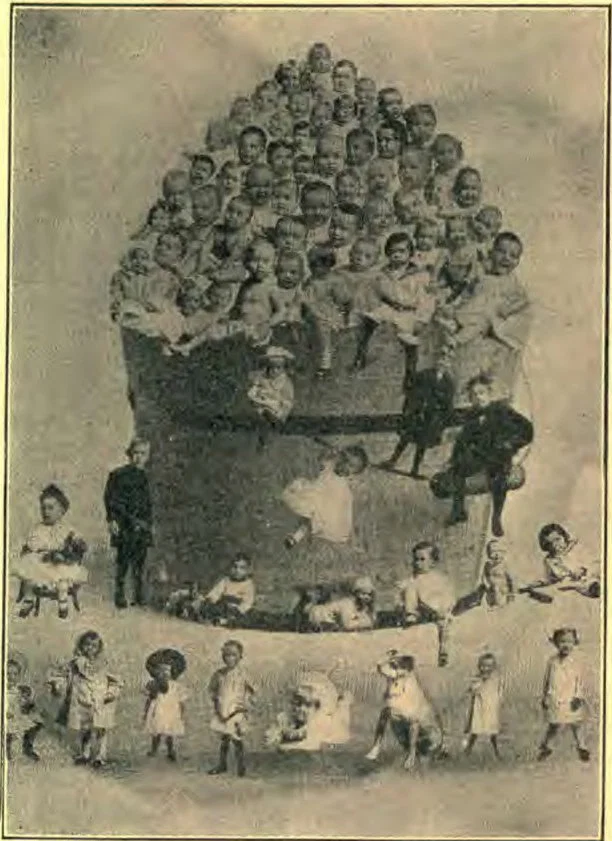
The sweetest gift of God to the world is the baby. And yet this treasure is not always as carefully guarded and protected as its worth demands; for somewhere in the civilized world a baby dies every ten seconds; 360 are laid in the cold ground every hour, 8,640 every day, and more than 3,000,000 every year,—a funeral train of dead babies nearly four hundred miles long! Your darling and that of your neighbor may have been among this number.
Men who have given profound study to the conditions that produce this appalling annual death-roll among the babies of our land, claim that one half, or 1,526,800, of these deaths are preventable. If so, then these million and a half were murdered through neglect, ignorance, and culpability. King Herod of old in his jealous frenzy slaughtered only a few score at most, and still the story of his crime is sounding down the ages—and rightly, too; but what do we deserve who sit quietly by and allow nearly two million innocent babes to be ruthlessly slaughtered every year by unfortunate conditions that might with effort be remedied?
In most cities, according to the report of the Society for Prevention of Infant Mortality, eighty per cent of the children that die under one year of age are bottle-fed babies; and ninety per cent of those that die from digestive troubles are bottle-fed. If the mothers could have nursed these, a very large percentage would have been saved; for “one ounce of mother’s milk is better than one quart of cow’s milk for baby.”
Professor Bunge, of Germany, spent thirty years in chemical researches on the composition of milk. He found that this composition is adapted, by the God of nature, to the needs of each species of mammal, and is different in the different species. Human milk Professor Bunge found to be more complex than the milk of any other mammal. He also found that it is especially rich in lecithin, which serves for the construction of the brain, because the weight of that of the child’s is relatively the highest.
There are several reasons offered why women do not effectively suckle their infants. One is, they are physically incapable of doing so. And this incapability is on the increase. “In the towns of Germany and Switzerland more than half of the women are already attacked by this inability,” says Professor Bunge. Heredity plays a large part in thus incapacitating women. Usually if the mother can suckle her child, her daughter has the same ability. This is not always so, but Professor Bunge found that in seventy-eight per cent of such cases of incapacity the father of the daughter was an immoderate drinker. In families where the mothers and daughters can suckle their infants, drunkenness is rare, but in a very large proportion of those families thus incapacitated, alcohol has played no inconsiderable part.
But alcohol does not strike at the baby alone through its mother’s breast. It makes the mother indifferent in every way to the needs of her child. It also makes her cruel and brutal, so disease and semi-starvation often result. And the stupor of the drunken mother is a frequent cause of the overlying, or smothering, of infants. Twenty-five hundred babies perish annually in this country from this cause. Out of 461 cases that came under the direct observation of one surgeon of police, 219 occurred on Saturday night, which fact connects their death unmistakably with alcoholism.
Scientific observation in both Europe and America reveals the fact that alcoholism in parents or grandparents is responsible annually for by far the larger share of the deformed, epileptic, idiotic, and incorrigible children that are brought into the world. Besides this, the children of alcoholics are especially predisposed to tuberculosis and insanity. And many of these children inherit a craving for alcoholic liquor. Mönkemöller found in one reformatory school hereditary taint due to parental alcoholism in 67.2 per cent of all the pupils. The family histories of 3,711 children have been traced by scientists through three generations.
Of the children of abstaining parents and abstaining grandparents only 4 per cent were dullards, whereas, the children of abstaining parents but drinking grandparents, 78 per cent were dullards. Dividing the 3,711 children into the following classes, we note striking contrasts:—
1. Of those free from hereditary alcoholic taint— 96 per cent were proficient. 4 per cent were dullards. 18 per cent suffered from some neurosis or organic disease. 2. Of those with hereditary alcoholic taint— 23 per cent were proficient. 77 per cent were dullards. 76 per cent suffered from some neurosis or organic disease.
“At a discussion on this subject at the Vienna congress against alcoholism, a medical man stated that the teachers in wine-growing districts of Lower Austria know that a supply of very bad scholars in any one year denotes a good vintage six years previously.”
Science and practical observation no longer hesitate to hold alcoholic ancestry largely responsible for our hosts of feeble-minded, epileptic, insane, tuberculous, and crippled children. The State recognizes its responsibility to provide homes of isolation for these; but, strange as it may seem, it hesitates to provide preventive and remedial measures, which course, from every view-point, would be wiser and more generous.