Alphonso Alva Hopkins, Ph. D.
TEMPERANCE LECTURER, AND AUTHOR OF “PROFIT AND LOSS IN MAN,” “WEALTH AND WASTE,” ETC.
THE Boy,—spell it with a capital B, Mr. Printer, for the Boy is a capital thing,—the Boy has rights as sacred as any which the Man can boast or claim, but to which, in large measure, the Man gives little heed. Seeing that the Man was once the Boy, this carelessness on the Man’s part would be inexplicable if it did not follow the Boy’s own unconsciousness. The rights of the Boy are not realized by him. Of those deepest and most sacred he can have no clear understanding. They concern his advent into being as a babe,—they pertain more to his future as a Man than to his present as a lad; to his fitness as a father by and by, when boys come to him; to his career as a citizen and a producing patriot. He can not, as a Boy, comprehend the rights which are his; but as a Man he should understand them, and stand for them, and insist that they be recognized and maintained. If all men were now to concede these rights of the Boy, and fairly guard them, society would soon be revolutionized, and the reformation resulting would shine across our world like a millennial glory.
THE FIRST RIGHT OF THE BOY is as fundamental as his birth—the right to be born with pure blood. Suppose all would-be fathers were to admit this, and to govern themselves accordingly, what would happen?—Well, nothing might just happen, but a law of cause and effect would insure astonishing results. Saloon doors would close. Distilleries and breweries would go out of business. The liquor traffic would mean bankruptcy for all engaged in it. For pure blood—the blood whereof babes have the right to be born—has no alcohol in it. No Man who expects to be, or who may become, the father of a child, has any right to taint with alcohol the blood of his own veins, and thereby entail such taint upon future generations. How extensive such taint is now, and how prolific of evil, only those can dimly apprehend who have studied sociological conditions with the most care, and who realize the widening effect of hereditary tendencies.
To insure the Boy’s right to be born with pure blood, we must deny the Man’s right to drink alcoholic liquors. Prohibitionists have not gone that far, generally, in their contention. On behalf of the Boy that is, and the Man who must be, of the nation that is and that must be safeguarded in its citizenship. I am willing to stand on that picket-line of reform, and to deny the right of any Man to poison his physical system with alcohol. Even if there were no such thing as hereditary taint—even if the Boy were to be in no danger from the curse of inherited appetite—still the effect of alcohol upon the father’s blood, and upon his procreative power, would be such undeniably as to prejudice the Boy’s rights later on,—to rob him of his proper chance, to place him at a disadvantage from babyhood to manhood and beyond.
The Boy’s Second Right
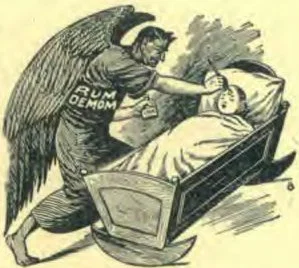
Concede, please, that the Boy’s next right, after birth, is the right to live. He did not seek this mortal being in which he finds himself. It came as a divine gift, under human conditions. No Man should be responsible for its curtailment, through responsibility for such human conditions as must imperil the divine gift. One such condition is drink in the parentage—paternal, or maternal, or both; drink, in the parent, that means death for the child.
Professor Laitinen has investigated child mortality with great care. His investigation “covered over 5,000 families, in more than a fourth of which parents were abstainers, or had been since marriage.” And he found that among the children of these abstaining parents, the mortality was 13.45 per cent, with but 1.07 per cent of abortions, while among the children of moderate drinkers the mortality was 23.17 per cent, plus 5.26 per cent of abortions; and among the children of immoderate drinkers the mortality was 32.02 per cent, plus 7.11 per cent of abortions. When drink in the parent means death for so much greater a percentage of children than results under abstaining parentage,—when, averaging the moderate and the immoderate drinking classes, drink must be held accountable for more than one half the deaths among children—are we not justified in denying to parents the drinking right?
The Boy’s Third Right
Concede the Boy his right to live, and you can not rightly deny him the right to live at his best, to live long; you surely have no right, as a Man, to weaken the blood upon which his life depends, to cripple the heart which must propel that blood, to impair the lungs which must keep the blood pure and assist the heart to maintain the life. The Boy’s right to live, as babe and Boy, is no greater than the Boy’s right to physical conditions that can resist the encroachments of disease, as Boyp. 13 and Man. It must be remembered that the large mortality among children of drinking parentage does not represent all the perils and loss for which drink is responsible through the effect of alcohol upon the blood. The Boy may live to become the Man, yet an easy prey to crippling and costly disease, a frequent burden to his family, if not a constant burden to the state. The blood of the Man must be his productive energy, as it is the seat of his protective mechanism.
Professor von Bunge conducted an inquiry as to the percentage of diseases among children in 2,051 families whose histories can be obtained, the fathers of which were none of them total abstainers. Of these diseases, where these fathers were occasional drinkers, 6.4 per cent were tubercular, and 4.3 per cent nervous; where the fathers were regular moderate drinkers, 9.4 per cent of the diseases were tubercular, and 7.6 per cent were nervous; where the fathers were regular immoderate drinkers, 17.1 per cent were tubercular, and 11.1 per cent were nervous; where the fathers were heavy drinkers, admitted drunkards, 24.2 per cent of the diseases were tubercular, and 22.2 per cent were nervous.
Without any statement as to the percentage of tubercular and nervous diseases among the children of abstainers, these figures by Professor von Bunge are painfully impressive as to the effect of alcohol upon the blood of those who do not abstain. The upward sliding scale of mortality, as the drink usage increases, is fearfully eloquent of the awful results.
Professor Landouzi, dean of the Paris faculty of medicine, and said to be “one of the most illustrious of French medical scientists,” has declared that “alcoholism is the road to tuberculosis.” According to the latest authoritative information, as to France, an appalling number of men are taking that road. As to Great Britain, Dr. John Hay, lecturing in Liverpool, lately reported that in one of the wards of a large union infirmary, devoted to pulmonary tuberculosis, there were thirty-six patients, and that, of these, thirty-four confessed to habits of immoderate drinking. The other two were children.
The admitted effects of alcohol upon the lungs, as related to pneumonia, and upon the heart, as related to the work of that organ, and the vital relation of both heart and lungs to tuberculosis, leave no room for doubt as to the effects of alcohol in spreading the “white plague,” and through that in curtailing the life of Boy and Man.
Remarkably wide-spread and active recent efforts, in this country, to cope with tuberculosis and overcome it, have shown how extensive and fearful a curse it is, although the chief cause of it has not been so generally and frankly recognized and asserted as by scientists and others across the sea.
Henri Roberts, a distinguished attorney of Paris, in an address before the Congress of Temperance Societies in Belgium last June, sorrowfully asserting first place for France in the progress of alcoholism and in demonstration of its frightful results, thus declared:—
Entire provinces, such as Normandy and Brittany, have been decimated. In some departments we have seen the population diminish by a half, in others by a third or a fourth, as a result of the ravages of alcoholism. It has been proved that forty, fifty, and even sixty per cent of the young men offering themselves for military service are unfit.
Another Right of the Boy
The right of the Boy to be born with pure blood, and his right to live long at his best, imply and require his right to be born into a sober home, and to go out of that home upon the safe streets of a sober town. To insure these rights, law must stand for them, and on the side of the Boy, not against them, on the side of the saloon. There can not be a license law, anywhere, which does not make against the Boy’s rights. No MAN CAN STAND FOR LICENSE, ANYWHERE, WHO DOES NOT ACTUALLY AND DIRECTLY OPPOSE THOSE RIGHTS WHICH, AS A BOY, SHOULD HAVE BEEN SAFEGUARDED FOR HIMSELF, AND WHICH, AS A MAN, HE SHOULD SAFEGUARD FOR BOYS TO-DAY.
According to the most conservative figures, which the least radical investigators have recorded, about fifty per cent of the crime, and over forty-two per cent of the pauperism, in these United States, are the direct result of the drink habit. This habit would not have been formed in sober homes, on streets that for the Boy were safe.
By the same conservative estimates of men far from radically minded, it has been shown that full forty-five per cent of the destitution of children is directly due to drink; and every destitute child has been robbed in some measure of his or her rights. Bear in mind, let it be said again, that the Boy has the right to live, and to live long, at his best. When drink means his deprivation, starves his life, and hastens his death, drink is not merely his curse but our crime.
WHOSE CRIME?—HIS FATHER’S, TO BE SURE, WHEN HIS FATHER IS THE DRINKER. THE STATE’S, WHEN THE STATE PROVIDES A LEGAL PLACE WHERE THE FATHER’S CRIME IS COMMITTED. YOURS AND MINE, MY BROTHER MAN, IF WE SANCTION THE STATE’S ACT, AND IF IN ANY MANNER, BY ANY MEANS, FOR ANY REASON, WE CONDONE AND PERPETUATE THE CRIME.
Patriotism alone should forbid the crime and command that it cease; for this republic is founded on manhood; and permanent prosperity, the highest welfare, will never come to our nation, until every man pays dividends on himself. He can do this only after his rights while a Boy have been safeguarded as patriotic duty requires, and under conditions that safeguard his life and labor as a Man, insure him fulness of productive years, make him a profitable producer instead of a costly consumer, and guarantee compensating return from society’s cash investment in him. Christianity and humanity should make the crime impossible. No cross of Christ points upward which does not call upon all men to protect the way where boyhood’s feet must walk. There is no licensed saloon in all this land which does not mock at Christ’s life, and, for many a sinner, nullify his death. The Christian spirit and the Christian faith, the very divine purpose out of which came the crimson cross, the heart of humanity itself, all combine in potent pathetic appeal to the soul and citizenship of every Man, that with every attribute of his, as a Man and a citizen, he shall stand for the Boy’s rights,—shall defend from wrong and injustice, from perilous tendencies and ruinous environment, the Boys that are and that are to be.