JAVA, you know, is the most densely populated island in the world, thirty-five millions of people being packed into forty-nine thousand square miles,” says Sister P. Tunheim, one of the first to take up work in that island. “Think of it! In the low-lying plains and the large cities the people throng like ants in an ant hill. The heart of the missionary is deeply stirred as he watches such scenes day after day.
“I was among the first missionaries who landed in Java, arriving Nov. 19, 1906. There was then only one Sabbath keeper on the island, but now we have sixty or seventy rejoicing in the precious truth.”
“Our first task was to begin studying the languages. This, you will admit, was no small one, as we have five leading languages in Java,—Dutch, Malay, Javanese, Mandoerese, and Soendanese. We have been able to learn only the first three. The others have peculiar written characters, which are difficult to learn to read, and also they each have two distinct dialects. When the natives speak to us, they must speak in the ‘high,’ so as to show honor; and we in return speak to them in the ‘low.’
“After some time we made the acquaintance of a Seventh-day Baptist lady who had a colony for the poor Javanese. She was very anxious that we should take over her colony and run it just as we saw fit. We finally did so, thinking that perhaps some of those who were there might accept the message; but after spending nearly three years at that place, greatly to the impairment of Sister Wood’s health and my own, we did not get any to accept the truth. Thus we put in our first five years in Java without seeing much result, though we learned the languages, and obtained many valuable experiences that have been very useful since then.”
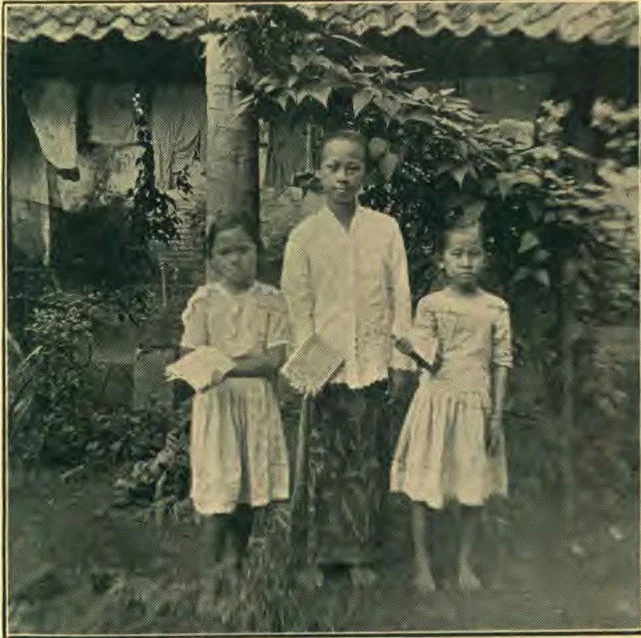
SOME OF OUR TRACT DISTRIBUTORS IN JAVA
“Nearly four years ago we started our work in the large cities. Brother and Sister Wood were located in East Java at Surabaya, and I in West Java at Batavia. Brother R. W. Munson had just started the work in Batavia, and a few had accepted the message, when he had to leave on account of his wife’s health. I have been working alone there since, for three and one-half years, and we now have a church of forty members. Most of these are earnest and faithful in paying tithe and offerings.
“We have learned that the best way to get the truth before the people is by going out among them with tracts and books, and holding meetings and Bible readings. We have tried a colony, as mentioned above, taught quite a large school, helped the poor and the sick, and provided land and work for those who could work. All this is a good work, we realize, a preparatory work, and helps to open the door for the message; but then comes the entering of the door, the test, the keeping of all the commandments, which means more to these people than the plate of rice they have been getting.”
Hearing the Gospel
“Our experiences are varied. One morning I went out visiting with Sister Kwie Nio, our Chinese Bible worker. The first house we went to was the home of a Chinese family. Chairs are luxuries in many of these homes, so we frequently find ourselves seated on a wide wooden or bamboo bench. Soon the lady of the house is seated beside us. Instead of resting her feet on the floor, as we do, she crosses them on the top of the bench in a comfortable position. After that, she pulls her betel box close to her, and from its respective compartments she takes a little tobacco, betel nut, lime, and gambier (tannin). These she rolls in a betel pepper leaf, which she puts into her mouth to make one generous chew. When this is thoroughly mixed in the mouth with a free flow of saliva, which becomes as red as blood, she pulls a large spittoon close to her, so that she can expectorate freely every two or three minutes. By this time she is in good humor to listen to the gospel. While she turns and moves the big chew from one side of her mouth to the other and frequently rubs her black teeth, she asks many questions on the different Bible subjects that we have presented. It sometimes seems strange to be in such an atmosphere; for beside us also is a large altar, where are many images which are worshiped instead of the living God. I cannot express in words the joy it gives us when we go to some of these homes after some weeks or months of study, and find the altar gone, the black mouths of the women clean, and the true altar of worship established.”
Calls for Help
“A short time ago three of our sisters went to the southern part of Sumatra to sell tracts and take subscriptions. They had very good success, and found one of their relatives who had heard the truth in Java and had worked against it, but the Spirit of God had since worked upon his heart and made it tender and teachable. He has fully decided to obey all the commandments, and has written a very pleading letter for me to come and teach him and several others who are anxious to hear more about the message.
“A man who is working in the Resident’s office in Mabon, recently received one of our tracts with our mission address on it. He then wrote to us, ordering a whole case of books, which we sent to him. These have been sold by him and by others to whom he has sent them in different adjacent islands. He has ordered many more tracts and books since, amounting to another case in all.
“There is a man in Timor who has sold more than twenty dollars’ worth of books and tracts, and has paid for them. A man from a near-by island has10written me that he has read some of these tracts and books, and feels convinced that the seventh day is the Sabbath, and wants to keep it. Thus we see the way is opening up faster than we can follow.”
What It Means to Keep the Sabbath
Brother F. A. Detamore, in charge of this great field, often meets cases in which to accept this truth brings severe financial embarrassment. He says:—
“One brother in Singapore gets eight or ten dollars a month. With this he must pay three dollars for rent, buy food for his wife and three children, and give them a scanty covering of clothes. His wife is a Roman Catholic, and scolds because he stops work on the Sabbath, when he could be working and making more money; but he brings his children to the Sabbath school regularly, and pays his tithe month by month. This is but a sample of the situation of many. Should all our people at home make as great sacrifices for the Lord, there would soon be men and means to finish the work.
“It is enough to move a heart of stone to hear some of them tell how they have to sacrifice to keep the Sabbath. One brother said, ‘I can go without food, but when the children cry for food, it is hard.’ God has blessed this brother, and now he is doing well financially; but for months he could scarcely get enough to keep himself and family alive. Do you not think that such persons love the Lord? I fancy their stars will be among the brightest that adorn our Saviour’s crown in glory.”
His Heart Touched
Our mission station in Sumatra is at Padang, the chief city on the west coast. The work was begun there nearly eleven years ago by Elder R. W. Munson and his family, who were there for about six years. A day school conducted in this field has a good attendance. Brother B. Judge, of this station, writes the following incident:—
“I have in mind one young man who was so bad that his parents, having exhausted all other plans for reformation, tried to bring him under the influence of Christianity, thinking there might be something in it that would restrain their son. However, they only wanted him to become a good young man; they did not want him to become a Christian and cast off his parents’ religion. Just as long as his parents tried to bring him under Christian influence, he did not want anything to do with it. But one day, when they were no longer interested regarding the influence of Christianity upon him, God touched his heart, changed it, and today he is a worker for God. At times when he is at work among the people, they remind him of his past life; then springs forth his testimony, ‘I am not ashamed of the gospel of Christ: for it is the power of God unto salvation to every one that believeth.’”
The Singapore Training School
In April, 1912, a church school was opened in Singapore, with an enrolment of twenty, Miss Isabel Fox being the teacher. By the end of the year the attendance of the school numbered twenty-five, and during the next two years it increased to thirty-four, the fluctuation in membership being caused chiefly by parents’ moving away from the city. At the beginning of 1915 it became the training school for this mission, under the direction of Brother K. M. Adams. At the start, the attendance was thirty-six. Seven weeks later it was forty-eight. The tuition is $1.75 a month for twelve months in the year.
On his return from the Shanghai general meeting in the spring of 1915, Brother Detamore found four Malay boys from Battakland in Singapore. They had come to be baptized and to go to school. They had sold their small farms, walked six days to get to a port, and then spent nearly all they had to come by boat to Singapore. “All we want is to know how to teach the Bible to our own people,” they said.
Concerning the work done by this school, Brother Detamore says:—
“We are doing two grades of work beyond the common branches. This is about like our intermediate schools at home, and all the work is in English. Then we have the Chinese and Malay departments, besides a class for natives who are learning to speak and read English. There are about twenty-five in the home, and fifty resident students, and there will be a material increase the coming year. Those in the home are nearly all preparing for the work, and a number of others are doing the same; so we look forward with hope to the help we shall receive from the students now in training.”
Baptism in Battakland
Again and again our hearts have been touched by the appeals that have come to us from this heathen province in the northern part of the island of Sumatra. Recently Brother John S. Yates visited Battakland, and baptized four believers. He says:—
“The work in that part of our field is singularly interesting. The government has not yet given us permission to establish a mission, hence we have no regular mission workers there. However, there are two young men, Brother Siregar (Battak) and Brother Shin (Chinese), who are teaching private schools. Both learned of the truth in Padang, and are now members of the Padang church. These brethren are spreading the message, and are entirely self-supporting. Opposers threaten them, and have succeeded in having Brother Siregar called a number of times before the government officials to answer for his faith. I talked to them about being persecuted, and they both said, ‘We do not fear what man can do to us.’”
“Brother Siregar had a list of twenty candidates for baptism. While perhaps the majority of these were keeping the Sabbath and had given up some of their bad habits, on examination only four seemed ready to unite with us. We promised the others that they also might be baptized when they are fully ready for this ordinance.
“In one year the Battakland tithe has amounted to one hundred and seventy-two guilders, or over seventy dollars. This sounds good when we remember that the average wage is only about that much a year. One month Brother Siregar reported spending a little over six dollars on home missionary work.”
A teacher for our Chinese department has been secured from the Missions Training School at Shanghai. This man, Lo Khi Kwong, does not stop working when the lessons are recited in the classroom, but goes with his students to hold Bible readings with the people. He also holds readings himself with those with whom he has become acquainted. In addition to all this he holds a meeting in Chinese every week at the church. This means that he has a sermon to prepare. The Malay teacher, Samuel Rantoeng, was born at Mendano, in the Celebes. He accepted the truth in Java. His wife has been a Sabbath keeper for several years, and they are both faithful workers.11
Loyal Hearts in Borneo
Borneo is one of the recently entered islands of the Malaysian Mission field; but at the capital of British North Borneo, Sandakan, we already have a church of twenty-two members. Many in different parts of the island are anxious to hear about the second coming of Christ. From Sarawak comes an urgent call for help. Sarawak is one of the political divisions of Borneo, and has a population of about five hundred thousand, most of whom are Dyaks.
A young man in Sandakan, who had been connected for some time with a government hospital dispensary, became convinced that the seventh day is the Sabbath of the Lord. “Shortly afterward he was promoted, and transferred to another place, with double his former salary. However, he was not satisfied to go on disregarding the Sabbath, and decided to resign, and return to Sandakan to learn what it meant to be a follower of Christ. The manager of the establishment told him that he was very foolish to give up such a position to join the Adventists. Another raise in salary was offered him, but he replied, ‘I will not work in Babylon, even if I should get a hundred dollars.’”
Only a glimpse of the work in the Malaysian Mission can be given in one article; but we hope that as your eyes are lifted up to look toward this distant field, your hearts and your interests will be united with those of the workers and believers who, like the disciples of old, are leaving all to follow the Master.