The Wheat Plant

8%

Review and Herald Publishing Company · Battle Creek, Mich. · Jun 27, 1901

FromThe Youth’s Instructor, Vol. 49, No. 26.

Read the full edition

The Wheat Plant

The grain-bearing, or corn, plants are called cereals, from Ceres, whom the ancients regarded as the goddess of corn and harvests. Formerly that one of the grains upon which any people depended chiefly for food, was called by that people “corn;” as wheat in England, oats in the north of Scotland, rye on the southern shores of the Baltic, and maize, or Indian corn, in North America.
The cereals comprise one of the largest and most important of the natural orders of the plant kingdom; this order is known in botany as the Gramineae, commonly called the “grass family.” This department of the plant kingdom is too vast to be explored in a single study, but it is of interest to form a slight acquaintance with at least some of its members. It is from this family that not only the human family, but a large number of animals, are supplied with food. “Our daily bread” is derived from the cereals. All the plants in this order are readily recognized by their strong family resemblance; first, by their leaves, which are for the most part long and grass-like, with parallel veins; that is, the veins all run lengthwise of the leaf.
The botanic name of common wheat is Triticum vulgare,—triticum signifying “to grind into flour.” Wheat is both annual and biennial, having the culm (the name given to the stems of grasses) round and smooth, from three to five feet high, bearing a head, or spike, at the top. The spike is more or less four-sided, and is crowded with spikelets, which usually bear from two to five flowers, and which contain the grains, or kernels, of wheat, although not often more than two perfect kernels are developed in a spikelet.
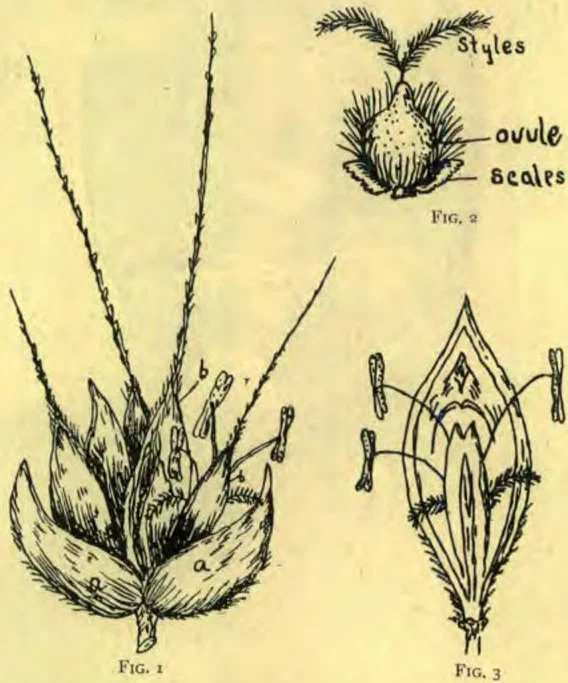
If we examine a head of wheat carefully, we shall find at the base of each spikelet two husks, or scales of chaff. (See Fig. 1, a.) These are called “glumes.” After the glumes we find that each separate grain is also inclosed in chaff. These are called “paleæ.” (Fig. 1, b.)
FIG. 1; FIG. 2; FIG. 3
Should we examine the wheat when it is in full bloom, we would discover that it has beautiful blossoms. On each little spikelet the glumes and paleæ open; and from beneath, three thread-like stamens protrude; on the end of each is suspended the silver-white anther loaded with pollen, with which to fertilize the ovule through the feather-like style, which rises from the top of the ovule (Fig. 2), and which also protrudes from beneath the paleæ. Fig. 3. It will be noticed that the flower has no corolla; nor is it needed, the glumes and paleæ serving the same purpose.
Summer wheat, commonly called “spring wheat,” which is sown in early spring and harvested the same season, is less hardy than winter wheat; the head is more slender, and its glumes are usually provided with much longer awns, or beards. Fig. 1.
As all farmer boys know, winter wheat is sown in early autumn. It lives through the winter, and ripens its seed the following summer. There are over seventy varieties of winter wheat, such as bearded, beardless, white-chaff, red-chaff, etc. Many of them are much alike, differing only in color and form, or in time of ripening; some, being more hardy, are better adapted to colder regions than others.
There is also a kind of wheat called “mountain spelt wheat,” grown in mountainous regions where common wheat will not ripen. It is a very early variety of spring wheat, but the grain is shrunken and light, yielding but little flour, and that of a very poor quality.
Wheat straw is much used in the manufacture of straw hats. The best straw for this purpose is obtained from the chalky lands of Italy. The famous Leghorn hats are made from straw of a bearded variety of wheat, which grows only about fifteen inches high, on the poor, sandy soils along the River Arno; the wheat is pulled green, and afterward bleached.
The culture of wheat is a most important one over a large area of the north temperate zone, and affords an excellent subject for study and observation during its whole life-history, from the time of sowing till it reaches our table in the form of bread or other food.
A. W. Kelley.