On the Boundless Deep — No. 9
MRS. C. M. SNOW
Arrival at Samoa
During the greater part of our voyage, after the first few days, the Pacific justified its name. We steamed regularly on, with smooth seas, sunny days, and starry nights. The heat was not yet unbearably oppressive. Awnings were stretched over the deck, and, what appeared strange to me, the sun’s rays seemed to strike at about the same angle all day. We seldom were obliged to change the position of our steamer chairs, except for wind and waves.
Those days of rest were so soothing, after all the hard work and heartbreak preceding them, that we were almost reluctant to see Tutuila, the island of which Pago Pago is the capital. This was to be our next stopping place. The day before reaching there was very warm, for the wind traveled with us. All our party were busy writing letters and cards to be mailed when we landed.
We could scarcely realize that we were rapidly nearing, yes, almost at the door, of those “Islands of the Blest,” around which the late Robert Louis Stevenson wove undying romance. Only a few hours off lies Apia, his former home. “By the way, Louis, how do you get to Samoa, anyhow?” asked a friend, on being invited to visit him there. “Oh, easily,” replied Stevenson. “You simply cross the continent to San Francisco, and it’s the second turning to the left.” This we have done, and are now at the second turning to the left. Small steamers ply between Pago Pago and Apia, the latter until recently the capital of German Samoa. Thus passengers are afforded an opportunity to visit the home of this gifted writer, and also his grave, on the summit of Mt. Vaea. The round journey may be made in about twenty-four hours.
When first the Samoan Islands are sighted, they appear as a hazy blue, jagged mass, with the summits in a bank of clouds, of which they seem a part. In the distance, the coast line seems low and regular, but a nearer view shows it to be lofty and rugged. The steamer forges ahead, steering directly for the highest peak. As it glides around the point into the sequestered harbor of Pago Pago, a novel sight is opened to view. It has entered the broken crater of an extinct volcano, whose steep walls rise all about the bay shore, hundreds of feet, crowded with vegetation from the rim of the sea to the crests of the highest peaks. The slopes are clothed in deep forests, with but space for a narrow road and a few native huts at their base, among the coconut and breadfruit trees near the shore.
The “bos’n bird,” first seen off the coasts of Oahu, again appears; and the bonito, the especial delicacy of the Samoan, leaps from the water, which is of almost glassy smoothness. The land breeze is moist and soft and as fragrant as that of a greenhouse, laden with odors of orange blossoms, jasmine, and gardenias.
Samoa, like the Hawaiian Islands, is a group of islets built by volcanic forces aided by the work of the coral polyp. They are generally counted as thirteen, but the number varies from less to more, depending on where one draws the line between an islet and a mere rocky crag. Three, however, are by far the most important in size and population, Tutuila, Upolu, and Savaii. They are thoroughly tropical, lying between 13° 30′ and 14° 30′ south latitude, and between 168° and 173° west longitude. They are thus quite near that mysterious line where the ship suddenly sails out of one day into the second succeeding day, or into the day before, depending on the direction she is sailing.
Tutuila is seventeen miles long and two hundred and thirty in circuit. It contains the harbor of Pago Pago, which was ceded to the United States as a coaling station. The whole island is now, by the new treaty, a possession of the United States. The harbor is pronounced one of the few almost perfect harbors of the Pacific. It was very pretty sailing into and out of this long, narrow harbor, which reaches far back into the center of the island, almost cutting it in two. With its high, encircling hills covered with tropic vegetation, it is a land-locked harbor of majestic loveliness, and we enjoyed the beauty of it all with keen delight. Our stop here was a bright little spot in our long journey.
Long before the anchor was cast, we could see countless natives scudding toward shore from the almost hidden native habitations along the shore. Some paddled out in their canoes filled with fruit and curios; others, with heaped-up baskets and with arms full, ran through the groves toward the village. As at Honolulu, the ship was convoyed to her anchorage by a perfect flotilla of native boats, clinker-built rowboats and native canoes—each with outrigger. The boats are filled with dusky-skinned, half-dressed natives, with wares for sale. The oars of the rowers, men and women, are timed to a wild, melodious chant.
Formerly if one wished to land here, he must take one of the numerous boats and be rowed ashore; but we anchored close to shore, the gangplank was placed, and the passengers allowed to go on shore, after the usual official ceremonies. As this is a United States naval station, no cameras are allowed. The gayly dressed officials and the band members, in their red and gold costumes with many decorations, made a gay picture, and the music was fine—sometimes lively, then full of wild pathos. The band played the most of the time during our stay, from 8:30 A. M. to about 1 P. M.
The “Sierra,” had brought a quantity of lumber and oil to Pago Pago, and it took much time to unload this, for here no one hurries. It seems the home of idleness or perhaps ease, that sits so calmly on this charmed isle—the peace that begets comfort and contentment. But the time was too short for us to see all that we wanted to. We would gladly have remained longer.
Samoa and Her Children
Pago Pago is an exquisite spot—exquisite in its entrance, the coral reef marking with a sharp, clear line the deep-blue color of the ocean from the olive-green color of the lagoon within; exquisite in the contour of the land, the fair scenery, and tropic flora and fauna. The most interesting attraction, however, is its people. Samoa is said to boast the handsomest race in the Pacific.p. 10 Physically they seem to be almost perfect. The men are large, well proportioned, and fine specimens of manhood. The women are gentle in disposition, graceful in form and movement, and attractive, with their simple, natural manners. Many of the younger ones are truly beautiful. And they are not without a consciousness of their grace, which they enhance with wreaths of the dark-scarlet hibiscus flower, and the lighter scarlet of the pomegranate blossom. I shall not soon forget the bright, laughing glance flashed to me from one of the beautiful, dark-eyed girls we met. I was admiring a scarlet flower in my hand when they passed. With the utmost grace and with smiling eyes, she motioned to me to put it back of my left ear. That is where they wear them, and very pretty they look amid their black locks.
The natives possess warm-brown skins and straight black hair. The Samoan dandy, however, who is much taller than the average kawaka, frizzes out his hair and bleaches it a Titian red with lime, which he gets by burning the coral of the reefs. Several men we saw were undergoing this process, and made a curious spectacle with their heads liberally covered with white lime, and the red and black hair peeping out underneath.
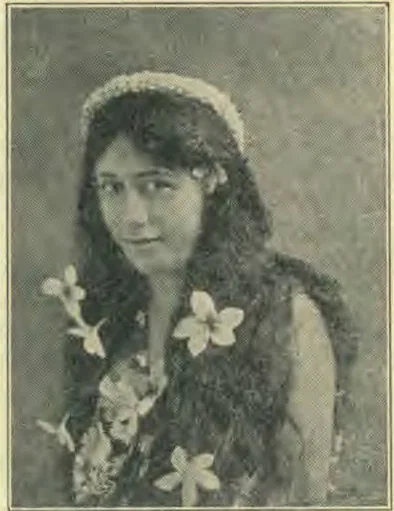
The Samoans have a passion for embellishment and decoration—not for clothing, but adornment. Their costumes are very brief, often consisting of a square of mulberry bark cloth about their loins, a necklace, armlets, or anklets, or a piece of string about the neck, arms, and ankles, in lieu of the more costly adornments; and, if a warrior, a tall and fantastic headdress. Besides this costume they wear an abundant coat of coconut oil, which causes them to glisten as if varnished. They also keep the hair well anointed with coconut oil. The men are tattooed, many having a pair of trousers tattooed on legs and hips, reaching to their waist.
They are not a warlike people, but peaceable and quiet in disposition, and have a strong love for their homes. When, however, aroused to fight, they become wild, cruel, and desperate. As these islands belonged to three different nations, there has been strife and loss in protecting their respective interests. Cyclopedias give instructive accounts of their history.
The native houses consist of great circular or oval roofs on posts and thatched with sugar-cane leaves. Coconut leaves plaited together form curtains for the sides which may be raised or lowered, according to the weather. They look some like large beehives. A few buildings on the beach of Apia are solidly built of coral rock. The Catholic cathedral is also there, for there the bishop of the South Sea islands resides.
In a stroll along a narrow rim of shore we caught many glimpses of island life in all its primitive simplicity. On the hillside we visited a native hospital. Here the children ran about as nature clothed them. If one member of the family is ill, all come to the hospital to remain until the sick one recovers. If compelled to go to a hospital, I should prefer one of our sanitariums. We were made welcome at a native house, which was neat and clean. I think these people were from Fiji. Pastor Fulton and the woman carried on an animated conversation, of which we could not understand a word.
And this reminds me of an old friend Pastor Fulton found here—a derelict boat in which he had made some of his earliest voyages. In this coincidence was a plain illustration of the difference between an inanimate object and a human being. A machine may work and work, but grow no bigger, stronger, or better; in fact, it retrogrades. But man, if he is the right kind of man, grows wiser, braver, better the more he endures. Here were these two old comrades, side by side once more. One was tipped up on its side high and dry, out of business; the other, after years of strenuous labor, was now, with heart divided between Fiji and Australia, about to enter a yet harder field, and already his heart and mind and plans were speeding onward to the Orient.