EVERY revolution has its victims. Standing out prominently among those of the recent one in Russia are four girls, whose names have barely been mentioned in the great cataclysm that has swept away their father’s throne, and whose fate is about as tragic as that of any of the heroines of old Greek drama.
I am thinking of the daughters of the man who, a few months ago, was the mighty czar of all the Russias, and who is now nothing but a prisoner in Siberia. No one has had a word of pity for these girls, who, born amidst all the pomp of the most luxurious imperial house in Europe, find themselves today outcasts among their own people; who have lost their position, their rank, their fortune, everything they ever possessed, and who stand, helpless and unknowing, in the presence of a future as uncertain as it is threatening.
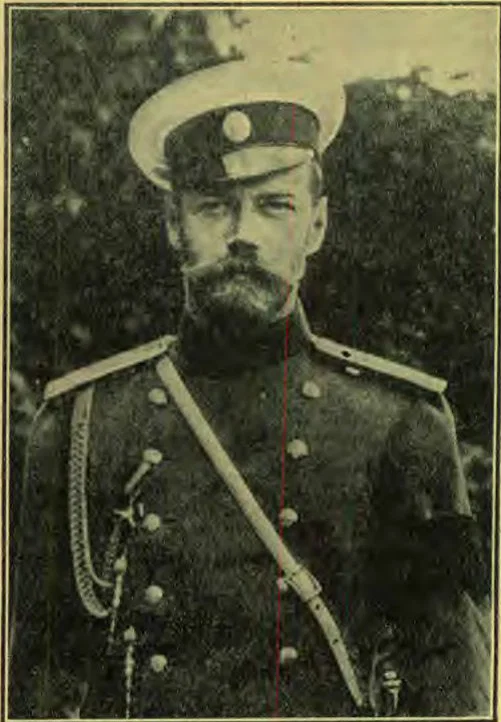
NICHOLAS ROMANOFF, THE DEPOSED CZAR OF RUSSIA
There are people who seem to have been born to misfortune, and the daughters of Nicholas II undeniably belong to the number. First of all, their births were nothing but a series of disappointments for their parents as well as for the Russian nation, who had, each time, hoped for an heir. When Olga, the eldest one, made her appearance, people grumbled, but thought that the expected boy would follow. Tatiana’s birth was a source of regret, and, as her two younger sisters arrived in due course, the nation began to express its discontent quite loudly, and, even among the imperial family, their advent into the world was considered in the light of an actual misfortune. For long weeks, the empress would not even look at them, and the babies were left entirely to the care of a nurse, at first, and of a governess afterward. Happily, the latter, Mademoiselle Toutscheff, was a person of great distinction, who took to her heart the forsaken children, and tried to give them some of the maternal love which was denied them by their own mother. She brought them up admirably, but, unfortunately, had to resign her functions a few months before the breaking out of the great war, owing to some disagreement she had with the empress, on the subject of Rasputin. She objected strenuously to his constant presence at the side of her pupils, and went so far as to speak to the emperor about it. The latter would not do anything to remove his daughters from the nefarious influence of a man who has been the evil genius of the House of Romanoff, and Mademoiselle Toutscheff left the young grand duchesses.
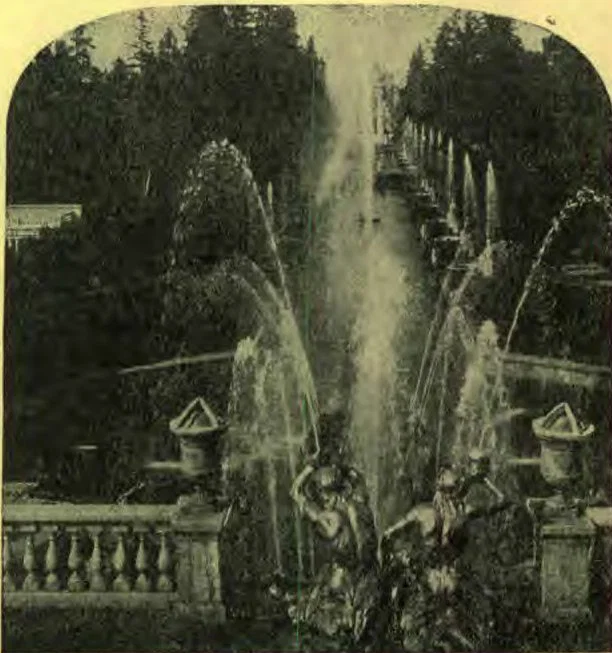
WINTER PALACE OF THE CZAR OF RUSSIA
Her departure was, for the latter, the first great sorrow of their existence. It left them entirely alone, since their mother deliberately avoided their companionship, and, although under the same roof, sometimes spent weeks without seeing them. The girls had no friends of their own age, no one to turn to, no one with whom they could have shared the pleasures, such as they were, of their existence, or its sorrows. They were not even allowed to visit their relatives, and they found themselves compelled to seek, within their own resources, the chance to live otherwise than in a purely mechanical manner.
Their days were spent mostly out of doors, in the park of Tsarskoie Sélo, where they had liked to wander ever since their baby days. Pomp and luxury surrounded them; they had fine dresses, jewels, and everything they might have wished for; but these girls required something more than that. They had generous hearts, noble souls, and minds far above those of the people with whom they lived. They had felt, without perhaps being aware of it, their ostracism by Russian society, on account of their mother, and they had suffered from it perhaps more than they had allowed the world to guess. Their existence has been an entirely unnatural one, and it is not surprising that it has transformed them into sad girls, who seldom smile, and who seem to be always expecting some misfortune or other to fall upon them.
The eldest daughter, Olga, was her father’s favorite, and has devoted herself to him ever since she could understand his position, together with her own. The unfortunate czar, who was so lonely amidst the splendors of his existence, found in his daughter the sympathy he had been unable to meet with in his wife, and the two became far more intimate than is even the case, generally, between parent and child. Olga walked with Nicholas II, she read to him, she tried to render6to him every small service that she could, and she more than once declared she would never consent to marry abroad, because this would surely entail her leaving him.
The emperor, on the other hand, fond as he was of this lovely daughter, would have liked to see her settled in life. He realized how different her existence was from that of other young princesses of her age, and he felt sorry for her, as well as for her sisters. It was partly for this reason that when the idea, first of a Serbian, then of a Rumanian marriage, for Olga Nicolaiewna was suggested to him by M. Sazonoff, then Minister of Foreign Affairs, he caught eagerly at it. The two princes received a warm invitation to pay a visit to Tsarskoie Sélo, and when they arrived, every opportunity was given them to see the grand duchesses, but neither of the latter would allow themselves to be persuaded to accept the prospect opened to them, and so the thing dropped, partly because of their aversion for it, and partly because the war broke out, which put aside every thought of matrimony for the daughters of the czar.
The two eldest girls were, at that time, nineteen and seventeen years of age. They had been seen only once in society, on the occasion of the anniversary of the three-hundredth year of the accession of the Romanoff dynasty to the throne of Russia. A great ball was given in Petrograd, in celebration, at which Olga and Tatiana were both present, chaperoned by their grandmother, the Dowager Empress Marie, as their mother only showed herself for a few moments at this festivity. The girls were immensely admired, and seemed to enjoy themselves thoroughly, dancing until the early hours of the morning. It was their first and their last appearance at any public entertainment, and the world who saw them then, was never to do so again—at least not as daughters of a reigning monarch.
When the storm burst, and the war broke out, Olga and Tatiana Nicolaiewna came out in their true colors. The emperor appointed them to the head of two relief committees, one of which was to deal with the difficult question of handling the refugees from the provinces which had fallen into the hands of the enemy. It was Tatiana who undertook the latter piece of work, whereas her sister Olga busied herself with the orphans left by soldiers fallen in battle. The sisters took most seriously the duties which had devolved upon them. They worked indefatigably, night and day, giving thus the denial to criticisms which had accompanied their appointment to such responsible posts. People, hearing about it, had shrugged their shoulders and declared that girls brought up as the young grand duchesses had been, could not possibly understand anything of relief work. But the lessons of Mademoiselle Toutscheff had not been lost on her pupils, who, suddenly, to the amazement of everybody, developed qualities which no one, not even those who knew them well, had ever supposed they possessed. Tatiana, in particular, proved herself an absolute wonder. Not only did she enter into every detail concerning the activity of her committee, but she visited, personally, all the various institutions which had been opened by it in different Russian towns. She sacrificed every penny of her large private income to the relief of the unfortunates, refused to buy even a new dress for herself during the two years that she busied herself with her work; she gave up her time, her activity, her thoughts, her energy, entirely to the suffering mass of humanity whose care she had undertaken, and, when one day her father urged her to take some rest, she replied that it would be unworthy of a Russian princess to do such a thing, while so many Russian soldiers were fighting at the front, without a thought of sparing themselves, in the service of their country.
The soldiers at the front, whom she often visited, simply worshiped her. They detested the empress, whom they would scarcely consent to salute, but whenever Tatiana Nicolaiewna appeared, she was greeted with shouts of enthusiasm. They called her “Nacha Tatianouschka,” “Our little Tatiana,” and whenever they saw her pass, in her white apron and kerchief of a sister of mercy, they crowded around her, and begged her to bless them.
By the side of the two elder grand duchesses, their small sisters were encouraged to imitate their example, and, very probably, would, in time, have also tried to do good around them. But the revolution came, and, not only deprived them, together with Olga and Tatiana Nicolaiewna of their position in the world, but also robbed the latter of what was far more precious to them than their rank and wealth—of the possibility of service. The committees over which they had presided were handed over to other people, and the two girls, helpless, saw the greatest interests of their whole life taken away from them, and found themselves, not only prisoners, but also useless members of a society for whose welfare they had worked with such energy.
What will become of them now, it is difficult to guess or to foresee. According to the custom observed in the Russian imperial family, the sum of two million rubles was always deposited in the State Bank, in the name of every grand duchess on the date of her birth, and the interest of it accumulated until she had reached her sixteenth year, when it began to be paid out to her. To this sum was added whatever the reigning sovereign chose to give her out of his private pocket, when she married, or after his death. This fund has been confiscated, together with the rest of the fortune of Nicholas II, and of his family. The question arises how these unfortunate people are going to live, in the still problematical case that they are permitted to leave Russia for abroad. They have priceless jewels, it is true, but, even if they are permitted to take them with them, will their sale be sufficient to insure for them an existence anywhere approaching the one to which they have been used?
When their father was compelled to abdicate, they were both desperately ill with a complicated attack of measles. They could not even be told of the change that had taken place in their destiny; but they were, alas! to understand it all too soon. Their servants left them in haste, their attendants fled from them. They were abandoned in their splendid apartments, surrounded with the luxury which was the only thing they had ever known; but not one housemaid could be found to sweep their rooms, or one valet to bring them their food. Had not the duma sent a doctor to attend the sick family of Nicholas II, it would have missed even medical care. The ingratitude of the world never showed itself in a more brutal manner than during those days when Russia, who for centuries had been prostrated at the feet of her czars, forced the last of them to abdicate.
It is related that when Olga Nicolaiewna was told that her father had been taken prisoner, she turned her head to the wall and wept silently; then, addressing the sister of mercy who was sitting at her bedside, she simply said: “All this is nothing, provided I am allowed to be with papa; poor papa, he will be the most unhappy among us all. Let me get well, and I shall7go and throw myself at the feet of the new government, and ask it for only one favor, and that is to be allowed to remain with papa.” And when the former czar at last reached Tsarskoie Sélo, and could proceed to his children’s bedsides, the Grand Duchess Olga extended her arms toward him, with just these few words: “They shall have to kill me, before they do anything to you.”
Olga and her sister regretted nothing of all that they had lost. They cared not a whit for the splendor, for the pomp, for the luxury in which they had been reared. Their only thought was for their father, and for him alone, and they did not seem to realize that they now stood in the world far more lonely and miserable than all the poor people whose distress they had applied themselves to relieve, for two whole years. They had lost everything, even the pity of others. They had to leave the home in which they had been born and reared, the palaces and parks of Tsarskoie Sélo and Peterhof, the magnificence of the Winter Palace in Petrograd, the sunny shores of the Crimea, where their vacations had generally been spent, for the solitudes of Siberia. And these girls for whom life seemed destined to be so bright, on the day when they were born, stand, at present, before the unknown future, an unknown which perhaps shall be as tragic as was the life of that other victim of the passions of a revolution, the daughter of Louis XVI and Marie Antoinette—the woman whom history was to know as the last dauphiness.—Princess Radziwill.