To the one who loves the out of doors and has learned to harmonize himself with wild and pristine surroundings, nothing is more enjoyable than an early morning stroll in the woods,—the more wild the better,—in paths and bypaths of forest trees. In treading the aisles of these airy cathedrals one has opened to vision the varicolored pages of the book of nature and an open sesame to pleasant surprises and joyous hours.
The trees are the homes of the birds, and morning time is bird time. Then their happiness is at its height, and is expressed in carols and bursting melody that breaks the light of day. Trees stand for grandeur, growth, and time. The boy who plants a chestnut tree may live to enjoy its fruit, but the life of the tree is longer than the life span of that boy. Those ancient olive trees of Greece under which Cicero declaimed are still producing olives, and furnishing us today with olive oil. The giant redwood trees of our western coast may have been shootless and started their course heavenward when the angels proclaimed the birth of Christ.
On a hot August day, how grateful the shade afforded by trees to bird, beast, and man. The fruit they produce is of the highest dietetic and digestive value. While perhaps per pound they do not all contain the amount of nutrition found in other foods, we must except the nuts, for here we have in concentration all elements of nourishment, including salts and vitamins, that are required for man.
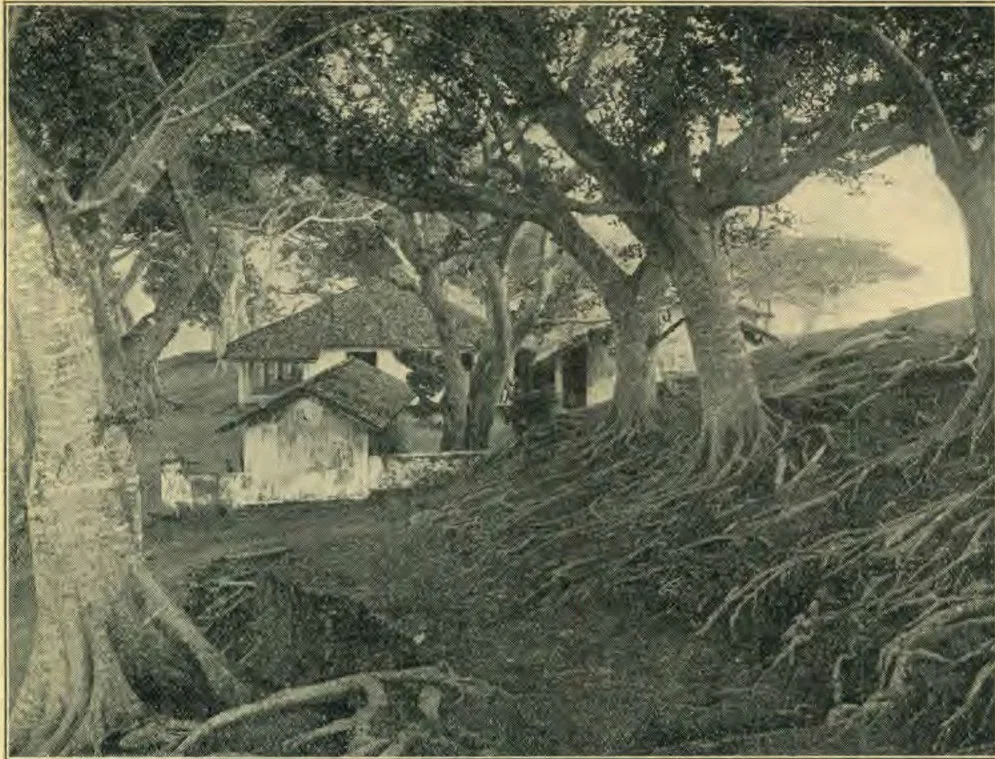
Who Can Identify This Tree by Its Roots?
To the student of forestry, every tree is a friend, and affords an opportunity for study; but all men should become acquainted with the trees. Can you tell a black from a red oak; a chestnut oak from a chestnut tree; a pin oak from a white oak, or on which6the acorns grow? Or can you tell a buckeye from a horse chestnut, or the difference between a yellow and an Ohio buckeye? What is commonly thought to be a horse chestnut, a tree frequently found along our avenues, is not a horse chestnut but a yellow buckeye. You may recognize it by their fan-shaped leaves.
For years I walked through parks and wooded tracts, and simply saw trees. From my boyhood experiences I was able to identify the shagbark hickory, walnut tree, and chestnut; for it was from these that I gathered bushels of nuts. I knew also the oak, willow, and cottonwood; but I could not distinguish the various kinds of oak. In our parks there were many stately trees that I admired, yet to me they were merely trees. But to make friends of the trees one must become acquainted with them; individualize them, and learn to call them by name.
In the month of May one will see along park driveways a tall tree, spotted with tuliplike, greenish-yellow flowers having a splash of orange near the center, forming a golden ring. This is the tulip tree that often reaches the height of two hundred feet or more. Now, any month of the year, this tree, so stately and so tall, may be recognized by its distinctive bark or by the graceful shape of its leaves, which seem to have had their tips cut clean across. If you once get to know the sycamore tree, with its peeling bark, white trunk, and broad leaves, you will never make the mistake of calling it a birch, and think that it was from these that the poor Indian got his bark to form his canoe. Ask the boy, and he will tell you that it is a monkey-ball tree, and throughout the snows of winter its branches are covered with brown balls.
Another tree, a native of China, that is possessed of both grace and beauty, is the ginkgo tree, or maiden-hair tree, with its big waxen leaf that renders it quite distinguishable from any other. Another rare tree that you will see now and then is the redbud or Judas tree. This dainty tree, with broad, flat head of smooth, thornless, angular branches, with its heart-shaped leaves, flowers in the month of April, before the leaves appear. Its purplish rose-pink blossoms of the pea type cover the whole tree with a wealth of bloom that will take long to efface from memory.
In the parks of many cities, usually found grouped in threes, are sassafras trees. The chestnut, like the sassafras, has a tendency to grow in clumps of three or six or more.
Other trees which have become close friends of mine are the spreading magnolia, the umbrella or catalpa, silver maple, ironwood, poplar, and Japanese cherry. Others interest us and claim our admiration, but the fairest, daintiest, loveliest of them all, like sheen on the new-mown hay, like wisps of mist in the morning; the most feathery, the most entrancing of them all, dressed like a fairy in green, is the tamarix. This African tamarix is a rather low-growing tree. It is composed of material that dreams are made of.
The trees are clothed with living green;
Each one to me is a dear friend,
Each branch a thought, each leaf a word,
They move my heart, inspire my pen.
A. W. HERR, M. D.