A Tongan Wedding

5%

Review and Herald Publishing Assn. · Takoma Park Station, Washington, D. C. · Oct 23, 1917

FromThe Youth’s Instructor, Vol. 65, No. 43.

Read the full edition

A Tongan Wedding

H. L. TOLHURST
The brother of one of our church members was to be married; and as we desired to learn all we could of native customs and ceremonies, we were glad that the opportunity would be ours of seeing this wedding, which was to take place in our village. A Tongan wedding conducted according to native style, is worth traveling far to see.
Days of preparation precede the event, but the preliminaries proper begin the day before the wedding. First, the female relatives of the bridegroom convey to the home of the bride’s parents a present consisting of a roasted pig, with other foods, cooked in a native oven. Then his male relatives bear a similar present to the bride’s parents.
The wedding ceremony was performed in the Tongan Free Church. The building was well filled with expectant friends and relatives. After a lengthy delay, owing to the nonattendance of the bride’s father through indisposition, a substitute was found. When everything was ready, the contracting parties entered the church by a side door, the bride walking behind the groom.
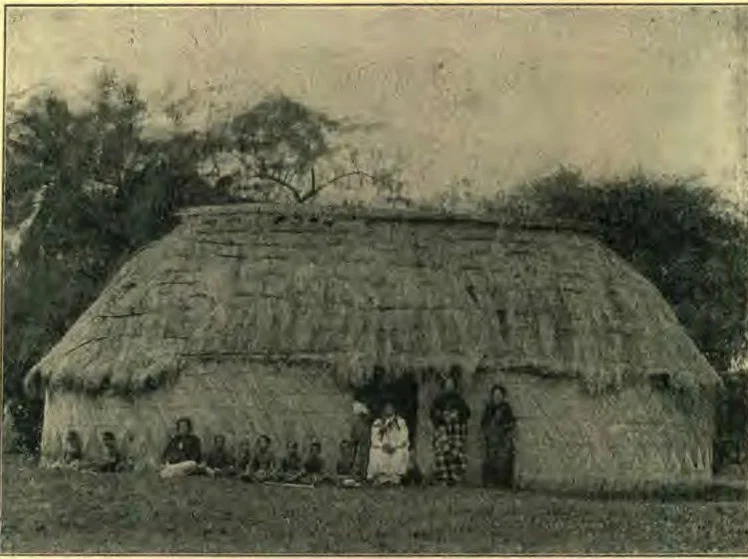
NATIVE HOUSE, TONGA
NATIVE HOUSE, TONGA
The bride wore few of the dainty things worn by European brides; but according to native fashion, both she and the bridegroom were well dressed. Over her dress, which came a little below the knee, were several valuable native mats, woven from the long, slender leaves of a certain plant. These mats were so fanned out at the bottom that a few inches of each was showing beneath the one above it. The top one was finely woven and beautifully ornamented with red feathers, and must have been quite an expensive article. These mats were turned over in a huge roll under the arms, preventing the hands from hanging by the side. The groom was similarly attired in native mats. He wore a singlet with short sleeves. In fact, both had bare arms and legs, which were plentifully besmeared with scented oil.
The two who were that day to unite their destinies took their places in front of the officiating minister, each sitting on the knee of a relative, though this custom is not always followed in the church. Certain preliminaries which usually are attended to in the vestry were performed. When the groom was asked his age, he excitedly turned to one of his relatives and asked, “How old am I?”
The service was about the same as others we had witnessed in Australia. When the minister asked, “Who gives this woman to be this man’s wife?” the one fulfilling this function stepped forward and taking her hand placed it in the hand of the bridegroom. After prayer, the minister kissed both the young people, as did also several relatives.
The ceremony being over, all left the church, the bride repairing to a building where she changed her attire, and the bridegroom going to a house in another part of the village. Soon a procession bearing a large basket of food passed along the street toward the house which the bride had entered. They were cheering as they went, and two of them were decorated with native mats. These were relatives of the bridegroom, and were bearing a present from his family to that of the bride.
Later a large procession approached with great noise and much cheering. It was the groom with his attendants, on his way to meet the bride. She had rearranged her toilet, and was awaiting his arrival. He marched in front, attended by a young relative of his mother, who carried a basket containing a bottle of oil. Frequently the attendant called a halt, while he oiled the bare legs of his charge. This seemed to be an essential proceeding. The head of the groom had been anointed with oil and liberally sprinkled with sandalwood sawdust. Next came a column of women dressed in native cloth, marching two abreast. One row consisted exclusively of the bride’s relatives and the other of the groom’s, and between them they bore a large native mat, measuring perhaps thirty feet by eight feet. Upon reaching the place where the bride stood waiting, they all turned and came toward us a little way, and then turned back to meet her. The whole procession then marched to the proposed scene of the feast. Sometimes this wedding feast does not take place till some weeks after the marriage ceremony is performed.
The procession was headed by relatives of the bride, bearing aloft enormous rolls of native cloth and other presents. The bride and groom followed, and after them was carried the huge mat before mentioned. Bringing up the rear were several male relatives of the bride, carrying thirty-two pigs of various sizes, two baskets of fowls, and one of fish, all cooked. After taking these to the place of the feast, they returned for the large pig, which is never absent on such an occasion. Soon they appeared, dragging it on a sledge made from the branch of a tree, the idea being that it was too large and heavy to be carried.
At the place where the crowd assembled, we found the bride and bridegroom each seated on the knee of a relative beneath a booth erected to shelter them from the sun. The presents were spread out before them on the grass, and the baskets containing pigs and other food were arranged in two long rows, with the largest pigs at the head of the lines to the right of the bridal party, and the smallest ones on the extreme left, at the bottom of the lines. The people sat on the grass near at hand.
As they sat thus, an influential member of the bride’s family began calling out such expressions as, “Good work,” “Good food,” a member of the groom’s family repeating the words in the same tone of voice. Shortly the order was changed, the member of the bride’s family repeating the call made by a member of the groom’s family.
The master of ceremonies, who was of the bride’s family, ordered the baskets of food to be examined. Each basket must contain other food besides the pig. Such omission is counted an unpardonable offense. After the examination, the presents were counted. There were found to be sixty-three pigs in all, besides twenty-nine baskets of fish and fowl.
The kava bowl was now brought into requisition. The root of the kava plant is pounded between two stones and then mixed with water in the bowl, which is a wooden vessel shaped much like a washbasin. It is fashioned from a single piece of wood, and is often handsomely carved. After being thoroughly mixed, the kava is strained through fiber. The latter is held in both hands and drawn through the bowl toward the operator, gathering up the particles of pounded kava root in its meshes. It is then wrung out and the small pieces of root shaken out of it, and the process repeated. The movements of the operator’s hands are very graceful. On such an occasion as this a complete kava plant, leaves and all, had to be provided; though, of course, the root only was used in the preparation of the beverage.
While the kava was being prepared, a gap was made in the lines of baskets through which the bridegroom passed, wearing a mat that trailed far behind him. He was accompanied by a female relative. Having reached the place where stood those in charge of the proceedings, the mat was taken as a present for the bride’s father. The two then departed, but soon returned with a long piece of native cloth, perhaps twenty yards long, which had one end fastened round the groom’s waist. This article went to the bride’s mother. They were both presents from the bridegroom.
At this stage the large pig was cut up and divided between the two families. Then all the food was distributed, each family receiving its share, to be taken home and there eaten. Very rarely do the Tongans at their feast eat together after the style of our picnics.
The preparation of the kava having been completed, one man filled a coconut-shell cup with kava, and called out in a very loud voice, “The kava is poured out.” The one in charge of the kava party answered him, “Take it for Jone.” Jone claps his hands to indicate his whereabouts in the kava ring. The vessel is handed to him by an attendant, who turns away while he drinks the contents, and then returns for the cup.
When the bride’s kava was announced, the bridegroom served her. No one else might do so, though it is quite permissible for him to wait upon others also, as he did on this occasion. The bride was the third to be served, as the person of highest rank, or the one being honored, is always the third served. This is the rule with the Tongans. Tradition explains the origin of the practice thus: One of the ancient kings, having heard of kava for the first time, procured some and decided to try it for himself. But desirous of having it tested first, he had some given to two of his officers. After waiting for some time, and observing that no harm befell them, he ventured to drink. So it became an established custom for the one in whose honor the kava party is given to drink third.
We were surprised on preparing to leave for home, to have presented to us a portion of the food. It is customary thus to provide for any visitors or strangers who might be present. Knowing our views on the question of unclean foods, they did not include swine’s flesh in what was given to us.
We praise God for a message that is calling out from the Tongans a company who forsake the feast of unclean things, the kava bowl, and the pipe, in preparation to meet their coming Master.