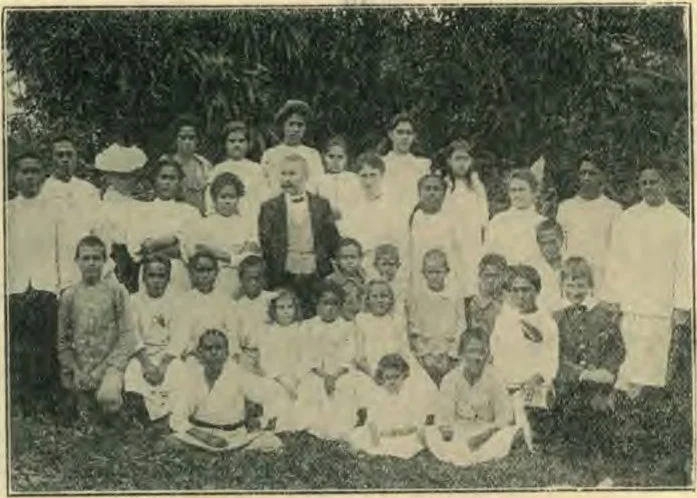
TEACHER AND PUPILS AT SCHOOL, NUKUALOFA,
FRIENDLY ISLANDS
IN a hospital where I recently had to spend some time I overheard a young man telling a friend that his failure to secure an education, because of his poverty, had been the greatest misfortune of his life. It had put him in a class with the common day laborer, he said, which meant that he must work long hours and receive poor pay.
After his departure, his friend came over to my bed and said: “What do you think? That fellow you saw me talking with a bit ago is twenty-five years old, and he can neither read nor write.”
Among those who heard the remark, some said, “What a pity!” others, “What a mistake!”
It was neither a pity nor a mistake: it was a crime against manhood. I know from my own experience that that man, if he had really wanted it hard enough, could have had a college education.
In the earlier years of my life I was denied, as thousands of others have been denied, the privileges of a common-school education, owing to the fact that I was almost a helpless cripple, due to an injury to my spine.
My father and mother — both hard-working people, though extremely poor, with a family of seven to feed, clothe, and educate — sacrificed as only parents must sacrifice in order to provide me with competent surgical aid necessary to effect a cure, while at the same time seeking to fulfil their obligation to the rest of the children. As soon as my physical condition would permit it, I was put to work.
It Was “Up to Me”
I knew that my parents had done for me all that was in their power.
It was now up to me to make good — to get for myself the education that they had been unable to give me.
How was this to be accomplished when I was twenty-four years old and working from ten to twelve hours each day in a blacksmith shop?7
There was a free night school that held out an opportunity to me; but the question of buying clothes, books, and paying board raised difficulties that seemed sometimes too great to be overcome, and yet they must be overcome.
I purchased at a secondhand store the books that were needed in the night school, and resolutely started in. The course of study covered a period of six weeks.
As soon as the school closed, I interested one of the teachers in my ambition, and enlisted her aid. When I laid my plan before her, she gladly gave me the aid I was seeking. Thus, after weeks of self-denial and sacrifice on her part, she made it possible for me to pass the required studies admitting me to college.
Not Even Railroad Fare
But my hardest fight was yet to be fought. I had the qualifications necessary for admittance; but, as the time drew near for the opening school term, I became painfully aware of the fact that I did not have enough money to pay even my railroad fare, let alone the matriculation fee, board, room rent, books, clothing, etc.
It was a discouraging situation. Yet I held to the hope that, if only I could continue to raise the money necessary to get me to the college, I should surely be able to find some work, out of school hours, that would assist me in meeting my expenses while there.
So, with this thought in view, I sought out a publishing house, and succeeded in getting a line of religious books and Bible cards to sell. The books retailed at one dollar each, and the cards sold for one dollar a set, paying me a fifty-per-cent commission.
I put in a month with the books and cards, and succeeded in getting together enough to pay my railway fare and the first term’s tuition fee. However, when this was done, it left me nothing with which to pay board, buy books, clothing, etc.
Nevertheless I determined to let the future care for itself, and set out for the college.
I introduced myself to the president, who listened attentively to my story, and said:
“I am deeply interested in the struggle that you are making for an education, and would gladly help you if it were in my power; but you are only one of the many that have asked for work. However, if you desire to return in September and try it out, I will promise you the first opening that we have.”
It occurred to me that I might possibly pay my way with the books and cards that I had been selling. I asked him what he thought of that plan, only to receive the unhappy information that the same books and cards were being sold in the territory adjacent to the college by another student, who was working as I was to secure an education. Of course I could not infringe on his territory.
Getting a New Grip on Myself
It seemed to me that my last hope had been taken away. But I was unwilling to admit defeat.
I think that college president must have known something of my disappointment, for he said, as he placed his hand on my head:
“Never mind, my boy. Remember, the darkest hour is just before day. You have the mettle in you that makes men, and I’m sure that you will win out.”
These words put new life into me. I took a new grip on myself, and determined that I would win out.
I paid the entrance fee out of the money I had on hand, and decided to trust to my ability to find work to pay for everything else. I would go as far as the money I had on hand would carry me. At the end of that time, if I could not make it go, it would be time enough to think of failure.
There were still three weeks before the term opened, and I continued the book business as vigorously as possible in territory near my home. I was successful in making enough money to pay my board while at home and to buy a new suit of clothes and an overcoat.
When the time came for me to say good-by to my friends, I took an invoice of what I had on hand, and discovered that I had my railroad ticket and $19.75 in money as the grand total of all my earthly possessions. Yet I was happy. Indeed, it seemed to me that I never was so happy in all my life as when, on the opening day, I took my seat beside the other students.
Managing on Twenty Dollars a Month
By close figuring, I found that by doing my own washing, ironing, and cooking I could manage on twenty dollars a month; so, with my $19.75 as a working capital, I realized that I had at least one month’s grace, in which I could organize myself and have an opportunity to find work.
I opened a “pressing parlor,” and charged the students twenty-five cents each for pressing their trousers. This was the only source of revenue I had the first month of school.
At the end of that period the president of the university, true to his promise, notified me that the faculty had elected me to fill the position of college postmaster.
My duties were to gather the outgoing mail from the college and carry it to the post office in the village, a distance of a mile. I made three trips each day — at 7 A. M., 12 noon, and 7 P. M.
This gave me a six-mile walk each day, and provided me with needed exercise, besides paying me a salary of ten dollars a month.
The Hardest Years of My Life
I next started a stationery business in connection with my office. The mail route paid my tuition, ninety dollars a year. My stationery business paid my food bill for the year, fifty-five dollars. My pressing and repair department averaged me thirty-five dollars a year.
This covered the cost of my clothing, twenty dollars; books, ten dollars; and left me five dollars over. These figured a grand total of one hundred and eighty dollars a year, and by close application and hard work I completed the four years’ course of study in three years. My books were bought secondhand from the upper-class men.
Those three years were the hardest of my life, but they have paid large dividends, and they lifted me permanently out of the ranks of helplessness and despair onto the road that leads to success.—Thomas F. Everhart, in Every Week.