Argentinian Courtesy

5%

Review and Herald Publishing Assn. · Takoma Park Station, Washington, D. C. · Sep 11, 1917

FromThe Youth’s Instructor, Vol. 65, No. 37.

Read the full edition

Argentinian Courtesy

INEZ HOLLAND-STEVENS
Upon coming to Argentine one naturally is impressed by the newness of everything, the strange customs, and the unfamiliar language; but one thing above others is especially noticeable to the North American, and that is the never-failing, ever-present politeness of the people. One sees it everywhere,—in the home, in the business circle, in society, on the street, in church, school, shop, or station. It seems to be a part of the Spanish make-up, and although we foreigners are likely to think it extreme sometimes and often savoring of form rather than sincerity, still we must confess that perhaps it is better to err along that line than be too outspoken and abrupt. As a matter of fact, the frank, open, businesslike ways of the North American seem nothing short of rudeness to these Spanish people; they forgive it because it is in a foreigner, but nevertheless it jars on their nerves.
In the public schools, from the lowest grades up, the children are taught the principles of etiquette, there being certain hours in the program regularly devoted to the study of good manners and courtesy in general. Textbooks are also provided which treat on those subjects. The children are taught respect for their teachers and superiors and are thoroughly drilled in the most common forms of polite address. It is good to see the little boys greet their teachers on the street, lifting their caps and making a gallant bow.
I once visited several of the best public schools in one of the larger cities of this province, and was surprised and delighted at the system and excellent order that prevailed. The children, when addressed by the teacher, arose immediately to their feet; their answers were prompt, polite, well made, and accompanied by a smile. When a visitor is presented to a room, all the children rise to greet him.
In the stores one notes a spirit of courtesy. The clerks are very obliging, and it seems to be no trouble at all to them to display their goods, whether the customer buys or not. Upon delivering the package, the clerk, with a smile and a slight bow, says, “Sirvase,” which is a very nice way of saying, “Here is your parcel.” In fact, that is the custom everywhere, when handing something to another; and to omit that polite form seems to them as rude as to shove something in one’s face without notice. It is never good form to leave the store without saying adios (good-by) to the attending clerk.
In this country where military service is obligatory, much is made over the soldiers, and although they are recognized as rather rough characters when in the barracks, still they, especially the officers, are noted for their good manners in public gatherings and when in contact with noted people. There are books on etiquette which the army men are obliged to study. In these are given rules on politeness and good form in higher society, in the middle class, and also among the common people. It is said that an Argentine officer need not be ashamed to appear in any circle of society, for he is supposed to be a model in politeness. Mothers, in teaching their children good manners, often admonish them to be “courteous as a soldier.”
In the matter of introductions the Argentinian does not stop with “pleased to meet you,” but acknowledges himself as your servant (Servidor de Vd), or says, “A sus ordenes” (at your service).
As might be expected, these people are very profuse in their expression of thanks. Although the simple form gracias (thank you) is much used, tantas gracias, or muchas gracias (many thanks), is very much heard, and the still stronger expression muchissimas gracias (many, many thanks) is used a great deal. In case that does not suffice to express one’s gratitude he can still resort to mil gracias (a thousand thanks), or better still, million de gracias (a million thanks). The final climax is reached when one explodes with un mundo de gracias (a world of thanks); and that usually suffices.
But it is possible to get too much of a good thing, and that is the case in Spanish letters. North Americans are so short and to the point in their correspondence that it is really quite a trial to learn to write proper Spanish letters. One never thinks of beginning in the businesslike way so common among us. We get right down to business, say what we want to say, and conclude by wishing health, happiness, etc., to the one addressed. According to the Spanish idea that would be selfish and rude. They reverse the order, placing all the good wishes and invoked blessings at the first, as a sort of preface, giving their first thought and preference to the one addressed. Then follows the real message.
We have received scores of letters from parents of our students who wrote with the express purpose of inquiring something about their children. In most cases, however, the larger part of the letter was taken up with introductory preliminaries, good wishes, and sometimes sermonettes, and at the very last came the purpose of the letter. More than once we have skipped over the first part of the letter to get at the real heart of the message.
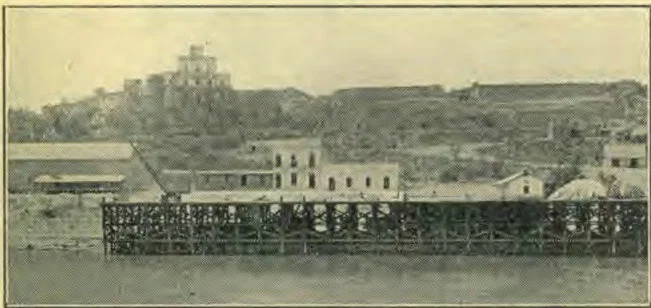
The Port of Diamante, Entre Rios. The City is over the Bluff to the Right.
In canvassing especially, one notices the inborn politeness of these people. They may have little or no interest in the paper or book presented, but rarely will one ever find, among the native Argentinians at least, a person who will say so. They may ask the canvasser to call again, or make some other excuse; but rarely does he receive anything but the most courteous treatment; in fact, he is received as a friend.
Of course we all know that after we have left some homes the people have laughed at our expense, and who knows what they said? but they at least treated us well to our faces, and any canvasser appreciates that.
If some one calls to make an inquiry or to ask some trifling favor, he is profuse in his apologies for having caused you so much trouble. I remember one case in particular which occurred shortly after we arrived here, five years ago. I asked one of our students to come over to see about a Sabbath school class she was to teach. I considered it a favor on her part to come over, and intended to tell her so at her departure; but before I had time to even suggest such a thing she strung out a long apology for having put me to so much inconvenience in taking my valuable time; thanked me for my most generous and kind attention, etc. That took all the wind out of my sails, and the fine little speech I had prepared was completely forgotten, as I mumbled some sort of answer.
Another strong characteristic of the native Argentinian is his consideration for the foreigner in learning the language. One cannot but wonder at their patience and long-suffering when they are forced continually to listen to foreigners butchering their beautiful language. Not by a word or look do they show their discomfort. One may have a fine idea and do his best to convey it to them through his poor Spanish: they nod their heads encouragingly and assure him they understand, when probably they have not the faintest idea of what he is getting at. They take the will for the deed, and would not discourage one by saying they did not get the point.
Very seldom one sees a native laugh at the mistakes of a foreigner. One may make a most ridiculous or disastrous mistake, and he sits as expressionless as a stone,—that is, if there are not some foreigners present to set a bad example. It takes the foreigners—North Americans, English, etc.—to notice and laugh at the mistakes of others. They, moreover, have the reputation of setting themselves up as critics and infallible authority on the Spanish language after a few months’ residence here.
I suppose one could write a book about the ridiculous mistakes in Spanish that are being continually made by our workers. One minister wanted to introduce his wife to a native, and presented her as his hermosa. That word in Spanish means beautiful, while the word he wanted to use was esposa, meaning wife. The woman in question happened to deserve the compliment, but the native never seemed to notice the mistake.
One of our workers once made quite a speech about the war in Europe, especially emphasizing some points about the Bulgarians, whom he mentioned many times, calling them Pulgas, which means fleas. He meant to say Bulgaros, of course. I do not know how intelligent an idea those hearers received from the discourse, but the speaker saw nothing in the expression of their faces to indicate that he had made a mistake, and so went calmly on. Afterward one of the students had courage enough to come up and ask him if he would please tell him what he had been talking about, that he did not quite get the connection. Small wonder!
I shall never forget one of my first blunders of that kind. Upon coming to the table at dinner time I remarked to the students seated around, “Pero, tengo un hombre!” meaning to say, “My, but I am hungry!” What I did say was, “My, but I have a man!” Nobody smiled even, although I noticed my mistake almost as soon as I had said it, and to hide my embarrassment laughed heartily at my blunder. But I did appreciate their kindness in not seeming to notice it. You know it is one thing to laugh at one’s own mistakes, and quite another when the laugh comes from “the other fellow.”
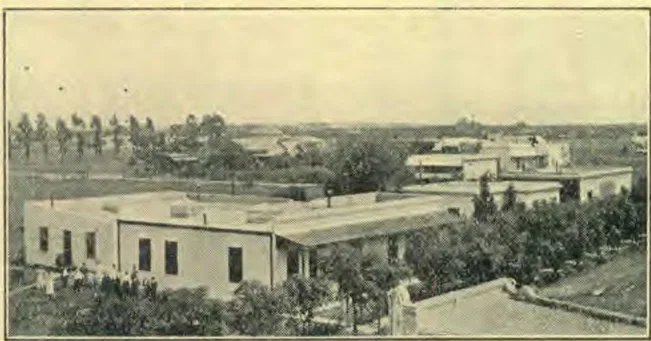
Seventh-day Adventist Headquarters, Florida, near Buenos Aires, South America.
North Americans boast of their civilization and progress, and with reason; but one thing is certain: as a nation they have no world-wide reputation for politeness and courtesy; and is it not barely possible that in this respect they may learn something from their less-favored neighbor to the south, down in the Neglected Continent?