THE SILENT SCHOOL

17%

Review and Herald Publishing Company · Battle Creek, Mich. · Jun 6, 1901

FromThe Youth’s Instructor, Vol. 49, No. 23.

Read the full edition

THE SILENT SCHOOL

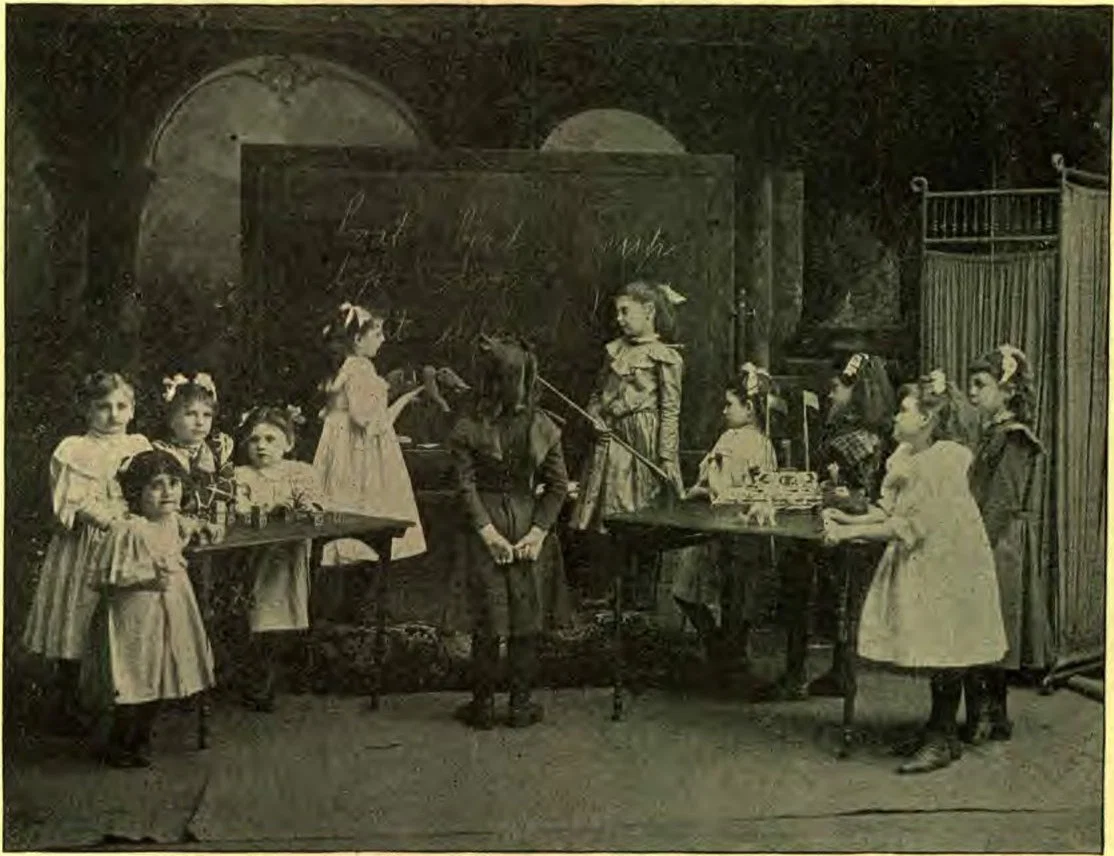
Few of the little folks who read this page realize the number of deaf-mute children there are in the world. Why, in the city of Chicago nearly a hundred girls are cared for in one school alone. This school is a silent one, and the pupils are never sent out in the hall for whispering. School never opens with singing, for a golden silence reigns at all times. They rise at six o’clock in the morning. Some of the larger children make the beds, put on the white spreads, and tidy up the sleeping-room, while others help dress the babies. Indeed, there is a general spirit of good nature and helpfulness through the whole school. At seven o’clock they go into the chapel for morning worship. They are very attentive and devout.
Each day has its separate duties for the inmates of the “Silent School.” Besides the ordinary studies, which range from the first to the eighth grade, there are housekeeping, cooking, millinery, and dressmaking classes. The dressmaking department has been divided. One class makes the dresses for the larger girls, and the other works on the children’s clothes. There are no idle hands in the silent school. Every one has his allotted share. Even the little ones, numbering eleven, and ranging from four to seven years, are taught order with their toys. Six little dolls and six little cups and saucers play a prominent part in their method of arithmetic. It is a great strain on the instructor to teach numbers, so it must be done in the most attractive way, to catch and hold the children’s attention.
The most interesting class in the silent school is the baby class. The youngest child in the house is four years old, a little brown-eyed Italian, with wavy black hair, and a most lovable manner. Her name is Mary Yanzitor. She came into the parlor the other day to see me, bowed politely, and threw me a kiss; all this in serious earnest, not a smile to be seen; then when I passed the four fingers of my right hand across my lips (the sign of candy), she laughed, and pressed her hand to her heart, which means, “I love.” Another little girl equally interesting is a Polish child, Regina Zagorske. She is five years old, bright and intelligent, and misses none of the fun in the playroom. I wish you could all see that room. In it there are building-blocks, elephants with rolling eyes and long tusks, balls to bounce, and above all, a large blackboard provided with colored chalks. This last seems to be the children’s greatest delight, as it is a means of expression, and helps them not only to express their own thoughts, but to understand one another.
THE SILENT SCHOOL
THE SILENT SCHOOL
Now, dear children, you who have been blessed with the double gift of speech and hearing, have you ever for a moment stopped to think how thankful you should be that you can hear the music of the birds, the loving voices of your parents and friends, and that you can speak and sing? There is another thing—we should be very careful to listen to nothing that is evil, or that will make it easier for us to do wrong; and we should pray every day that our lips may be kept from foolish, idle talk.