Donald and His Friends Become Greatly Interested
CARLYLE B. HAYNES
When the tent master turned on the lights in the big tent on Sunday night, he found a row of boys on the front seats. They did not propose to miss the pictures which had been promised. The most interested one among them was Donald Hunter.
By half past seven there were about seven hundred persons in the big tent, and among them were Donald’s father, mother, and sister. They were seated in the middle of the tent. New songbooks were passed out, and the people joined heartily in singing old-time favorites. This song service was conducted by Brother Harris, who was a singer as well as a preacher.
After fifteen minutes’ singing, Brother Harris opened the meeting with a short prayer. He then announced the subjects for the following evenings of that week, saying that meetings would be held every night except Saturday night. He expressed a hope that many would find it possible to attend the services, that they might all together study the teachings of the Bible. He announced also that at the close of each address there would be a question-and-answer service, requesting the people to bring in such questions as had been a source of perplexity to them.
In beginning his sermon that evening, Brother Harris read a part of the second chapter of Daniel. He then told the story of the captivity of Daniel and his three companions. He described the city of Babylon where King Nebuchadnezzar lived, and told of the wonderful hanging gardens which the king had built, gardens which rose, terrace after terrace, to the height of the great walls that surrounded the city.
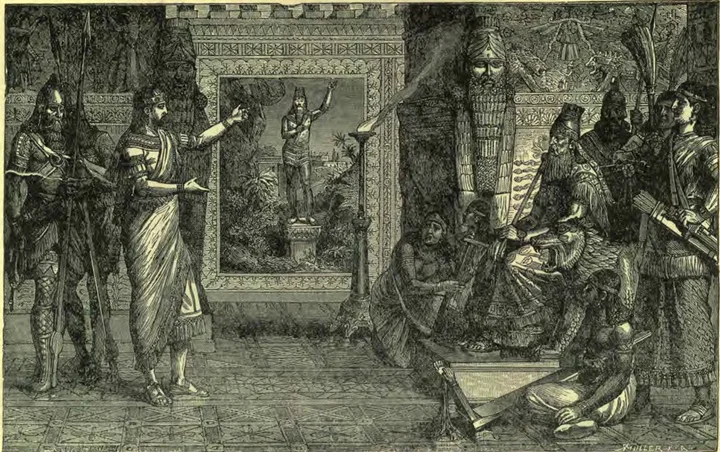
“One day,” he said, “the king was out walking on these terraces, and he could see over the length and breadth of the great city which he had built. A feeling of pride came into his heart as he looked over his possessions. And then he began to wonder what would become of this great kingdom of his after he died, who would be king, and whether any other kingdom would ever be able to overthrow Babylon. As he went to his palace and retired that night these were the thoughts which were on his mind.”
“That night God gave him a dream which answered the questions that he had been turning over in his mind. But when he awoke the next morning he could not remember the dream, though he was deeply impressed that there was something in it which was very important. He called in the wise men of the kingdom, the astrologers, the soothsayers, the magicians, the Chaldeans, and the sorcerers. These people were the same as those today whom we call fortune tellers, palm readers, and Spiritualistic mediums. The king told them his trouble, and asked them to tell him the dream and what it meant; but they could not do it. The king was very angry, because they had professed to be able to do so much, and were now found to do so little.”
“So the king commanded to kill them all. As Daniel and his three companions were accounted among the wise men, the officers sought them to slay them. Daniel had known nothing of these facts until the soldiers came to kill him, and when he was made acquainted with the circumstances he asked for time, promising that he would tell the king both what his dream was and what it meant.”
“The next morning he was brought in before the king, and told him his dream. We will now see on the screen what the king saw in his dream.”
Suddenly the great crowd was plunged into darkness. Then the hiss of the stereopticon light was heard, and a picture was thrown on the screen.
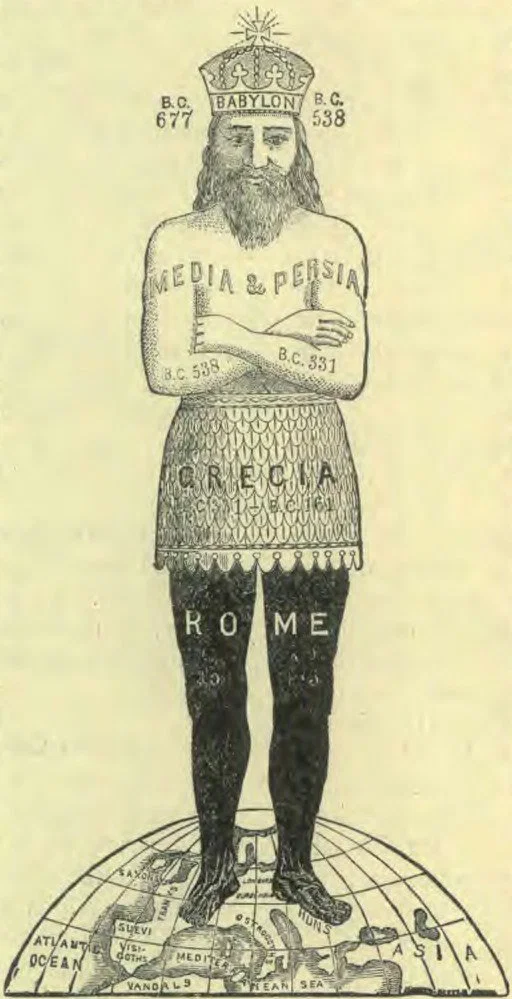
“This is what the king saw,” said Brother Harris, as he pointed to the picture. “He saw this great image. It had a head of gold, its breast and arms were of silver, its waist and thighs of brass, its legs were of iron, and its feet and toes were part of iron and part of clay. Then Daniel told the king that this image represented the course of the history of the world from his day down to the very end of time. Babylon, Daniel said, was shown on the image by the head of gold. This, however, was to be followed by another kingdom, shown by the breast and arms of silver, which would overthrow Babylon and take its place. Then another kingdom, a third, would come, which would be succeeded by a fourth kingdom, representedp. 7 on the image by the legs of iron. This fourth kingdom would be divided into ten kingdoms, shown by the ten toes on the image, some of which kingdoms were to be strong and some weak, represented by the mixture of iron and clay.”
“Then the king saw a great stone cut out of a near-by mountain, which struck the image on its feet, as you see in this next picture. The stone ground all the image to pieces, while the wind caught up the dust into which the image was ground and blew it all away, so that not so much as a particle remained. Then the stone grew and became a great mountain, until it took the place of all other kingdoms and filled the whole earth.”
The lights were then turned on, and Brother Harris began to explain the fulfilment of this wonderful prophecy. He said:—
“The head of gold meant Babylon. After Nebuchadnezzar’s death this was overthrown by Medo-Persia, which is represented by the arms of silver. Medo-Persia, in turn, was overthrown by Greece, under Alexander the Great. Greece is symbolized by the waist of brass. Then Rome overthrew Greece, and is represented by the legs of iron. After this, Rome was divided into just ten kingdoms, as shown by the ten toes. These ten kingdoms were the Alamanni, the Franks, the Suevi, the Burgundians, the Vandals, the Anglo-Saxons, the Heruli, the Ostrogoths, the Visigoths, and the Lombards. Do you boys on the front seat think you can remember that?”
Brother Harris looked down at the boys with a smile. Donald Hunter was sure he could not remember such strange names, but he made up his mind he would get that list of kingdoms from Brother Harris and study it. Then the speaker continued:—
“I will tell you what some of these kingdoms are now called, and that will help you remember. The Alamanni, Germany; the Franks, France; Suevi, Portugal; Burgundians, Switzerland; Anglo-Saxons, England; Visigoths, Spain; and the Lombards, Italy. Three of these kingdoms have been destroyed, the Vandals, the Heruli, and the Ostrogoths.”
“So you see that God has brought us in this prophecy down through all the history of the past to the present kingdoms of Europe. And now God, through Daniel, makes a wonderful prediction regarding these kingdoms of Europe. He says, ‘They shall not cleave one to another.’
“And, true to this prediction, these kingdoms have never again been welded into a great empire as they once were under Rome. Nor will they ever be again, for God’s word is against it. Men have arisen in different nations and at different times who have tried to do what God said should never be done, but they have all failed. Charlemagne tried to unite the nations into one again, but he did not succeed. Charles V of Spain tried it, and he failed. Louis XIV of France tried, and he failed. All the wisdom and shrewdness of Napoleon Bonaparte, all his ingenuity and knowledge of military tactics, and all the strength of his mighty army were not sufficient to break the power of these few words of Scripture, and Napoleon’s great dream of world empire came to an end at Waterloo. God says, ‘The Scripture cannot be broken.’ Seven short words spoken by God twenty-five hundred years ago have proved stronger than all the legions of the world’s mightiest generals. Surely, these words are the words of God, who knows the end from the beginning, and not, as infidels tell us, the words of uninspired men.
“And then this wonderful prophecy closes by saying, ‘In the days of these kings shall the God of heaven set up a kingdom, which shall never be destroyed.’ This means that before very long the long-looked-for kingdom of God is to be established in this world. ‘In the days of these kings,’ this is to take place, and ‘these kings’ refers to the modern nations of Europe. In our days, before these boys here live out the natural span of their lives, Christ will come, and his kingdom will come to take the place of all the kingdoms of the earth. This will not be done by the conversion of these kingdoms, but by their destruction; for the great stone, which represented the kingdom of God, broke the image, with all its parts, to pieces and groundp. 8 it to powder. Thus we must look for the destruction of the nations.
“And, now that we know these things, our supreme duty as Christian people is to make ready for these great events which are coming on the earth, and especially prepare ourselves to meet Christ in peace, for many here in this tent tonight will live to see him come.”
As Brother Harris closed his sermon with this earnest statement, Donald Hunter felt a strange thrill of fear, mingled with very deep interest, run through him. Jesus coming again! Coming before he died! He had never been told that before. Why had they not told him? It certainly must be true, for Brother Harris had made the Bible very clear about it. He went home that night a very thoughtful boy, and he decided that he must attend every meeting at the tent, so that he might know what to do to get ready for Jesus’ coming. He felt sure Brother Harris would say more about it.