How to Swim on the Back
Back-Swimming. First, take the back-floating position: arms by the sides, legs straight, with the feet in line with the shin bones.
Second, turn the legs onto their sides, so that the knees point outward and the heels touch.
Third, draw the legs up toward the body, gradually flexing the knees and keeping the heels touching.
Fourth, bring the feet to right angles with the shin bones, at the same time turn the legs to the knee-up position.
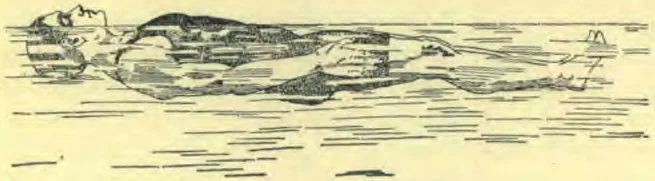
Fifth, kick out to the sides with the soles of the feet, as if you were actually pushing against a wall.
Sixth, bring the feet to the stretched-back position and the legs together with force.
Seventh, repeat until thoroughly mastered, being very careful of the stretched-back position of the feet on their recovery.
Each delivery should urge the body forward at least half of its length.
The next move is to combine the arms and legs, which is done as follows:—
First, bring the arms up from the sides with the recovery or drawing-up movement of the legs. In doing so, glide them over the chest and face out as far in front of the top of the head as you can reach.
Second, turn the hands back to back, and with the straightened-out arms return them to the sides in unison with the leg kick.
In reaching forward for delivery, the arms should be kept close together, so that the palms of the hands touch as they pass over the chest and face. Likewise, the arms must be kept close to the body and not raised above it in their passage to beyond the head.
Never show the knees above the surface; this is very bad form.
Maintain the back-floating position all through the movements; that is, keep the head low in the water.
Synopsis
Take the back-floating position. While drawing up the legs bring up the arms, and, carrying them over the body, reach as far forward of the head as possible.
Deliver the strokes and repeat.
Another manner of taking the arm stroke is to raise the arms completely out of the water and thus carry them over the body and beyond the head, dropping them with the hands back to back into the water and making the delivery. The outer edges of the hands must cut the water, and care must be taken not to splash.
Considerable speed may be obtained upon the back by simply kicking the straightened-out legs up and down alternately, with the feet in the stretched-back position. Both arms should rest by the sides, and if employed at all they should only move from the forearm and the wrist. This movement is known as propelling with the hands, and is done by revolving the hands upon the wrists with a downward, inward, and upward action. The arms should never strike the surface at right angles to the sides.
The Chest Stroke
The chest stroke is similar to that taken upon the back, only that the position of the body is reversed.
The main features not to be lost sight of in this style of swimming are proper coördination of the arms and legs, proper breathing, and complete strokes.
Always bring the arms close into the sides at the conclusion of their delivery, and bring them well up under the chest for their recovery or forward push.
Chest-Swimming Stroke
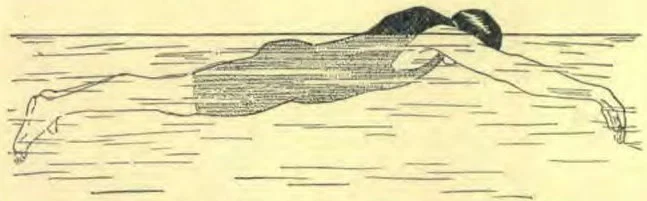
First, take the stomach-floating position.
Second, raise the face from the water and extend the arms forward of the head, palms of the hands touching.
Third, turn the hands and bring them back to the sides for recovery.
Fourth, when the arms in their backward movement are in a line with the shoulders and are ready to make their downward curve, the legs are well on their recovery.
Fifth, as the sweep of the arms is concluded, the legs will have kicked out so as to form the letter Y of the body.
Sixth, the legs come together with force as the arms shoot forward for delivery.
Breathing. Inhale as the arms open out. Exhale as they come into the sides and shoot forward for their delivery. A splendid practice for beginners is to take one long breath, inhalation and exhalation, with each delivery and recovery of the arms.
Synopsis
Take the stomach-floating position.
Bring up the arms under the chest with the hands palm to palm.
Simultaneously with the advance of the hands draw up the legs.
Bring back the arms and kick out the legs.
While curving the hands in for the next recovery, bring the legs together.
— J. H. P. Brown, in "Modern Swimming."