“WHAT did we learn at our story hour last evening?” asked Mrs. Laon, as she and the children gathered for another lesson on the importance and beauty of truthfulness.
“We learned,” answered Carroll, “that real roses, peaches, and diamonds are better than artificial ones, and that boys and girls to be genuine must be truthful. If they are not truthful, they are mere shams, or imitation boys and girls.”
“Good, Carroll! What great men, Lucile, have you found who loved truth and hated lying?”
“I could think of only Washington, Lincoln, and Mr. Wu you told us about in our last lesson.”
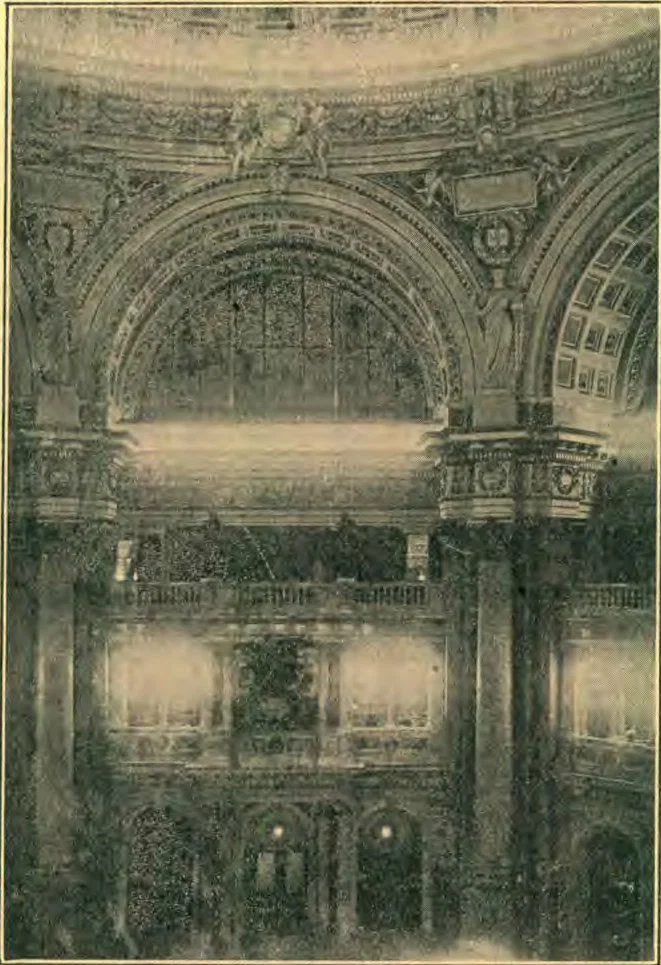
Portion of the Main Gallery of the Congressional Library,
Washington, D. C.
“How do you know Washington always told the truth?” asked Carroll. “My teacher says the story about the hatchet and the cherry tree is a myth.”
“That may be a myth; but here is a story known to be true, which shows that Washington in his youth loved truth. One day he and two neighbor boys had great fun with a colt. George mounted the colt, a new experience for the young creature, so he gave the fearless rider a lively scamper over the pasture. The three boys played various tricks upon the colt, and kept up the fun until the animal dropped dead from a broken blood vessel. The consternation of these bold riders was expressed in a period of absolute silence as they viewed the remains of their once lively entertainer. But of course when the full significance of the colt’s demise came over them, they began to think of the forthcoming explanation to be made to the owner of the colt.
“The two neighbor boys invented a plausible story for George to tell his mother; but when that youth presented himself before her he told the exact truth. Mrs. Washington, on learning the story the boys had proposed, said, ‘My son, I should rather lose a thousand colts than have you tell me an untruth.’”
“The names of the two boys who prepared the lie were forgotten long ago; but after nearly two hundred years, the name of George Washington still lives in the hearts of men throughout the world.”
“How do we know Lincoln was truthful, Carroll?”
“He wouldn’t have been called ‘Honest Abe’ if he hadn’t been truthful.”
“Yes, an honest person cannot be untruthful. When the young Mr. Lincoln was a clerk in a village store, he sold an assortment of goods to a woman. She paid the price, $2.06; but after she left the store he discovered that he had overcharged her six cents. It troubled him all the evening, so bright and early the next morning Mr. Lincoln called upon the lady, apologized, and returned the six cents.
“At another time he failed to give a customer the full amount of her purchase. He lost no time in adjusting the matter, after the error was discovered. You may be sure such a conscience would not suffer him to falsify.”
“Do persons who are truthful always become great persons, mother?” asked Lucile.
“Not always in the sense the world counts greatness; but in the Lord’s sight all truthful persons are great persons, and it is quite safe to say that all really great people are truthful.”
“Jackson was another president who abhorred lying; so did President Hayes.”
“This picture of the main gallery in the Congressional Library contains sixteen life-size statues of the world’s greatest men. One of these is the statue of Moses, and one is of the apostle Paul. Why are Moses and Paul so honored? It is because they loved and spoke the truth. If Moses had been a lying man, he could not have lived in the hearts of the people for more than three thousand years.”
“Raphael, who painted the beautiful Sistine Madonna, loved truth and hated evil. It is said that ‘every evil humor vanished when his comrades saw him, and every low thought fled from their minds.’ Evil thoughts flock to the liar.”
“Who composed that beautiful piece you have for your lesson this week, Lucile?”
“It is one of Bach’s pieces, mother. My teacher says he’s wonderful.”
“He is, and some one said that ‘wherever Bach’s music is heard it makes of that place a church.’ He was a true man, or he could not have composed music so pure and sweet that it would make a church or sacred place wherever played.”
“One of the rules that the great Marshal Foch gives to his soldiers and demands that they heed, is: ‘Tell the truth squarely, face the music, and take your punishment like a man, for a good soldier won’t lie.’”
“A good soldier will not act cowardly, and it is cowardly to lie to shield oneself from reproof or punishment.”},{