THE church of San Blas, one of the leading urban parishes, is decked out with candles, bouquets, and palms, arranged in fantastic forms on ceiling, walls, and altars.
At about five o’clock in the afternoon two young men wearing red rockets appear at the church door, calling the people to the ceremony. When the bell sounds for six, two deacons and three priests come out from the sacristy, richly dressed and wearing miters such as used to be worn by the Jewish high priest. They perform the usual genuflections and offer incense according to the Roman ritual, and then sit down in some large chairs and begin to drone the Gregorian chants which are sung at Christmas time in Catholic churches the world over.
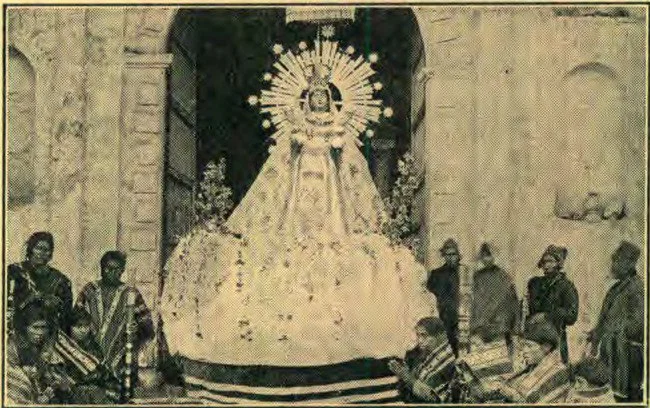
IMAGE OF THE VIRGIN MARY AS CARRIED IN PUBLIC PROCESSIONS ON FEAST DAYS
Hundreds of wax tapers glitter in the church, while from the great steeple sputter and flash fifty giant light fuses. The great crowd of praying, singing, and shouting Indians and the blanketed musicians rend the air with their noises. During the lulls one can barely hear the voice of the priests who are chanting sentences in Latin, or the response of the choir, these last being accompanied by the orchestra after the manner of the ancient Chaldeans, Greeks, and Romans in their tragedies. By oft-repeated kneelings and bowings the worshipers seek to show their affection for an oil-painted image which occupies a rectangular frame at the side of the room. This is the Virgin of the Nativity.
The worshipers recite prayers to Mary with sobs and devout sighs. While the chanting continues in the church a wild, drunken multitude forms at the doors with flutes, drums, and other native instruments. To the accompaniment of this music they sing all sorts of native picnic and Indian songs. The “brotherhood stewards” set off rockets, bombs, fire wheels, Roman candles, whizzers, and fire mountains, which throw fire about in confusion, burning the clothing of the spectators. At the door of the church lies the body of an Indian saturated with alcohol. He was killed by falling from a high altar that he was dressing up for the feast. There he lies abandoned, and no one seems to pay any attention to him.
The arrival of bonfire wood is indicated by the arrival of twelve young llamas, richly caparisoned with red “bandana” handkerchiefs and flying pennants. They are led by as many Indian girls, who also carry large jars of chicha (a native beer) and demijohns of rum. Ahead of these llamas go three groups of dancing yumbos (masked Indians), rustic backwoodsmen dressed in their Sunday best. They dance to the music of the fife and the discordant tom-tom, in imitation of the Incas, Caribs, and Aztecs. They make a specialty of dancing and pirouetting at the church door before the praying priest, who thus receives their homage.
The drunkenness now reaches its height, and the five bonfires are lighted. These are distributed about the square, which is filled with people. Four policemen guard each fire. The yumbos keep up a ceaseless dancing and yelling to the monotony of the tom-tom. The general racket and public drinking continue till far into the night, when some retire to the near-by drink shops, others go home, and the more drunken ones lie stretched out in the open streets.
Early the following morning begins an endless flow of brotherhoods and Indian worshipers. Everybody admires the arrangement of the church and the ornamentation of the Virgin of the Nativity.
A number of wooden statues clad in dressing gowns and having tin wings arrive about nine o’clock. They are “angels” who have come to the procession. They are carried on litters by specially selected Indians. They are placed in two rows under arches of evergreens and lanterns, among these latter being one with the inscription, “Lunch, Coffee, and Beefsteak at all hours.” The “angels” are followed by a crowding multitude of brotherhoods with long, thick wax candles for the procession. Some enter to hear the mass, while others remain in the court, firing rockets and firecrackers and sending up paper balloons. The wind music and the drinking go merrily on. It is the hour of the mass. The three priests, the deacons, the acolytes, and the sacristans appear near the altar, dressed according to regulations. When the mass begins, the uproar increases. The mass continues with all the pomp and ceremony of the Roman ritual. Here and there through the press are to be seen white persons who, with prayer book and rosary in hand, join in the general confusion. The whole thing reminds one of so many talking machines turned loose at once.
The hour for the “preaching” of the “gospel” arrives. The priest mounts the pulpit called “the chair of the Holy Spirit,” and with great oratorical freedom pronounces the panegyric. He extols the imaginary virtues of the Nativity of Mary. He presents her as the coredeemer, savior, mediator, and advocate of her devotees, especially of the brotherhoods and their families, who are spending the savings of a year in this feast.
Is it possible that these priests of the Roman Catholic apostolic religion are ignorant of the teachings of St. Peter, of whom they affirm that the popes are the legitimate and infallible successors? When Peter in the name of Jesus healed the man who was born lame, Annas, the chief priest, and all those of the lineage of the high priest, laid hands on him and cast him into prison. The following day, when they insinuated to him that he should neither teach nor speak in the name of Jesus, he replied: “This is the stone which was set at naught of you builders, which is become the head4of the corner. Neither is there salvation in any other: for there is none other name under heaven given among men, whereby we must be saved.” Acts 4:11, 12. O Romanists, why do you teach the people doctrines that are contrary to the Sacred Scriptures? Why do you seek to hide the sublime truth that we can be justified and saved only by faith in Jesus Christ? that Christ alone is our Redeemer and Saviour, his being the only name whereby we must be saved? Why do you set up other saviors, mediators, and advocates, assuring the people that they are able to save us?
All during the mass the stewards are distributing little cards and bouquets of artificial flowers, crowding in among the young women especially, and interrupting all in the most ridiculous manner. Once the mass is ended, the “Indian king” starts out. He wears a mask, and as he goes out he shouts: “Everybody to the procession!” The parade begins at the church door and passes through several of the principal streets. The vanguard is composed of yumbos dancing, leaping, and pirouetting. Indians of both sexes, carrying lighted candles, form long lines, with a space between through which pass the “angels” in litters borne by the singers, who quarrel and nearly fight for the privilege. In the center, mounted on a luxurious litter and borne by the stewards, comes the Virgin of the Nativity. This is an image in the form of a handsome young woman, about four feet high, adorned with charms, bracelets, earrings, necklaces, etc., and clothed in a beautiful silk dress covered with gold braid and brilliants. The musicians go ahead of the image, also the Indian king and the singers. These are mounted on prancing steeds led by lackeys. Behind the image, prayer book in hand and with solemn tread, marches the gowned and mitered priest under a giant parasol and surrounded by fanatical women who chant the rosary. Flowers are showered down on the image from the windows as the procession passes. The noise of the rockets, firecrackers, and bombs reminds one of a battle. During all the course of the procession the wives of the stewards pass along serving wine and rum to the faithful.
On reaching the church the procession halts and silence is ordered, that the praises of the Indian king and the singers may be heard. The first farsical stanza is recited in a thin, weak voice by a young singer about fourteen years old; the second by another about twelve years of age, but with a stronger voice; and the last, a clownish mixture of prose and verse, is recited by the Indian king. All are silly adulations of the image of the Virgin,—who is called “Mother of God,” “Queen of the Universe,”—and of the priest, the stewards, and the people who are co-operating in the feast. At the end of each part, the yumbos throw sweets and oranges, at times with such force as to smash them against the image or the worshipers. As the priest seems to be the special object of one of these “attacks,” he hastily retreats to the church, where he peeps from a window approvingly, to the general delight of all.
Slowly the crowd disperses, and this part of the feast is over. The yumbos and candle bearers dance through the streets to the house of one of the stewards, where a “wedding feast” is prepared and where drink flows freely. The carousal keeps up four days. Many drunken men and women may be seen at any hour of the day or night, dancing or reeling along the streets, or lying in the gutters unconscious. For convenience there are six saloons within a hundred yards of the church.
If scores of these feasts are celebrated every year in the capital city in plain sight of Archbishop Dr. Gonzalez Suarez, who is called the glory and mentor of the Ecuadorian clergy, what must be the custom in the rural villages and parishes?
We are almost at the close of our planet’s history. The prophecies and the unmistakable signs of the times clearly show that we of this generation are treading on the very threshold of the divine judgment. Instead of wasting time in feasting, we ought, with a loud voice, to give the warning of the threefold message of Revelation 14:6-12: “Fear God, and give glory to him; for the hour of his judgment is come: and worship him that made heaven, and earth, and the sea, and the fountains of waters.”
My beloved reader, with all respect for your belief, permit me to ask you a question: Whom should we believe, God or man? Conscience and duty point to one road, and selfish worldliness points to another. Search the Scriptures, and if you find that you are in sin, seek real heart repentance, and accept the gospel of salvation by faith in Jesus alone, who tells you, “I am the way, the truth, and the life: no man cometh to the Father, but by me.” “Come unto me, all ye that labor and are heavy-laden, and I will give you rest.” BENJAMIN DE LA TORRE.