The beautiful Taj Mahal is said to be “the greatest love story ever written.” Completed more than two hundred years ago, it remains today in perfect condition, the most magnificent mausoleum upon which the sun has ever shone.
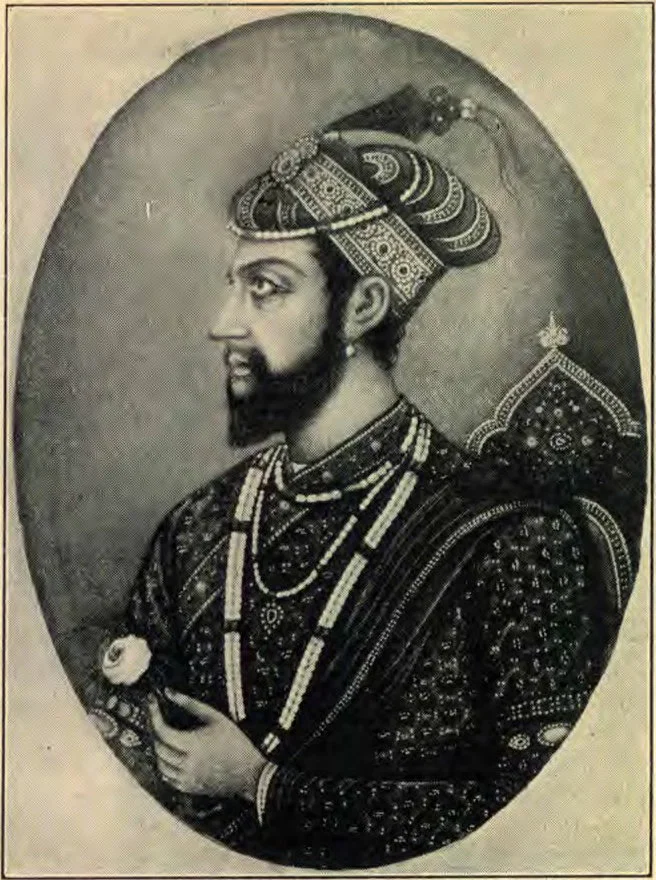
The idolized wife of Shah Jehan, one of the greatest of the Mogul emperors of India, was Moomtaz-i-Mahal. For fourteen years he devoted his energies to satisfying her every desire, and they were supremely happy. When she died in 1629 the emperor determined to perpetuate her memory and his love for her by building the finest tomb the world had ever seen, in a garden on the banks of the Jumna River, which had been her favorite resort. The best architects of the world were summoned to compete for the contract, and the winner was Eesa Mohumed Effendi, sent by the Turkish sultan. Some time was spent in perfecting the plans, and collecting necessary materials, and the actual work of building required twenty-two years. Various figures estimate the cost as not far from $15,000,000, and 20,000 workmen were employed.
The Taj stands on the bank of the river, its grounds forming a garden in the midst of an extensive plain, and is visible for miles in its dazzling whiteness from any direction you may chance to approach. The visitor enters the inclosure through a great ornamental gateway. The ascent is by stairway to the second story where from a lofty balcony may be obtained a beautiful panoramic view. “Just below begins the garden, laid off in sixteen sections, stretching far back, and the whole forming a square of 890 feet. Each of the sections is appointed for a distinct class of vegetation—one for roses alone, another for ferns, and another for palms. At the farther end of the garden stands the Taj Mahal, resting on its vast platform, 313 feet square and eighteen feet in height. On each side of the outer edge of the platform is a mosque, and at each corner rises a minaret 133 feet high. The main dome of the mausoleum is fifty-eight feet in diameter, and eighty feet high. At each corner is a smaller dome which gives completeness to the picture. The mausoleum itself would be a perfect square of 186 feet except that the corners are cut off opposite each of the towers.” Each of the broad sides has a grand half-dome entrance rising nearly to the cornice, while on each side are arches, one above the other. Around this magnificent doorway are Arabic inscriptions. Thomas W. Knox says that the whole of the Koran is on the walls of the Taj, written by the inlaying of black marble in the white walls.
“Straight through the garden, all the way from the gateway where one stands to the Taj itself, there runs a stream of pure, clear water. This, with its twenty-three fountains and the central platform and fountain, gives a variety and movement to the whole scene, which at once take from the place all appearance of a tomb.”
“Everything is of polished white marble. The bed and sides of the broad way down which the water runs; the splendid terrace on which minarets, mosques, and the wonderful central mausoleum stand; every part of the Taj itself from the lowest step in the dark crypt to the topmost stone of the dome,—it is all a wealth of spotless marble.”
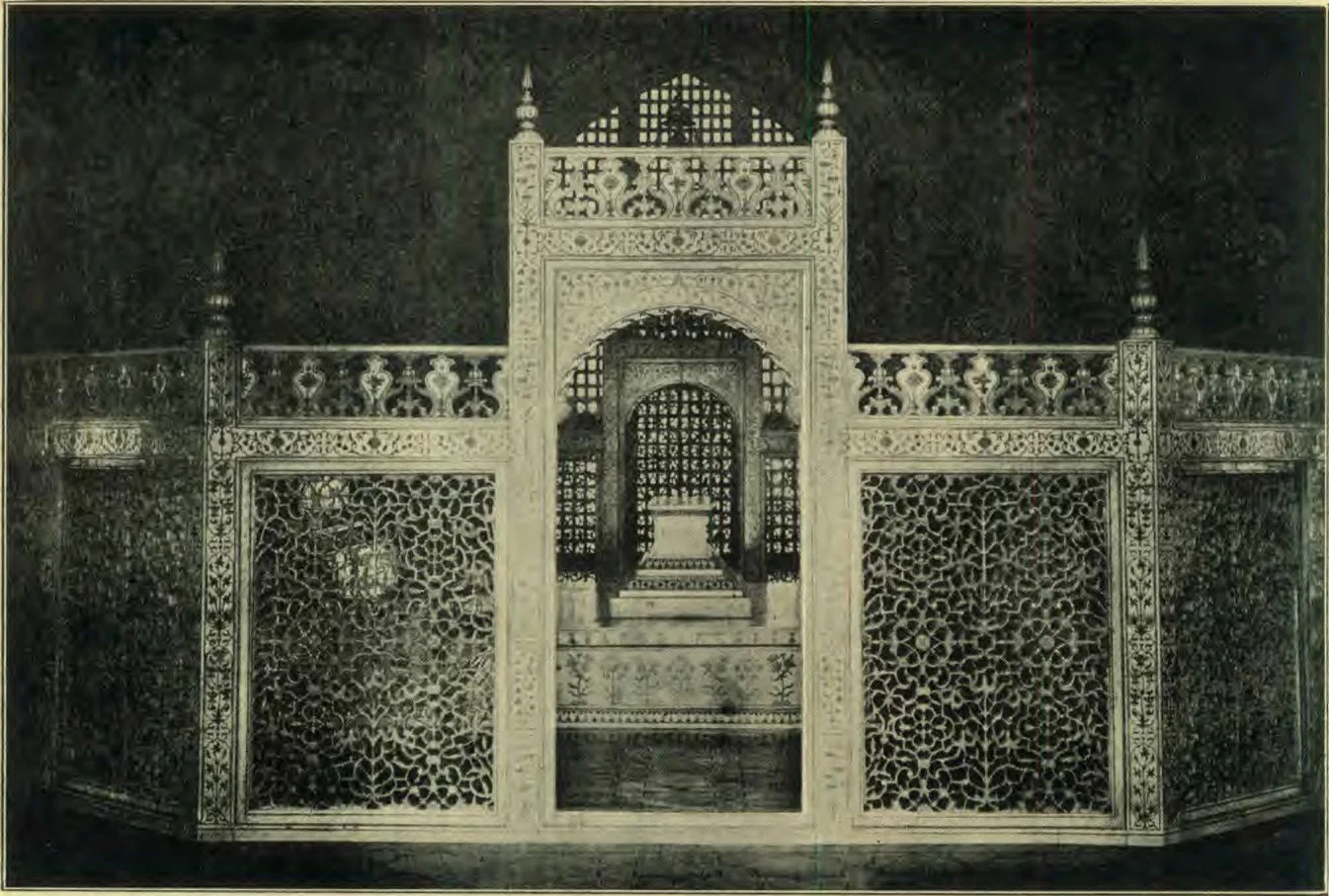
The tombs of Shah Jehan and his wife are in the vault beneath the central floor, while the monuments for show are erected on the floor itself, surrounded by a marble screen. The body of the beautiful Moomtaz-i-Mahal lies directly beneath the central dome; that of her disconsolate husband at one side.
SHAH JEHAN
MOOMTAZ-I-MAHAL
Within the Taj we find marvels of Oriental workmanship. “Tombs, monuments, screen, walls, and pillars are covered with mosaic work, chiefly of flowers7and scrolls.” Here we also find texts from the Koran in black marble, “but the flowers and scrolls are of jasper, carnelian, agate, and other semiprecious stones, with here and there an addition of mother-of-pearl.” One writer says: “We saw a single rose containing more than thirty pieces of stone, and yet the whole flower was not more than an inch in diameter.” “These stones are thrust into the walls with such profusion that one is bewildered by the display. Yet when you realize the design you could not spare a single rosebud or lily leaf. Look as closely as one may, he can hardly distinguish the lines between the stones, so minute is the workmanship, so deft the hand.”
There is a wonderful echo in the dome of the Taj. It repeats every sound of the voice with great distinctness when words are spoken slowly. Very low music is also exquisitely echoed. “An English writer says the chord of the seventh produces a very beautiful effect, and it was this chord that Bayard Taylor heard and described as floating and soaring overhead in a long, delicious undulation, fading away so slowly that you hear it after it is silent, as you see, or seem to see, a lark you have been watching after it has been swallowed up in the blue vault of heaven.”
The Taj is wonderful in the sunlight, exquisite in the soft shadows of twilight; but magnificent, gleaming white, in the moonlight. It is one of the world’s greatest buildings, man’s richest tribute to a woman’s love and memory.