PROBABLY no spot in the United States is of more historic interest than the place of the landing of the Pilgrims. The sole interest in this place in 1620 was in the one hundred two persons who stepped from the “Mayflower;” to-day there is a flourishing town of over eleven thousand inhabitants. It is noted for being the home of the Plymouth Cordage Factory, the largest plant of the kind in the world, employing over two thousand hands, and furnishing nearly all the rope which Uncle Sam uses in his navy. Careful provision for the comfort of the employees is seen in the library, restaurant, and baseball grounds connected with the factory.
One of Plymouth’s chief industries used to be fishing. Now the energies of the people are devoted largely to the manufacture of tacks and woolen goods. In 1904 forty thousand barrels of cranberries were raised.
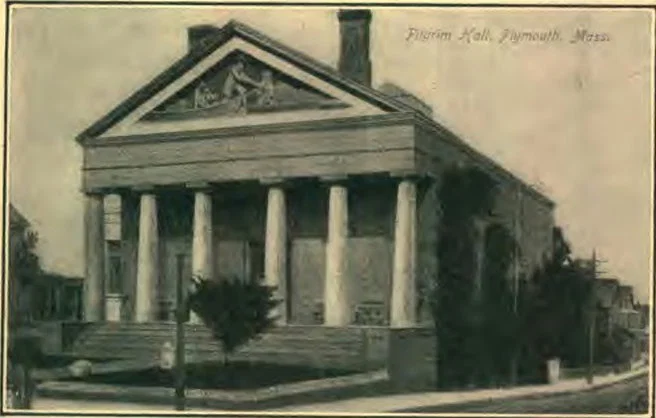
Pilgrim Hall, Plymouth, Mass.
An electric-car ride of about five minutes will bring one in sight of the Monument to our Forefathers, which conspicuously adorns one of the highest hilltops, and is said to be the largest piece of solid granite statuary in the world. Thirty years were required to build it. The granite of which it was made came from the quarries of Hallowell, Maine. On the central pedestal stands a figure of Faith, one foot resting on “Forefathers’ Rock.” In her left hand she holds a Bible, while with the uplifted right she points to heaven. Around the base of the monument, on wing pedestals, are four large figures of solid granite. One represents Morality, holding the decalogue in her left hand and the scroll of Revelation in her right. The other three represent Law, Education, and Freedom. On the faces of the pedestals are carved scenes from the history of the Pilgrims,—the departure from Delft Haven, the compact in the “Mayflower,” and the first treaty with the Indians. (See cover page.)
The total height of the monument is eighty-one feet. The length of the arm in the uppermost figure is nineteen and three-fourths feet, the circumference of the head thirteen and one-half feet, the neck nine feet,—and all of solid granite two hundred sixteen times life size. The cost was forty thousand dollars.
As I stood in the shadow of this monument one beautiful Sabbath day, and thought of the glorious principles of civil and religious liberty which it was intended to commemorate, and then of the decline from these principles which we have witnessed in the growing tendency to Sunday legislation and the tyranny of labor unions, I could not help recalling, with tearful eyes, the words of our Saviour to the Jews: “Ye build the tombs of the prophets, and garnish the sepulchers of the righteous. . . . Wherefore ye be witnesses unto yourselves, that ye are the children of them which killed the prophets.” It is truly a glorious thing to have the law of liberty written in stone; but how vain it is if those who thus inscribe it do not have it in their heart.
At Pilgrim Hall, on the wall of the curator’s office, hangs the commission from Oliver Cromwell, Lord Protector of England, to Governor Edward Winslow, as one of the arbitrators between Great Britain and the United Provinces of Holland. At the east end of the large hall is a picture of the “Landing,” thirteen by nineteen feet, painted by Henry Sargent, of Boston, and valued at three thousand dollars. Charles Lucey’s painting of the “Embarkation” is another work of value. Under the Sargent picture are the chairs of Elder Brewster and Governor Carver, and the Peregrine White cradle. In one of the glass cases is the sword of Miles Standish, the inscription on which was never understood until, in 1881, Prof. James Rosedale, of Jerusalem, an excellent linguist, pronounced it Cufic language, and translated it thus: “With peace God ruled his creatures, and with the judgment of his arm he troubled the mighty of the wicked.” It is supposed that this sword came to Captain Standish from the crusaders.
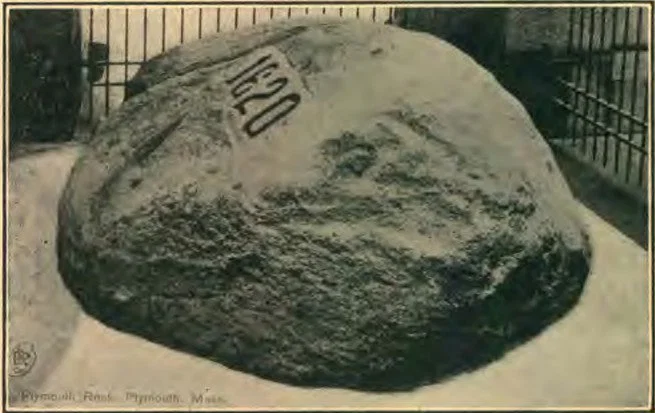
Plymouth Rock, Plymouth, Mass.
Another case holds the gun-barrel with which King Philip was killed. Here also are the original manuscripts of Mrs. Hemans’s celebrated ode, beginning, “The breaking waves dashed high,” and William Cullen Bryant’s poem, “Wild was the day, the wintry sea.” The north anteroom contains the old sofa upon which Governor Hancock sat with Samuel Adams as they plotted treason against the English crown. On the north wall of the library is the portrait of Josiah Winslow, whose grandson was the British officer who removed from their homes the French Acadians, whose4sorrows Longfellow has made classic. The portrait of Governor Winslow is the only one in existence of any person who came over in the “Mayflower.”
A case at the west end of the library contains the oldest state paper in existence in the United States,—the first patent granted to the Plymouth colonists by the New England Company.
There is a book which was given to Governor Bradford by Pastor John Robinson, brought over in the “Mayflower” by Bradford, and afterward given to the church. Elliot’s Indian Bible is there also.
The object of supreme historic interest in Plymouth is the world-famous Plymouth Rock. At the foot of North Street, at the water’s edge, we find it, resting under a large granite canopy. It is an ordinary looking boulder about seven feet long, of greenish syenite in composition. It is claimed that not a shadow of doubt rests upon the identity of this rock. Thomas Faunce, whose father came over in 1620, upon hearing that the rock was to be disturbed in pre-Revolutionary times, visited the locality, and at the age of ninety-five, in the presence of witnesses, testified that it was the one upon which the forefathers landed. The attempt to move it farther away from the water’s edge resulted in splitting it into two parts. Some of the people were in favor of taking it to a more sightly place, and some of leaving it where it was. As a compromise between the contending parties, one part was removed upon higher ground, and the other left in its original place. After one hundred five years the incongruity of its being up in the center of the town was commented on by a visitor of note, so it was carried back and reunited with the other piece.
Passing up Leyden Street, one is thrilled with the thought that here, on each side of the present thoroughfare, were built the first homes of the Pilgrims. At the farther end of the street is Burial Hill, with its ancient gravestones and strange epitaphs.
“The Pilgrim fathers are at rest:
When summer’s throned on high,
And the world’s warm breast
Is in verdure dressed,
Go stand on the hill where they lie.”
This hill was the location of the old fort and the watch-tower. On one side of Governor Bradford’s obelisk are the Latin words, “Qua nos patres, difficillime, adepta sunt, non turpiter relinquere,” which, translated, mean, “What our fathers with difficulty attained, let us not basely relinquish.” On the easterly slope is a stone with the epitaph of a one-month-old child, as follows: “He glanced into our world to see a sample of its miserie.” That of Tabitha Plasket is curious for its spirit of defiance:—
“Adieu, vain world! I’ve seen enough of thee,
And I am careless what thou sayest of me;
Thy smiles I wish not, nor thy frowns I fear;
I am now at rest; my head lies quiet here.”
On a stone to Elizabeth Savery is written:—
“Remember me as you pass by.
As you are now, so once was I;
As I am now, so you will be;
Therefore prepare to follow me.”
At the base of Burial Hill runs the town brook, of which Governor Bradford wrote: “And there is a very sweet brook runnes under the hillside, and many delicate springs of as good water as can be drunke.”
Just above the famous rock is Cole’s Hill, the ground which has been hallowed by the fiercest struggles of the Pilgrims during the first dark, sad winter in which they landed. One who was there has portrayed the awful scene as follows: “This month (March) thirteen of our number die, and in three months past die half our company, the greatest part in the depths of winter, wanting houses and other comforts, being afflicted with scurvy and other diseases which the long voyage and unaccommodate condition brought upon them, as there die sometimes two or three a day. Of a hundred persons scarce fifty remaining, the living scarce able to bury the dead, the well not sufficient to tend the sick, there being in their time of greatest distress but six or seven, who spare no pains to help them.” On the hill they buried their dead, then leveled the graves and planted corn, so the Indians would not know how great was their loss. Severe rains have at intervals since revealed many of the skeletons.
The Pilgrims’ endurance of hardships in seeking freedom of worship should inspire us, who are taking part in the last gospel work, which is preparatory to ushering in not only freedom of worship, but everlasting deliverance from sin, disease, hardships, and death. While their faults are well known, let us remember their virtues, and seek to emulate them.