[The subject of eclipses is so concisely yet comprehensively treated in the following article that it should challenge the careful attention of all readers of the INSTRUCTOR.—EDITOR.]
To watch the sun mysteriously disappear from view, either wholly or in part, as if being devoured by some ravenous dragon of the sky, and to see the full moon suddenly grow dim and bloody, were among the most terrifying experiences of the ancient nations. And even today many strong hearts shudder with awe as the black chill of a solar eclipse races with almost lightning speed across the land.
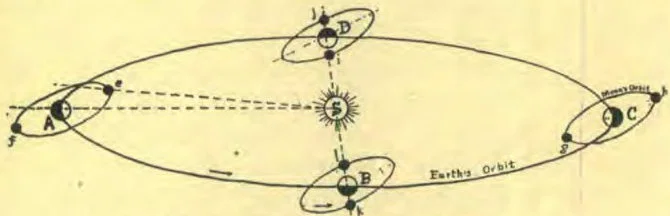
Fig. 1.— When solar eclipses can and cannot occur.
Yet the eclipse is no mystery. It is simply the cutting off or shading of the light of the sun from the earth or the moon by the companion body moving between, reminding us anew of our dependence upon the Creator of heaven and earth for the blessings of each day.
The phenomenon of the eclipse can be nicely illustrated by an apple, orange, or other round object and a lamp. If you stand facing the light so that the head is on a level with the lamp or electric globe, and far enough away that the hand containing the apple can be held at full arm’s length between your body and the light, by adjusting the position of the hand but slightly, it is easy to shut off the rays of light from the eye. In other words, we say that the apple has eclipsed the light of the lamp. Wheel slowly to the left with the apple in the same position, and you will notice that when your back is to the lamp, the apple has passed into the shadow of your head, and is itself darkened or eclipsed. By continuing to turn, the apple emerges from the shadow on the other side, and the eclipse has ended.
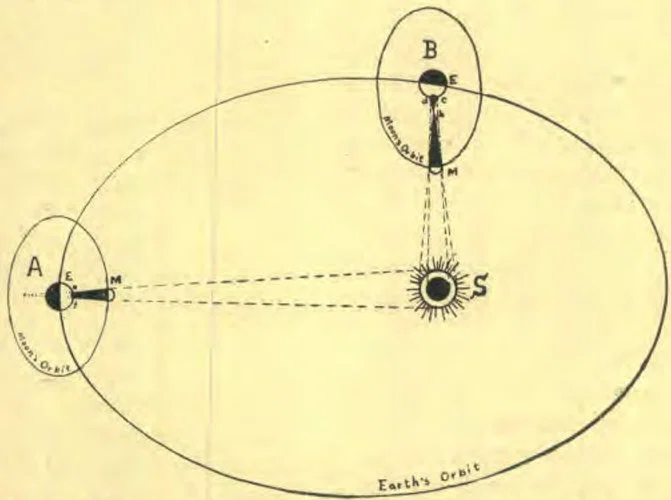
Fig. 2.— Relation of sun, moon, and earth at time of annular eclipse.
Now hold the hand a little above the level of the head, and the shadow of the apple, while still extending away from the light, passes above your head and does not shut off the rays of the lamp. On turning away from the light again while holding the apple in this elevated position, the shadow of the head does not touch the fruit, but the light from the lamp shines full upon it all the way around. No eclipse has occurred on either side this time.
The diagram at Figure 1 illustrates this same point. The light of the sun (S) striking the moon (e) makes its shadow extend above the earth (A) in the direction of the dotted line. Also when the moon is at f, the shadow of the earth at A goes above it. The reverse is true with the earth at C. But an entirely different case is shown at B and D. With the moon at i or l, it is directly between the sun and the earth, and the lunar shadow strikes the surface of the latter, shutting off a part of the rays of the sun from the earth. As the sun, or at least a part of it, cannot be seen from the earth directly behind the moon, the sun is said to be eclipsed.
When the moon occupies a position at l, the shadow of the earth D falls upon it, and the moon is eclipsed. This is also the case at k.
Eclipses of the moon can occur only at the time of the full moon, and when the earth is directly between the sun and the moon. When the moon passes between the earth and the sun at new moon, shutting off the light from our view, the sun is eclipsed. This usually occurs about two weeks before or two weeks after an eclipse of the moon, as it requires that length of time for the moon to pass around its orbit from its full to its new phase.
These points illustrated by i, j, k, l, where eclipses may occur, are called the moon’s nodes, and the straight imaginary line connecting them with the sun and earth is the line of nodes. Eclipses of the sun or the moon can occur at no other place in the earth’s orbit, and only about seventeen or eighteen days before or after the moon has reached this position. As these positions (B and D) are on nearly opposite sides of the sun from each other, it is clear why eclipses of the moon or of the sun usually come about six months apart.
The Solar Eclipse
There are three kinds of eclipses of the sun,—partial, total, and annular. A partial eclipse is one where the moon is seen to pass above or below the center of the sun as viewed from the earth, and cuts off only a part of the sun’s rays. There is a total eclipse at that place when the moon goes directly between the sun and the observer, and shuts off all the sunlight from a certain portion of the earth’s surface. Outside of this full shadow the eclipse is partial.
The annular eclipse is also central, but instead of all the sun’s rays being cut off, a ring of light can be seen around the edge (S. in Fig. 2). The moon appears smaller than the sun, lying right in its center, and surrounded by its outer light. Annular comes from the Latin word annulus, meaning a ring.
Fig. 3.— Solar ecliptic limit, south, east, and west of moon's ascending node.
The diagram in Figure 2 will explain the difference between a total eclipse and an annular. The larger curve represents the earth’s orbit around the sun. This orbit is an ellipse, although here greatly exaggerated to better illustrate the point. The smaller rings, which represent the moon’s orbit in two different positions (A and B), are also greater in length than in breadth.9The sun being larger than the moon, the shadow of the latter is in the form of a cone with the point, or apex, away from the light. When the sun is farther away from the moon, the shadow is longer than it is when two are closer together. Astronomers tell us that the greatest distance that the moon gets from the earth is 252,972 miles, and the least distance is 221,617. When the sun is farthest from the earth and the moon, the shadow of the latter, or the length of the shaded cone, is 238,300; and when nearest, it is 236,050 miles. So it is evident that the moon’s real shadow (M to b at B, Fig. 2) sometimes does not reach the earth. When this is the case, the moon, which usually appears about the same size as the sun, looks smaller, and seems to lie within the sun, the light of the latter showing in a ring around the outer edge. This is an annular eclipse. (Notice S in Fig. 2 as seen from B.)
When the earth with the moon is closest to the sun and the moon is farthest from the earth (B, Fig. 2), the point of the moon’s real shadow (b) will fall more than 24,000 miles short of the earth’s surface, and will throw upon the earth not a full shadow, but what is known as a “shadow extended.” At this extreme, the cross section of the extended shadow, indicated by a small inverted cone pointing toward the sun (ebd), will be 206 miles across when it reaches our planet (from d to c). This is its greatest possible width on the earth; and it ranges from this to nothing as the moon draws closer to the earth, and the earth farther from the sun, and the eclipse becomes total.
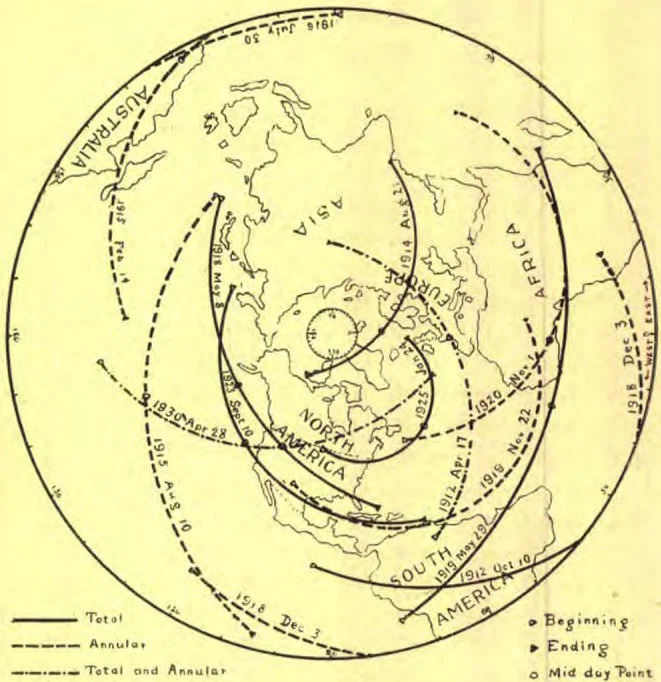
Fig. 4.— Record of eclipses.
The Total Eclipse
When the earth is farthest from the sun and the moon is in its nearest position to the earth (A), the shadow is lengthened. Then the true shadow instead of the “shadow extended” touches the earth’s surface. To a person upon the earth, within this shadow, which, under the most favorable conditions, can be not over 168 miles across, the sun cannot be seen at all. It is a total eclipse.
While this dark spot not over 168 miles in width on the earth’s surface in a total eclipse seems very small as compared with the earth itself, yet the rapid turning of our world upon its axis makes the shadow travel from west to east at the rate of from 1,300 to 2,100 miles an hour, according to whether the eclipse touches near the earth’s equator or toward the poles. The annular eclipse travels with about the same rapidity.
If we divide 1,300 by 60, the number of minutes in an hour, we shall see that the eclipse travels not less than 21 2-3 miles a minute at its slowest rate. And by dividing this number into 168, it is found that a total eclipse on the earth could last not quite eight minutes at any one place. In fact, the longest time that any eclipse of the sun can be total at one spot is 7 minutes and 58 seconds, and this is only possible when the moon is the closest to the earth about the first of July, and its shadow strikes the earth at or very near the equator. An annular eclipse may be seen at the most 12 minutes and 24 seconds. Partial eclipse of the sun may last much longer. Of course, it must be understood that no eclipse can be total or annular without being partial to observers outside of the main shadow zone.
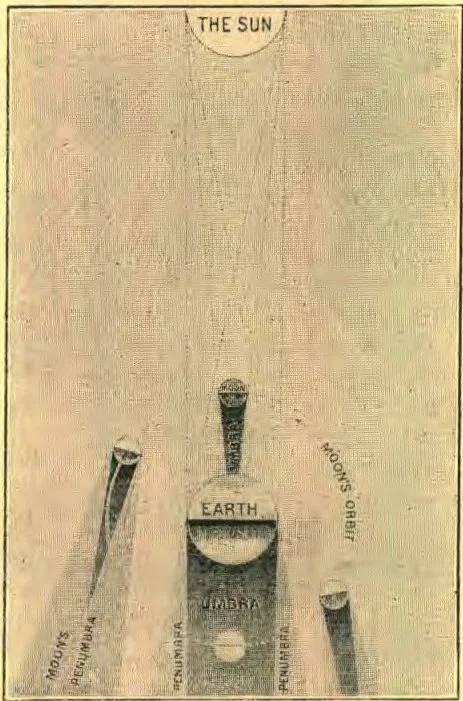
That portion of the shadow from which the light is only partially excluded is called the penumbra; and the darker portion where none of the sunlight is visible, is the umbra. Within the umbra, the eclipse is total; within the penumbra, it is partial. There is also an umbra and a penumbra in lunar eclipses, but the latter is often not very marked. (See Fig. 5.)
Large sums of money are sometimes spent in preparations for observing a total eclipse of the sun. Expeditions consisting of men with telescopes and other instruments are often sent long distances to the place where the shadow will pass. Sometimes months of traveling and work are necessary in order to watch the moon pass between the earth and the sun for only four or five minutes. But during a total eclipse is the only time when the sun’s light is cut off from the earth sufficiently to allow the edge of the sun and the region about it to be studied to the best advantage. And more than once, after spending a long time in preparation and large sums of money to observe a total eclipse of the sun, its observation has been hindered by rain or heavy clouds when the minute arrived.
A total eclipse of the moon may last for one hour and three quarters, or it may remain total but a short time. The moon’s disk can usually be seen even when totally shaded, and often has a dull copper color, caused by the refracted sunlight.
Oppolzer’s Canon
During the fore part of the last century there lived in Austria a man by the name of Oppolzer. He was an instructor in the University of Vienna, and although he died while comparatively young, this man did a lasting service to the astronomical world by publishing a book known in English as Oppolzer’s “Canon of Eclipses.” In this is given the day, month, and year of all eclipses of the sun from 1207 B. C. (November 10, Julian calendar) to 2161 A. D. (November 17, Gregorian calendar), 8,000 eclipses in all. He also had computed the elements of 5,200 eclipses of the moon, extending from 1206 B. C. (April 21, Julian calendar) to 2163 A. D. (October 12, Gregorian calendar), which latter date is yet nearly two hundred fifty years in the future.
Data are presented by which mathematicians and astronomers can figure the exact place and magnitude of all these eclipses.
Fig. 5.—How eclipses of sun and moon take place.
In talking at one time with Director Campbell of Lick Observatory, on Mt. Hamilton, in California, about the elements given in Oppolzer’s “Canon,” the writer asked him if it had been found that the figures there given as to time and place were always correct. He answered that experience had proved them almost absolutely accurate, varying occasionally a few seconds or so from his computations. The data are sufficient for all practical purposes. This emphasizes once again the exactness with which the laws of God operate in his mighty universe.
In connection with the sun’s eclipses recorded by Oppolzer, there is given a large number of charts or maps showing the path on the earth traveled by all the total and annular obscurations of the sun occurring between the two dates given.
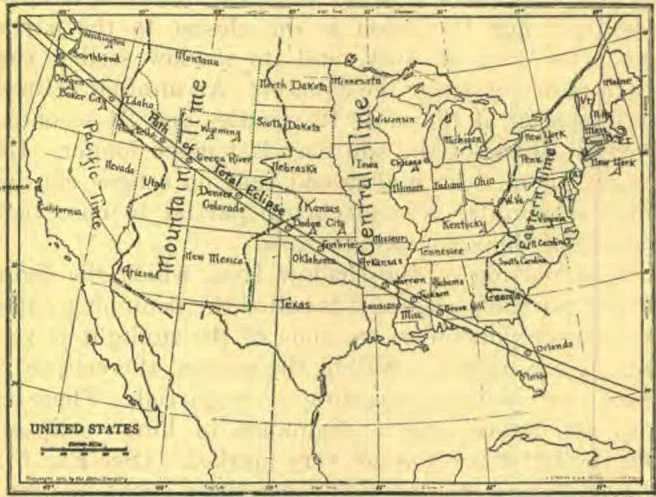
A condensed modification of one of Oppolzer’s charts is shown in Figure 4. From this it will be noticed that on June 8, 1918 (copied by mistake as May 8 on the chart), there will be a total eclipse of the sun passing the entire diagonal length of the United States from Washington State to Florida. Also on Sept. 10, 1923, another eclipse of the sun will pass over central California and on through Arizona, New Mexico, and Texas. For many years no total obscurations have been seen in this section.
PATH OF TOTAL ECLIPSE OF JUNE 8, 1918.
The Total Eclipse of June 8
The path of the total eclipse of the sun on June 8 of this year starts in the China Sea south of Japan, and crosses the Pacific Ocean a little distance below the Aleutian Archepelago, entering the United States off the Washington coast at Grays Harbor in latitude about 47° north. It passes east through portions of the States of Washington, Oregon, Idaho, Utah, Wyoming, Colorado, Kansas, Oklahoma, Arkansas, Louisiana, Mississippi, Alabama, and Florida, and ends at sunset among the Bahama Islands off the Atlantic Coast, last touching Florida at north latitude 28°.
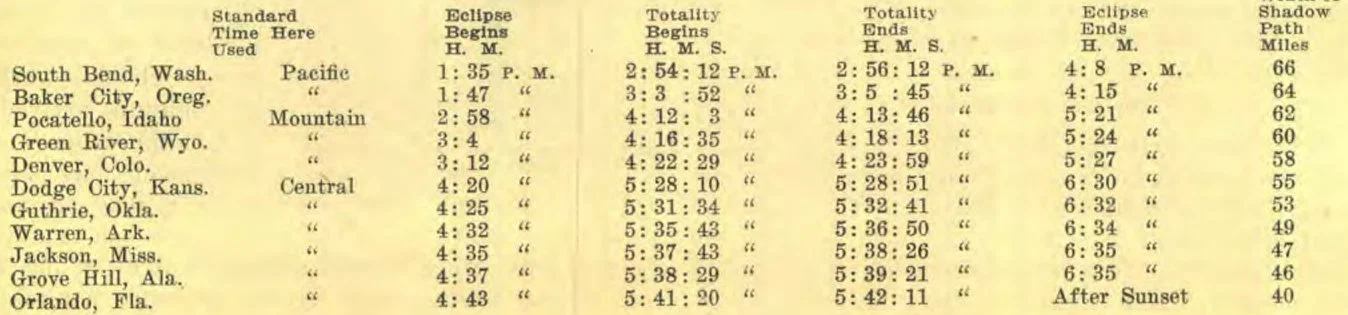
This phenomenon will first be seen as a partial eclipse near South Bend, Washington, at 1:35 P. M., Pacific time. At 54 minutes and 12 seconds after two o’clock the total phase reaches this same point and lasts exactly two minutes, the partial eclipse, however, not disappearing until 4:8 P. M. at this place. The width of the total path will be 66 miles where it enters the United States and 40 miles where it passes into the Atlantic Ocean. Some of the points lying directly in the path of totality, the time when the eclipse begins and ends, and the width of the shadow path, are given at the foot of the page.
While seen as a total eclipse only in a path averaging fifty-three miles in width running diagonally across the United States, this phenomenon will show as a partial eclipse throughout entire North America. The approximate time of the eclipse at any given point within the United States can be roughly estimated by drawing a perpendicular to the path of the eclipse, and noticing the time of the place as given above nearest to where this perpendicular touches the path, making due allowance, if necessary, for the difference in Standard time of the two places.
A smoked or colored glass is always necessary for viewing an eclipse of the sun unless a considerable portion of its surface is darkened. A piece of ordinary windowpane is all that is required. It should be held above the flame of a candle for a few minutes and moved back and forth to keep the glass from becoming too hot in one place, and also to smoke a larger surface. It may be darker in some parts than in others; but by testing, the best place for seeing will soon be found. Camphor gum burned underneath the glass gives a better smoked surface than the candle does. Sufficient camphor can be purchased at the druggist’s for a few cents. One should never attempt to view the sun in any event without a colored or smoked glass through which to look, as such brightness is likely to cause permanent injury to the eye.