‘A Pleasant Fourth

7%

Review and Herald Publishing Assn. · Takoma Park Station, Washington, D. C. · Jul 3, 1917

FromThe Youth’s Instructor, Vol. 65, No. 27.

Read the full edition

‘A Pleasant Fourth

At the St. Helena Sanitarium
NATURE gave us a perfect day. The shower of a few days before, a rare thing in California at that time of year, had laid the disagreeable midsummer dust, washed the abundant foliage, and refreshed not only all things in nature but all the people as well.
Up here on our beautiful sanitarium hillside the program for the day had been planned in a way most fitting and appropriate to the occasion. Clear notes of the bugle and the answer from a distance were the awakening signal given at 7 A. M.
At nine o’clock all who could not walk were wheeled or carried, and were seated around the front of the sanitarium. Soon the band was heard,—the parade, original and interesting, had started. First came the huge flag, with a Teddy bear, miniature emblem of our State, fastened to the top of the pole, and carried by a tall young man in immaculate white. Following the flag was our sanitarium band, all the members of which were also dressed in white. Then came the graduate nurses, all in white from cap to toe. The training school nurses were next, in regulation uniform (blue and white stripe), such a lot of them. The dining-room girls, in white middies and white skirts, followed, and to close the procession, a young girl led a small boy, a son of one of the patients, with his flag in his hand. They marched as far as the hospital and back to the sanitarium around one of the driveways, and formed a circle while the flag was raised.
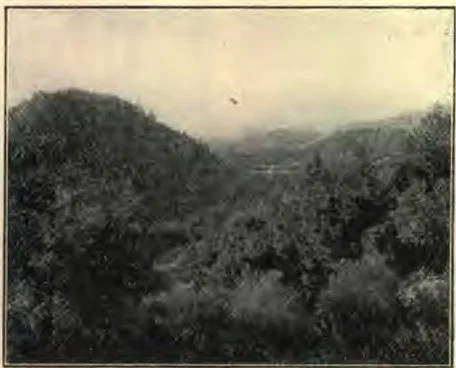
VIEW NEAR ST. HELENA SANITARIUM
A prayer by Pastor S. T. Hare, was followed by a short but inspiring speech by our manager. Briefly, but in a comprehensive way, he reminded us of the blessings enjoyed where civil and religious freedom is guaranteed, and he admonished us not to forget that our nation and its liberties cost many lives. This uplifting speech concluded one part of the program.
Twelve o’clock noon saw the beginning of funny feats in the swimming pool: diving, and more diving, of various kinds, with underwater, tub, and barrel racing. The most striking feature was a short trombone solo played while the musician was hanging by his toes from the trapeze bar over the water.
After dinner there was an exciting baseball game. The married men versus the single men, with a score of 6 to 0 in favor of the former, to the great confusion of the single men. The game concluded, all assembled on the hill crest, and were pleasantly surprised by the announcement that Elder R. C. Porter, of the Asiatic Division Conference, would speak to us. Such a glimpse as he gave us of Chinese cities! We were glad that we saw through our mind’s eye and were not near enough to sense conditions with our olfactory organs. People, pigs, cows, and chickens all housed under the same roof for safe-keeping!
The people of the Orient think stealing is all right if you don’t get caught. That is the only crime connected with it. Thieving is common, and in China thieves are dealt with summarily. Once a missionary had occasion to complain to the police department that a number of articles had been stolen from the mission compound. Later the officer inquired if the trouble had ceased. The missionary replied that they were having no more trouble in that way, and asked if any offenders had been caught. “Yes,” said the officer, much to the chagrin of the informant, “thirty-five have been beheaded!”
While in the Philippines, one native sister told the speaker that her husband had not come to the meeting because he was some older than she and felt it hardly wise to walk the two and a half miles to the service. When questioned as to the age of her husband, she replied that he was one hundred and thirty-six years of age! Brother Porter asked if he might meet her husband, and she said, “Certainly.” Accompanied by Elder F. A. Detamore and another worker, he called the next morning at this centenarian’s home, and was greatly surprised to see the door opened by an erect, active man who looked scarcely half his years. He remarked that his birth was inscribed in the records of the Catholic church. Elder Porter had the record verified. When questioned as to his diet, this old brother said that with the exception of a little fish he had always lived on fruit, grains, nuts, and vegetables.
Elder Porter spoke of this remarkable case to an officer of the ship crossing over to Hongkong, and that gentleman said that he had known several of these centenarians. One had recently died at the ripe old age of one hundred and forty-two years.
After tug of war, running, and jumping, the band played and lunch was announced. The nurses and helpers passed picnic plates with sandwiches, buns, and fruit nectar, followed by delicious sherbet. A very large crowd did full justice to the sanitarium hospitality.
The evening program of band music, recitations, a solo, and a splendid patriotic speech, concluded the day’s celebration. MRS. BERTHA PIERCE CLOSE.