BEAUTY of sentiment, nobility of thought, and refinement of manner come not so much by endowment or chance as by daily striving for purity and excellence. Of all the varied means of self-improvement, there is no other so beneficial and at the same time so widely available as reading. One who acquires a taste for good reading carries a key of happiness which the world cannot take from him. Sir John Herschel said: “If I were to pray for a taste which would stand by me under every variety of circumstance, and be a source of happiness and cheerfulness to me through life, and a shield against its ills, however things might go amiss and the world frown upon me, it would be a taste for good reading.”
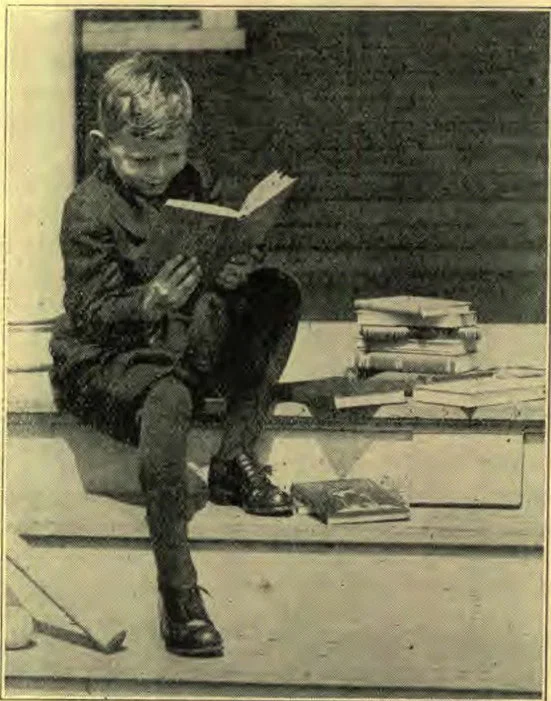
This boy has stopped playing ball to read the new Missionary Volunteer Reading Course books. You can see that he is pleased with what he is reading, and so will every boy and girl be pleased who is provided with this excellent assortment of books. Do not delay to place your order with your tract society.
The most valuable part of a human being’s equipment for life is the mind; but, like any fine tool, it is worthless or harmful unless its owner is skilled in its use and care. So the most valuable preparation for life is the training of the mind to know, love, and seek for the best and highest thoughts and motives, as well as training it to keen, deep, well-controlled habits of thinking. This training can be obtained in two ways — by choosing good companions, and by reading good books. Every one is not permitted to associate with the noblest and most cultured persons, but all may associate with the noblest of books,—the Bible,—and with other books which draw their nobility from the Bible, such as the biographies of worthy men and women, histories of God’s providence among the nations, and accurate descriptions of the world and its people.
The Reading Course presents from year to year the right opportunity for this training and association with the highest, and it is our loss if we do not seize these opportunities, which offer a culture and a mental training to be obtained by no other means. The method of studying the books of the Reading Course gives a priceless training in habits of observation and reflection.
To one who was in danger of losing her Christian experience through indulgence in light reading, Sister White wrote:
“You are indulging an evil which threatens to destroy your spirituality. It will eclipse all the beauty and interest of the sacred pages. It is love for storybooks, tales, and other reading which does not have an influence for good upon the mind that is in any way dedicated to the service of God. It produces a false, unhealthy excitement, fevers the imagination, unfits the mind for usefulness, and disqualifies it for any spiritual exercise. It weans the soul from prayer and love of spiritual things. Reading that will throw light upon the Sacred Volume and quicken your desire and diligence to study it, is not dangerous, but beneficial. You were represented to me with your eyes turned from the Sacred Book, and intently fixed upon exciting books, which are death to religion. The oftener and more diligently you peruse the Scriptures, the more beautiful will they appear, and the less relish will you have for light reading. The daily study of the Scriptures will have a sanctifying influence on your mind. You will breathe a heavenly atmosphere. Bind this precious volume to your hearts. It will prove to you a friend and guide in perplexity.”—“Testimonies for the Church,” Vol. I, pp. 241, 242.
In giving instruction to the children of Israel regarding their king when they should come into the Promised Land, the Lord said:
“It shall be, when he sitteth upon the throne of his kingdom, that he shall write him a copy of this law in a book of that which is before the priests the Levites: and it shall be with him, and he shall read therein all the days of his life: that he may learn to fear the Lord his God, to keep all the words of this law and these statutes, to do them: that his heart be not lifted up above his brethren, and that he turn not aside from the commandment, to the right hand, or to the left: to the end that he may prolong his days in his kingdom, he, and his children, in the midst of Israel.”
Paul’s instruction to Timothy was, “Till I come, give attendance to reading.”
If the farmer wishes a good harvest in the fall, he begins his work early, and continues all the spring and summer preparing the soil, planting the seed, and cultivating the growing crops. If he does not spend his time well during the spring and summer, he will not have a good harvest. Just so with the youth (and older persons, too); if we fail to improve our time well during the present, we shall in the future be no better off for having lived; worse still, if the time has been ill spent, we shall be going backward instead of forward.
It is true in more senses than one that “the pen is mightier than the sword.” If employed in writing truth, the pen can move the heart when the sword4cannot; but if it is employed by the wicked and depraved, it is more destructive than the sword; for it not only destroys the usefulness of the life that now is, but also causes the loss of that which is to come. The sword kills bodies, but the pen ruins characters.
A few years ago, in a city in central Indiana, a number of railroad ties and other things were found on a railway track. They had been placed there to wreck a passenger train, soon to pass. A number of boys about twelve or thirteen years of age, who had been reading of such things in exciting tales, and were desirous of emulating their favorite characters, had planned to wreck the train.
No one can feed exclusively upon daily newspapers, magazines, and stories, and develop a Christian character. Let us forever turn away from dangerous reading matter, and fill our minds with the good, the noble, and the true! Most important of all, the uses to which reading may be applied is that of encouragement to noble living and elevation of character.
It requires time to reach any ideal of worth. Economy of time is essential for success in any undertaking, especially in carrying out a plan of self-improvement, but such economy will pay large dividends. Gladstone said: “Believe me when I tell you that thrift of time will repay you in afterlife with a usury of profit beyond your most confident dreams. And the waste of it will make you dwindle alike in intelligence and in moral stature beyond your darkest reckonings.”
To form a taste for good books is to keep the best of company, and have it when we want it. We should select our books as we choose our companions. We should not take every one on the street for companions, neither should we read everything that passes under the name of literature, but choose only the best.
Much care should be exercised in the selection of the material to be admitted into the storerooms of the mind. It is not a question of merely filling the space; the material should be useful, that which will prove of value along the journey of life, as well as valuable at the end of the journey. In many respects life is like a grocery box—its value in the world’s great market depends chiefly upon what is put into it.
The influence of reading is very great, preparing the individual for life eternal or death eternal. Robert E. Speer said, “A low mind cannot long remain low when filled with great words, which cannot be kept down, but soar aloft to God.”