WITH blankets over our shoulders, burlap-covered square cans for canteens, and the needful “eats,” five of us set out for Mt. St. Helena: five boys—all boys, for it was vacation, and “teacher” was “one of the boys,” not the “brisk wielder of the birch and rod.” For months the mountain that stands but twenty miles from us had invited persistently, almost defiantly, and when summer came, the invitation was accepted.
California can be hot at times, and that was one of the hottest days of the season; at least, so a talkative rancher on the way cheerfully told us, and we accepted his word without argument. But there was no hurry, and we took all the time we wanted; stopped in the shade and poured water on one another to cool off, took off our shoes to rest our feet in cool streams, and occasionally did a little botanizing.
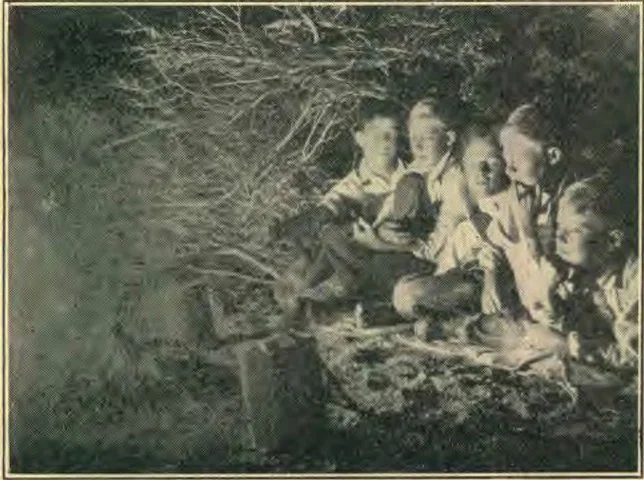
A CAMP FIRE FOR DREAMS
By the middle of the afternoon, we came to the tollhouse, at the top of the saddle that runs out from the peak, within two miles of the summit. There in the shade of tanbark oaks and firs, by a splendid cold spring, we waited until the sun was almost ready to go behind the mountain. And then for the last climb. Over the rocks, through stretches of loose bowlders and broken stone, winding about through chaparrals, or dense thickets, of chamisal and manzanita, ever gaining a broader view, we climbed upward, till just as the sun was sinking behind the farthest coast range by the Pacific, we reached the top. With a happy shout, Alfred, the youngest, climbed to the top of a cairn of rocks at the summit, followed by all the rest, to gaze after the sinking sun.
On three sides the mountain is very steep, with little sign of soil—just cliffs and broken rocks. It was a hazy sunset, but a number of cities and towns lie scattered about through the valleys, sending up the smoke of their homes and industries. On clear days the ocean can be seen on the west.
An interesting marble tablet claimed our attention. It is a restoration of a tablet in honor of early pioneers, among them the Donner Lake Party and the leaders of the Bear Flag Battalion. The legend is on a metal plate, one part in Russian, another with the translation in English, and a third with the statement that the monument was restored in June, 1912, the one-hundredth anniversary of the founding of Ft. Ross, and giving the names of the principal families famous in the early days of California.
But nature called for food. Searching out a sheltered open place among the thickets of scrubby manzanita, we soon had a great camp fire blazing. Night coming on, it turned cold, and the fire was welcome. There we made our big can of coffee and spread our blankets before the cheerful blaze. All sorts of good things came from the five packs, but we were so hungry that Adolph declared there would be nothing left for the next day.
What is there more cheerful than a rousing camp fire? Eat and talk and drowse and rest! Stretch out at length before the glowing coals and leaping flames, and see visions in the fire! Lie on your back and gaze beyond into the starry blue, and see visions there! Go out beyond the glare of the fire and look over the valleys about and see the twinkling lights of a dozen towns, and away to the south the intermittent flashes from the lighthouse on the shore. Beyond that light lies the mighty Pacific, and beyond the Pacific lies—O, it’s easy to dream by a camp fire on a mountain top!
Camp fire stories! That marble monument up near the summit had its stories to tell of the Russians who came in 1812 and built a fort and traded with the Indians, remaining until 1841. The river on which they made their fort is still called the Russian River.
The tragedy of the Donner Lake Party is one of the events of the early days. Eighty persons were in the company that attempted to cross the Sierras in 1846. Winter coming on suddenly, the party was caught in the mountains. Their cattle were lost in the snowstorm, and they were forced to eat their horses. Twenty-two attempted to force their way through, but only seven succeeded in reaching Sutter’s Fort, near where Sacramento is now. Captain Sutter sent some friendly Indians to their aid with supplies. These supplies were soon eaten, and then the desperate travelers ate the Indians, too. Only a few of the large party survived the terrible winter and the famine.
California, you must know, has had many flags. About 1843, the Mexican flag floated over its few forts and scattered posts and missions. In that year John C. Fremont was sent out by the United States government to explore the West, reaching California in 1845, and Sutter’s Fort in 1846. No one knew just why he came,—Uncle Sam does not always explain all he does,—but there was a great stir throughout the State, with rumors of war and conquest. Some Americans captured a number of Mexican horses, an act that did not please the Mexican authorities. Then12the Americans took the town of Sonoma, and surprising General Vallejo, took him prisoner. The new party adopted a flag—made of white cotton with a great red bear of berry stain—and the “bear flag revolt” was on, and soon over, for the spoils of the Mexican War included California. Right or wrong, California the Golden became a part of the United States; and the Bear Flag Battalion doubtless did its share in acquiring it.
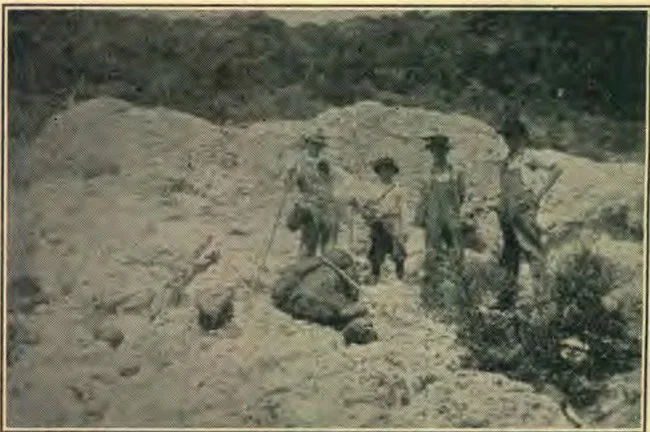
VIEWING MUD CRATER
Bedtime came, and Willie and Oscar and Adolph each rolled up in his blanket. Alfred and the biggest boy found the jolliest little soft place near the fire, and rolled up in their blankets—before long they were both rolled in the same blankets! The fire died away, though for hours the wind kept the embers glowing. All was still and peaceful, until a little whiff of wind rattled a paper near Willie. Mountain lions! flashed through his sleepy head, and with a cry of “Wough!” half of fright and half of defiance, he sat up in his blanket. The shout and the movement brought Adolph up, too, just in time to receive full in his face a handful of sand that Willie hurled at the “mountain lion.” And then everybody was awake.
Finding only a paper rattling in the wind, the boys settled down to sleep again. Half an hour later we were all awakened again; this time by Adolph. He began with a quiet chuckle, but ended with a whole-hearted laugh. “What is it now?” some one asked him. “O, Willie went ‘Wough!’” he replied, bursting again into a laugh, in which we all joined. What do you think of that? Wake up in the night to laugh at a joke! But that’s Adolph. His first greeting on waking in the morning was, “Wough, Willie!”
Of course the thing to do on a mountain top is to see the sun rise. And to be strictly truthful, one must own that the ground bed does get uncomfortably hard by that time of day; and so we went up to see the sun rise, ostensibly, but the boy cropped out as usual. Three steep mountain sides and a pile of loose rock suggest something to a boy. For half an hour those boys rolled rocks down the mountain. How they worked! And what a sensation it is to start a huge rock over the precipitous side of a mountain and listen and watch as it goes crashing and leaping down! Once I was up there with a sober college professor, and he did it, too. I do not know whether that was a sign of the boy in him, or just nature—boy nature, I suppose, that some of us never get out of our systems.
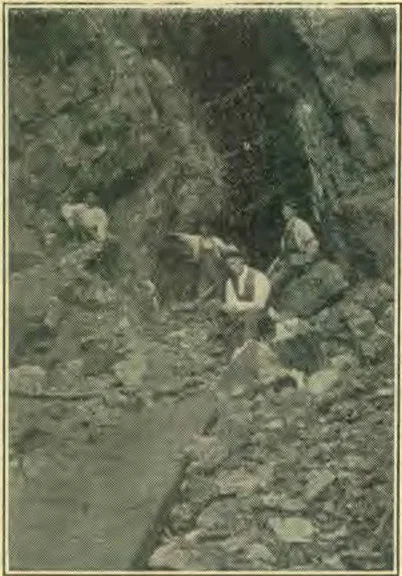
Breakfast over,—there were remnants enough, and we knew the kindly landlady at the tollhouse had boys of her own,—the tramp down the mountain began. Sometimes we ran, in sheer joy of living. In the trail we found the tracks of deer, but of course five boys make too much noise ever to hope to get sight of a deer. Leaving the trail half a mile above the tollhouse, we followed the ridge of outcropping rock to the entrance of the old Silverado Mine. It is a narrow vein in the harder formation, and leads quickly down. It has not been worked for many years, though there is much silver there still.
Just across the gulch from the mine is a tablet to the memory of Robert Louis Stevenson. Where the tablet is his little cabin stood, and there he wrote “The Silverado Squatters.” Good place for dreams again! See the poor man, fighting for life, but cheerful and hopeful, with his bride making a home of a cabin of the tiniest dimensions, high on the mountain side, among the sympathetic and kindly silver miners. A woman’s club erected the tablet only a few years ago.
But boys do not dream long—except Willie, and then it is of mountain lions, not sick poets and brides. And the landlady did help out our commissary department; the wife of a Silverado squatter is a kindly soul. Just as we came to the spring above the house, Alfred discovered a rattlesnake. We missed the deer, but found a rattlesnake, not a very common neighbor in these parts, but occasionally met. This one had ten rattles and a “button”—boys always add the button.
Just down from Mt. St. Helena is the old tree-grown crater of an extinct volcano; Mud Crater it is called. It is nearly half a mile across, and the formation is very interesting. The stones have the appearance of dried mud. To climb down the rough sides is an experience we would not have missed. At the tollhouse they told us to follow the “ducks” on the rocks to find the crater. Arriving there, we decided we could find our way out by climbing down through the cañon that appeared to lead through a cleft of the cliffs at the outer edge of the valley; and being boys, we made it without trouble, the absence of a path only adding zest to the climb down through the cañon.
Once outside the “Palisades,” as the great cliff is called, the valley lay before us, and the walk homeward.
Making for the nearest town, Calistoga, we struck through the woods, down the valley of a mountain stream, coming at length to the vineyards and orchards of the foothills, and then to the fields and lowlands about the town. There was not a watermelon in that whole town! But on the homeward way we crossed Napa Creek. Everybody knows the almost supernatural affinity there is between boys and a swimming hole. How cool and restful that swim was, the last event of a jolly tramp! No, not the last—it has not ended yet; for when we are together on our tramps nearer home, we talk over again and again the delights of that trip; and the memory is very real, and very pleasant.