“PROFOUNDLY for war-time prohibition.”—Luther Burbank, the “Plant Wizard.”
“In favor of national prohibition during the war and forever after.”—David R. Forgan, National City Bank, Chicago.
“Sale of liquor should be prohibited.”—Simon Lake, inventor of submarine.
“Conditions loudly call for diversion of foodstuffs from distilleries, breweries, and bars to gristmills, bakeries, and breakfast tables.”—Louis F. Post, Assistant Secretary of Labor.
“Favor national prohibition during the war to prevent disease, save food wasted in the manufacture of liquor, and promote national efficiency.”—B. F. Harris, president First National Bank, Champaign, Ill.
“No greater saving financially and in manhood could be made than war prohibition. Every bushel of grain used to make liquor takes bread from the poor.”—Richard H. Edmonds, editor Manufacturers’ Record, Baltimore, Md.
“Entire Interurban Clinical Club approve national prohibition.”—Dr. George Blumer, Yale University.
“For economical reasons as well as others, strongly favor national prohibition.”—C. C. Chesney, manager General Electric Company, New Haven, Conn.
“Favor well-defined war prohibition.”—J. P. Reeves, treasurer Chicago and Eastern Railroad Company, Chicago.
“I am for nation-wide prohibition as a war measure, because of effect on food, economic, and health conditions.”—W. A. Evans, editor of health department, Chicago Tribune, Chicago.
“National prohibition during war has unqualified approval.”—J. H. Wesson, president Smith & Wesson, Springfield, Mass.
“I strongly favor national prohibition during the war.”—Frederick Palmer, author, correspondent, British army and fleet.
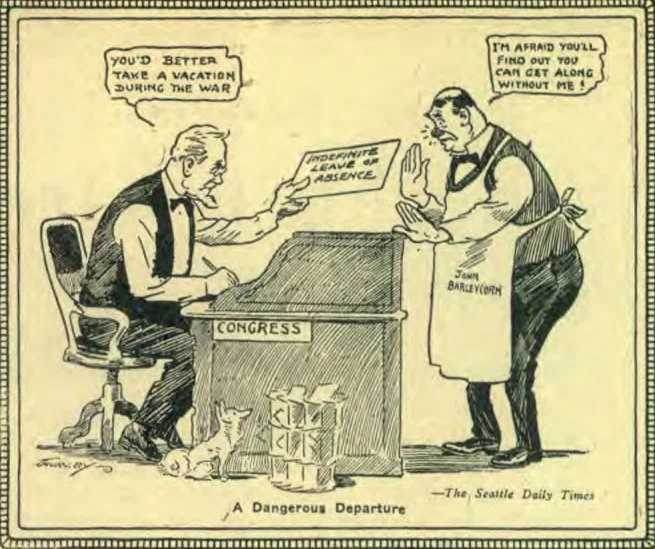

“Statistics show clearly that the United States should immediately adopt national prohibition as a war measure.”—Roger W. Babson, Babson’s Statistical Organization.
“Favor war prohibition. Effect on health, efficiency, and national economy would be great.”—Howard Elliott, president New York, New Haven, and Hartford Railroad.
“Favor war prohibition as measure of economy and efficiency.”—John Crosby, Washburn-Crosby Company, Minneapolis.
“Unqualifiedly for national prohibition.”—Charles K. Haddon, vice-president Victor Talking Machine Co., Camden, N. J.
“Seriousness of the task before us demands prohibition to conserve food supply, raise efficiency of the nation, and open far richer sources of revenue.”—F. A. Vanderlip, president National City Bank, New York City.
“I firmly believe national prohibition would be of great benefit.”—Samuel S. Childs, Childs Restaurant Company.
“Prohibition would enormously reduce disease, would save food now wasted, and promote national productiveness more than a dozen other measures.”—John D. Rockefeller, Jr.
“National prohibition absolutely essential to preserve food supply.”—John T. Stone, president Maryland Casualty Company.
— Compiled by the American Issue.