W. S. CHAPMAN

3%

Review and Herald Publishing Assn. · Takoma Park Station, Washington, D. C. · Apr 17, 1917

FromThe Youth’s Instructor, Vol. 65, No. 16.

Read the full edition

W. S. CHAPMAN

Algeria

W. S. CHAPMAN

ALGERIA, in Northern Africa, lies on the coast of the Mediterranean Sea, with Morocco on the west; on the south, and partly joined to it, is the Great Sahara Desert. The inhabited portion lies between the sea and this desert, an average width of about three hundred kilometers, yet scattered over the Sahara are isolated oases, either where natural wells and consequent growths have made them habitable spots, or where artificial wells have been bored, giving gushing wells and verdure.
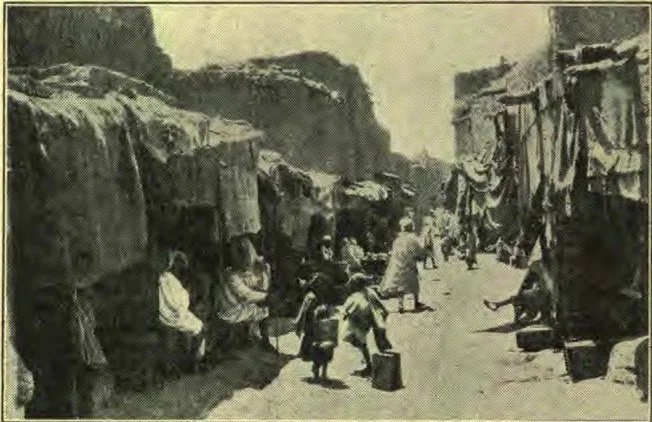
A STREET SCENE IN SIDI OKBA, ALGERIA
Algeria, a dependency of France, being acquired in 1830, is a wonderfully interesting country, teeming with a vast and heterogeneous population, all under French domination. Its principal cities, strung along the coast, are of great interest because of their ancient ruins scattered everywhere, and because of the peculiarities of the inhabitants. One feels continually as though walking among modern people inhabiting a dead world.
Algiers, formerly an Arab city, is the most beautiful of all in a country covered by cities that attract; but, as with all the other “show spots,” the French conquerors have so desecrated its houses and streets, and so much that was of value because of age or associations has been pirated, together with the cutting back of the quaint old Moorish dwellings which almost met overhead in the streets, and the introduction of the wide boulevards of France, well paved and brilliantly illuminated, that the contrasts and innovations are quite a shock to sentimentally inclined tourists. Especially is the damage prominent in the destruction of the sea front, which has lost the ancient aspect it bore in the days of the savage pirate kings.
“In this changeful north Africa, succeeding conquerors have imposed their civilizations and their work upon those of the conquered in a manner that has hardly a parallel in Europe. Carthage destroyed, Rome came in her might and built a hundred cities, conducted water, brought huge areas into cultivation, and made roads after her manner; and in due time overthrew her own ancient altars in zeal for a new faith. . . . All went down in a day before a troop of Arabians who rode as conquerors from Egypt to the Atlantic. Islam followed in their wake. The civilization derived from Europe disappeared; the water courses were broken, the desert resumed its sway, and the stones of Roman temples and basilicas went to build the mosques and villas of the visitors. For twelve centuries the creed of Mohammed held dominion; Europe was busy with its own affairs, and endured the insolent depredations and exactions of the deys with scarcely a serious attempt to suppress them. But at length the cup was full. An English fleet struck the first blow; and a few years afterward France took the subjugation of Algeria seriously in hand; and today European civilization is once more paramount in the ancient provinces of Rome.”—Stanford.
The most numerous and scattered of the peoples to be met with are the Arabs, the Berbers, the Mohammedans, the Jews, the Mzabites, and the border tribe of Biskris. Negroes are found everywhere. They do the heavy work as masons and on railroads. Their happy faces are a relief and contrast to the dignified and solemn demeanor of the Orientals. The Negro women are the servants and masseuses at the baths.
The Arab is a wanderer because his wealth consists of flocks and herds, which compels a change from place to place in search of pasture for his animals. Under the Romans the Berbers were all nominally Christians, but after the Arab invasion they adopted the religion of Islam, but had nothing else in common with their conquerors. The men are not inclined to wander, but dwell in the mountainous region, and are reliable, industrious laborers.
Mohammedans who live in the towns are called Moors. At the present time they have intermarried largely with the Arabs and Berbers. They are the chief merchants of the towns. Their wives go veiled, but the Berber women are unveiled, even living side by side with Moorish women who are veiled and relatives.
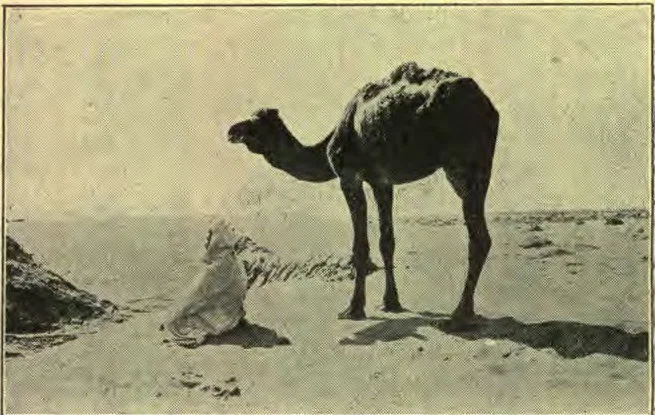
EVENING PRAYER
EVENING PRAYER
Another class of traders who are also skilled bankers, are the Mzabites, frequently seen in the cities, but whose home is far out in the desert, on the very borders of the Sahara, some four hundred miles from Algiers. They are energetic and persevering, and have created a city of their own on the desert sand, dug wells and found water, and have established a system of dams and irrigating canals to distribute the spring rains, so that they have a fertile and beautiful garden of green surrounded by the bare rocks and burning sand of the Sahara.
Another very low class, also from the Berber tribe, are the Biskris, whose home is in the east and far down in the desert at Biskra. They are the water carriers and scavengers of the cities. As they have Negro blood in their veins, they have somewhat of his happy nature and a love for bright-colored clothing, so that when gathered around the public fountain they form not only a pleasing but an amusing sight.
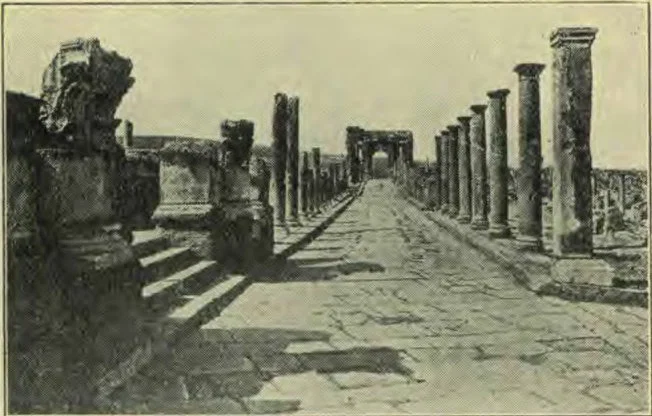
A STREET IN TIMGAD, ALGERIA
Algeria consists of two parallel ranges of mountains, the northern sloping to the sea and the southern toward the Sahara. The sloping sides of the northern range with its vast plains was once the granary of Rome. Between the two ranges lies a lofty plateau of barren sand, almost a desert. Occasionally oases with fresh water are found, and in these places a scanty population reside and earn a precarious living.
Four hundred miles west from Algiers lies the holy city of Tlemcen, of the Mohammedans. In every direction can be seen square whitewashed buildings surmounted by domes. They are called koubbas, the tombs of Marabouts, or saints, and are objects of veneration and the cause of endless pilgrimages. In its prime Tlemcen was once one of the great cities of Algeria, peopled by pure Berbers rather than Arabs. It was supposed to have had a population of 150,000.
Two hundred miles east of Algiers lies the city of Setif, a city 3,573 feet above the sea. It is the center of a vast grain-growing country once the granary of Rome, a great sea of grain without a single tree. East of Setif the mountain slopes down to the valley of the river Roumel, which forms the moat of the rock-girt city of Constantine. The whole hillside is full of the remains of Roman cities and public buildings.
The city of Constantine is built on a plateau formed by surrounding chasms or ravines 1,000 feet deep, the top of this circular peninsula being the city itself. It has no connection with the mountain except in one place. It is said that the city has withstood eighty sieges. Its original name was Cirta, but the Romans renamed it Constantine, after the daughter of the emperor. The Jewish population of the city is very great, and the Jewish women of this city are said to be the most beautiful women in the world.
Two hundred and eighty-eight kilometers from Constantine begins the great Sahara at the oasis of Biskra, and a short distance from this place, at the village of Batna rise the Aures Mountains. They are of no especial interest except for the character of their inhabitants. For centuries this far desert region was an asylum for the fugitives from the armies of the many nations, tribes, and peoples, escaping in the various wars that have desolated Algeria. There is therefore no distinct class or peoples, as intermarriage has obliterated all racial lines, yet there is a noble dignity in their bearing, and their classic faces impress the beholder. Their isolated position has made of them a peculiar people in language, customs, and habits. “Their language is full of Latin words. They observe the twenty-fifth of December as a feast, under the name of Moolid (the birth). They use the solar instead of the Mohammedan lunar month, and the names of the months are the same as our own.”—Stanford.
To the north of Batna lies El Kantara, where the mountain suddenly splits into a deep narrow gorge, which the Arabs call the Mouth of the Sahara. In front is a beautiful oasis having an abundance of olive and palm trees. Continuing to descend until the hills are left behind, the traveler will reach Biskra on the very borders of the desert. Unlike any other city in Algeria, Biskra is distinctively African in all its attributes. It consists of a score or more of native villages ruled over by a French garrison, occupying a large oasis some four or five miles long and with an average width of about a mile. It contains an immense number of palm trees which constitute the wealth of such places. The city is populated by representatives of every tribe in Africa in almost countless numbers, like flies, added to which are a large proportion of Negroes. Two hundred and twelve kilometers farther south is Tuggurt, a desert town containing 200,000 palm trees.
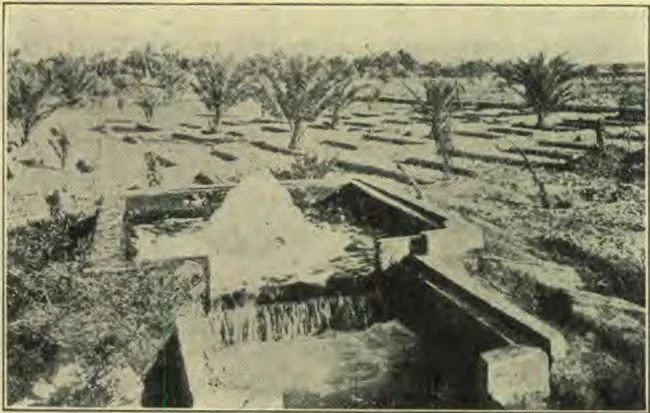
AN ARTESIAN WELL
AN ARTESIAN WELL
The desert of Sahara is commonly regarded as a vast region of arid, bleaching sand, a scene of perpetual desolation. One can travel, however, for days over the rocks of the Sahara and not see sand enough to fill one’s hat. Rain falls everywhere, and the most destructive storms come at points which are the driest. The region has always an abundance of rain, but it leaches through the sand and falls into the underground rivers. Wherever the natives dig wells, or where modern methods are used and wells bored, with the coming of the water vegetation springs up like magic, and a glorious oasis forms, to be soon quickly populated and cultivated. Ninety per cent of the Sahara is composed of rock, however, and there is, therefore, more or less barrenness, as no water can be procured in such places.
The coming of the French well digger in 1856 was a great event. The people at that time were still unfriendly and even hostile, and gave the workers very little encouragement, but when, after twenty-two days of incessant work, the bore threw out a giant stream of a thousand gallons a minute, the people went wild with excitement and enthusiasm. Their feelings toward their conquerors changed at once, and they have ever since remained cordial. The oases so created, however, can never sustain dense populations, because the regions are unhealthy, malignant fevers and chronic diseases always prevailing. Then, too, the changes in the summer climate are trying, the change from 120° F. to freezing often occurring in one and the same day. Only the Arabs and Berbers seem capable of enduring these excessive changes.
The horse and the mule are of little value in the great desert. The employment of the camel is a necessity, but the French had much trouble in learning how to treat and to work them. At first they were treated with contempt, the habits and wants of the creatures being misunderstood. The common idea was that the camel is an animal of great speed and endurance, going without water or food for long periods without serious results. This occasioned much suffering and great loss. The facts are that the camel requires just as much food and care as does a horse, the only difference being that it can stand greater irregularity in its meals. This ability and the fact that it can drink enough water at a time to last it for several days make it of use in desert wastes. The camel can work for half the year and subsist on the scanty vegetation of the Sahara, but his diet for the rest of the twelve months must be rich and abundant, or some morning without a sigh or groan, when apparently well, he will quietly lie down and die.
“For a caravan of camels traversing the desert, the stomach of the beasts is the sovereign lord of marches and halts, the director of the daily program; day and night, the fatigue and hunger and sleep of the men do not enter into the account; everything is subordinated to the single necessity of nourishment for the herd. Whenever a little edible vegetation is found, at whatever point of the itinerary, a halt is made for several hours or several days; in the intervals, even as happens sometimes of two or three kilometers or of five or six days, progress, slow and regular, is made without truce, almost without sleep, beneath sun and stars alike. One can stop only at a pasturage; a voyage in the Sahara is a hunt for a blade of grass.”—Stanford.
Before the present European war, Algeria had a shipping interest of 109 vessels with a total tonnage of 11,290,600. Now, because of the submarine campaign in the Mediterranean, not over fifty vessels are engaged in trade. Aside from these a large number of other vessels have been sunk, so that over fifty per cent of the vessels doing business with Algeria have disappeared.
The main source of wealth in Algeria is in her vintages and in export of garden produce to France, but these industries have suffered severely. The port of Algeria, the capital, has been hit the hardest, more than sixty per cent of its tonnage having been destroyed.
Oran, the next largest port, has suffered sadly. Its exports consisted, mainly, of vegetables, of which large quantities were carried to France, 10,250 tons of artichokes, peas, green beans, tomatoes, and other vegetables, in the course of a year. This explains, in part, the augmented cost of living in France, and the stringency of the money markets in Algeria.