THE ideal basic principle of government in the Chinese nation is that of the ideal home. From the district mandarin upward, each officer in his sphere, to the chief ruler, is the “father and mother of the people.” In this sense both the home and the government are patriarchal.
Then again, the father as head of the home, the mandarin as head of the district or province, and the chief executive as head of the nation, are, respectively, to be reverenced as the “father” of the home, province, or the nation, as the case may be, not only during life, but after death, forever. This, in brief, constitutes the ideal of “filial piety” in the writings of Confucius and in the teachings in the native schools. As an ideal it has some charm, but as incorporated into the lives of the people the “worship of ancestors” is a gripping horror fearful to contemplate.
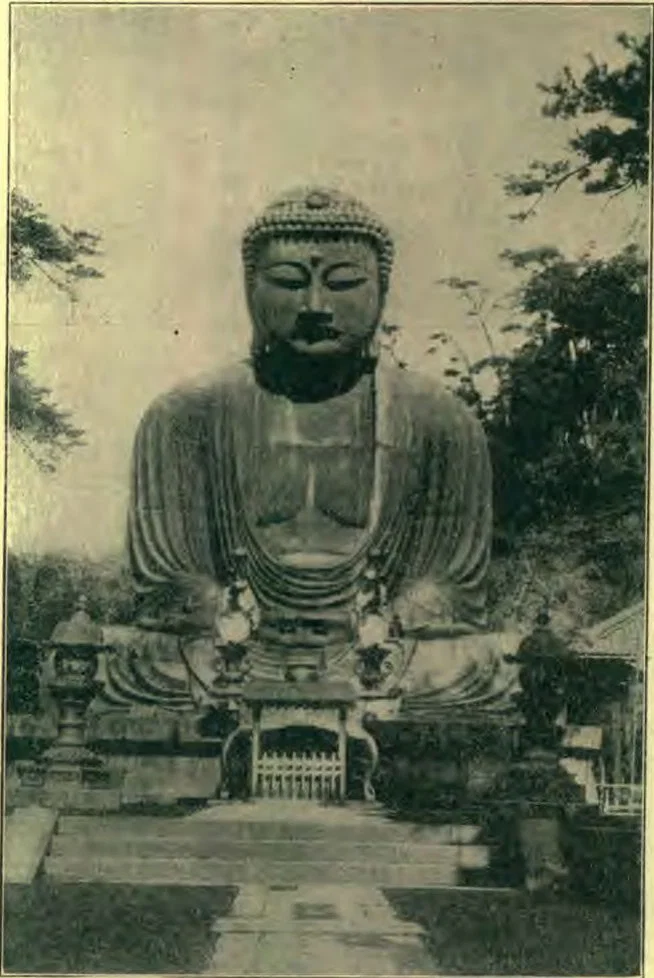
BUDDHA, THE GOD OF THE BUDDHISTS
The principal purpose in life of the living Chinese is the proper care of his dead ancestors. Not that their filial piety is of the pure and elevated character that Confucius wrote about and taught, but because of fear and the influence of avarice. When a male member of the family dies, father or brother, it is believed that he is transformed into a devil. However kind and agreeable he may have been in life, in death he changes into a spirit, with the vindictive mind of a devil, and must be propitiated, or he will bring evil and poverty upon the members of his former family. The surviving relatives, therefore, exercise great care in burying the bodies in pleasant localities, in keeping the graves in good condition, and in furnishing the departed spirit with food and paper money to amply supply their spirit needs. The dead are supposed to possess power to confer riches and prosperity upon their relatives, and all success in life is, therefore, ascribed to them. In this ability of the dead to prosper the living they are supposed to have a power beyond that possessed by either the dragons or idols. The idols are propitiated through fear, the dead from motives of avarice, mainly. The worship of ancestors takes precedence of the propitiation of idols and the dragons because ancestor worship is part of Confucianism, the oldest form of present-day religion, while the idols and dragons are part of Buddhism and Taoism forced upon the Chinese by their conquerors, and so from the beginning took the second place in their estimation.
Each home is supplied with an ancestral tablet. Before it certain religious ceremonies are performed at prescribed regular periods as a propitiation of the dead. Only the male members of the family can take part in these ceremonies, and this is one great reason why the birth of a son is considered an event of such vital importance, and the arrival of a daughter so grievous a calamity. Should the males die out, there would be no one left to worship before the ancestral tablet, or provide for the wants of the ancestors, and the family, as such, would disappear.
The terror to a Chinese is the fear that after his death there will be no filial son to care for his grave and provide for his necessities in his spirit home. Just where the dead reside is as much a mystery to the Chinese as to other nations, but it is believed that they have homes in places which are the exact counterpart of the places in which they resided when alive; that is, in a city or village that is an exact duplicate of the one on earth. If the relatives provide amply for their wants and in paper money, which, after being burned over the grave, is by some unexplained process turned into the actual thing, then the dead occupy exalted positions among their fellow spirits, and, in gratitude, prosper their relatives; but if they are neglected by their heirs, their lot is a miserable one in the spirit world, and in wrath they make their relatives suffer for it.
China has, in reality, no formal state religion. While Confucianism is the avowed imperial religion, it has no temples or formal worship, the whole is but a mental assent to certain sentiments and instructions never followed in the lives of the people. Buddhism has filled the land with idols, for it is idolatry, per se, and both it and Taoism, or necromancy, have built temples by the hundreds at every available location, but no man can tell you to what cult he belongs. Generally, he is a mixture of all three.4
Religion, however, as recognized and practiced in civilized nations, is something unknown in the East. Religion as defined in encyclopedias—“a rite or ceremony as practiced in the worship of God;” “a system of doctrines and worship regarded by its adherents as of divine authority”—has no counterpart in China.
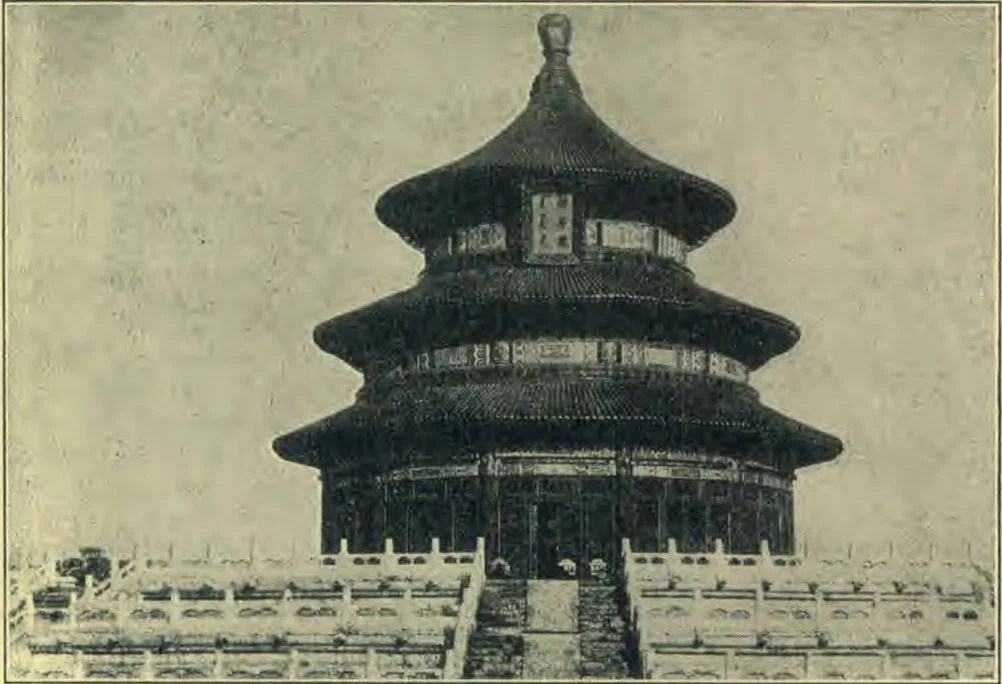
THE TEMPLE OF HEAVEN AT PEKING, CHINA
God is unknown in the sense in which Christians present him. The Chinese worship of idols, of ancestors, and of demons and devils has no connection with morality or reference to reformation of character.
Confucius evidently knew of the true God, and some historians think that in his day the nation worshiped the Creator. It is known, however, that in the three centuries following his death the people gradually turned to the worship of nature. Early in the first century A. D., Buddhism and the worship of idols were introduced from India, followed by Taoism; and the Chinese sunk, morally, to the low level they now occupy.
The memory of the true God is, however, not absolutely lost, being kept alive in a dim, mystic, and unprofitable manner. At certain intervals and in times of great distress, the people go to worship what they call Heaven, and they give it a personality, the Chinese words for the name meaning “The One Great,” having supreme power. Heaven is so mystical and so far away, however, that, in despair, the Chinese have originated idols in their yearning to communicate with the unseen and the unknown world. In emergencies individuals will turn to Heaven for relief, and once each year the ruler, as the great high priest of the people, ascends to the Temple of Heaven, offering gifts to the One Great, while the nation with bowed heads join in his entreaties for help.
Confucianism is not a living issue in China. As a cult it lost its hold upon the people centuries ago. Like “filial piety” it is now only a beautiful theory which in no way affects the lives of the people for good or bad. The sayings of Confucius confront one on all sides in printed streamers and wall decorations, even in the opium dens, but with this kind of outward expression, the recognition of Confucianism ceases, outside of the schools. Few if any ever dream of applying its principles to the betterment of character.
But the people have a deep-seated and absolute belief in the potency for good or evil of all they worship, from the One Great to their dead and their idols, even down to the kitchen god, and bitterly resent any effort to interfere with any of them—not because of any attachment to or veneration for any, but for fear of calamity to follow from their vengeance if disturbed. This is the primal cause for all opposition to republicanism in China.
The test comes, and the insufficiency of idol worship is shown, when seasons of great distress descend upon the nation, or come to individuals. For instance, if a prolonged drought devastates the country, or terrible floods bring ruin and desolation and death to vast areas and to thousands of the people, the Chinese, unitedly, drop all their gods and in terror call on the One Great for relief, acknowledging that it is he alone who can right wrongs and give complete relief.
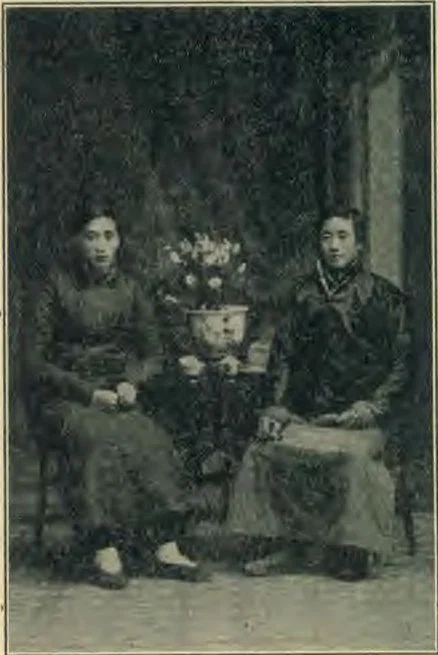
TWO OF OUR CHRISTIAN COLPORTEURS
Occasionally, in the dimness of a fading day, or the darkness of a moonless night, a silent figure can be detected climbing some mountain or high hill. He seeks the very highest attainable elevation, for he is going to talk to the One Great. He bears no gift in his hand as would be the case if he were approaching an idol or some demon, or going to the grave of an ancestor. He does not come with any thought of propitiation, but as though coming to a trusty friend for sympathy. He comes to tell the One Great of his pitiful condition, fully believing that he will be heard, sympathized with, and answered; so he climbs high because he wants to be sure that he is alone when he speaks to his friend and helper. Then, having reached the top, with head humbly bowed, and hands held out beseechingly, he pours out his soul to the One Being who, he has faith to believe, will listen and can and will answer. Who can doubt that the poor wretched creature is reaching out after the Unknown God, as did the Athenians; and that some, at least, of his tears flow because of the gentle and tender and sympathetic touch of an answering angel?3
In this fitful crude worship of the One Great is found the only “religion” the Chinese possess, and it is the answering chord which the missionaries touch when they tell the tale of Jesus and the atonement. The story fits into the crude dream of the poor heathen of a being somewhere with power to help and with no inclination to torture and destroy, and his heart reaches after a knowledge of him with a hunger sometimes that words cannot express. Is it any wonder that Chinese converts are often so faithful?